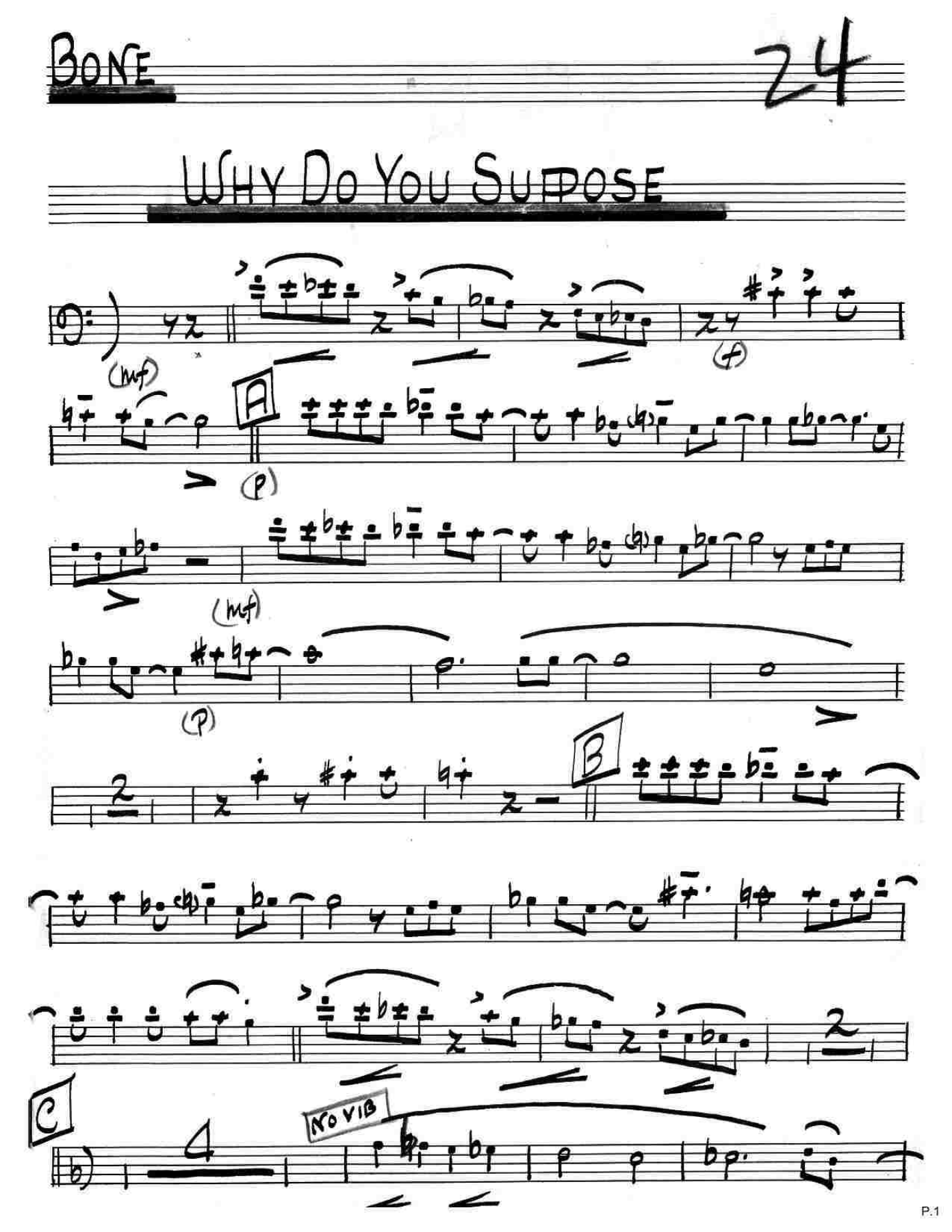
Why Do You Suppose (M.Paich)
Composed by Richard Rodgers
Arranged by M. Paich
- Ensemble: Small Ensemble
- Style: Jazz Standard
- Pages: 23
- Difficulty: easy
- Content: Sheet Music
- Format: PDF Download (Instant)
- Price: $12.99
"Why Do You Suppose," a captivating jazz standard, originated from the Broadway musical *Heads Up*, which premiered on November 11, 1929. Composed by the legendary Richard Rodgers with lyrics by Lorenz Hart, this tune hails from the golden age of American musical theater, a period (1920-1940) when many popular show tunes became the foundation for jazz improvisation and the broader Great American Songbook. While not as frequently cited as some of Rodgers' later collaborations with Oscar Hammerstein II, the song's sophisticated harmonic structure and lyrical charm cemented its place within the jazz repertoire, inviting countless interpretations by instrumentalists and vocalists alike. Its enduring appeal lies in its elegant melody and the inherent flexibility of its form, making it a favorite vehicle for creative exploration. Marty Paich's arrangement of "Why Do You Suppose" transforms this classic into a vibrant, medium-swing small ensemble piece, imbued with the distinctive "West Coast cool" sound for which he was renowned. Paich, often dubbed "The Picasso Of Jazz" for his uniquely tasteful and sophisticated arranging style, excelled at making small groups sound like full-size orchestras. This arrangement is a testament to his mastery, characterized by his signature use of rich, extended harmonies, intricate counterpoint, and clever voicings that allow each instrument to shine within the texture. The mood is one of sophisticated playfulness, maintaining the original's lighthearted essence while elevating it with a contemporary jazz sensibility. Expect a bright, engaging energy that is both intellectually stimulating and deeply swinging. Paich's treatment features the melody gracefully passed between various instruments, ensuring dynamic contrast and engaging all members of the ensemble. While specific melodic assignments will be detailed in the parts, musicians can anticipate opportunities for featured solos over the song's well-crafted chord changes, a hallmark of Paich's arrangements that encourage individual expression within a cohesive framework. Technical challenges include navigating Paich's characteristic harmonic substitutions and maintaining precise ensemble blend and balance within the often-dense voicings. The rewarding aspect of performing this chart lies in experiencing the intricate interplay and the sheer beauty of Paich's orchestral approach to a small group, culminating in a sound far greater than the sum of its parts. Specific musical moments, such as unexpected reharmonizations and a meticulously constructed soli section, stand out as particularly gratifying to execute. This small ensemble arrangement is ideally suited for college-level jazz combos, advanced community jazz groups, or professional ensembles seeking a sophisticated and engaging addition to their repertoire. The demands on individual musicians require a solid grasp of jazz improvisation, strong sight-reading skills, and an understanding of ensemble dynamics. While high school groups with exceptionally talented and dedicated musicians could approach it, the nuances of Paich's harmonic language and the need for mature interpretation make it most appropriate for players ready to delve into advanced jazz arranging. Its 23 pages reflect the depth and detail of Paich's scoring, promising a substantial and enriching performance experience. Conductors should emphasize a relaxed, medium-swing feel throughout this arrangement, ensuring that the rhythmic pulse remains buoyant and unforced. Pay close attention to Paich's dynamic markings, which are crucial for bringing out the intricate voicings and preventing the ensemble from sounding heavy. The primary technical challenge lies in achieving a seamless blend and balance within the horn section, particularly during the close-voiced harmonic passages and the contrapuntal lines. Encourage musicians to listen across the ensemble, adjusting their intonation and timbre to match. Soloists should be encouraged to articulate clearly and explore the extended harmonies provided by Paich, utilizing the rich harmonic context as a springboard for their improvisations. Rehearsal time should be dedicated to isolating and refining the soli sections, ensuring rhythmic precision and unified phrasing. No special techniques like plunger mutes or falls are explicitly required, allowing the focus to remain on articulation, blend, and harmonic clarity. Q: What instruments/parts are included in this arrangement? A: This is a small ensemble arrangement, typically featuring a standard jazz rhythm section (piano, bass, drums) and a flexible horn section, often including trumpet, saxophone (alto/tenor), and trombone, though specific instrumentation can vary based on the arranger's intent for a small group. Q: What is the difficulty level of this arrangement? A: This arrangement is considered medium-difficult to advanced, suitable for college-level or professional jazz ensembles due to its complex harmonic language, intricate voicings, and the demands on improvisation and ensemble precision. Q: What is the musical style and historical context of "Why Do You Suppose (M. Paich)"? A: This arrangement is a jazz standard in a medium-swing style, originating from Richard Rodgers' 1929 Broadway musical *Heads Up*. Marty Paich's arrangement imbues it with his signature "West Coast cool" sound, characterized by sophisticated harmonies and orchestral textures for a small group. Q: What makes this arrangement unique compared to other versions of the song? A: Marty Paich's distinctive arranging style makes this version unique, utilizing rich, extended harmonies, intricate counterpoint, and clever voicings to create a full, orchestral sound with a small ensemble. His approach highlights the melodic and harmonic possibilities of the original tune. Q: What is the typical performance duration or tempo for this piece? A: While performance duration can vary with improvised solos, this arrangement is designed for a consistent medium-swing tempo, allowing for a relaxed yet engaging rhythmic feel that typically results in a performance lasting approximately 4-6 minutes.
Musicians Also Search For
Why Do You Suppose M. Paich PDF • Why Do You Suppose M. Paich sheet music • Why Do You Suppose arranged by M. Paich • M. Paich small ensemble charts • M. Paich jazz arrangements PDF • Why Do You Suppose Richard Rodgers sheet music • Why Do You Suppose Richard Rodgers small ensemble arrangement • Richard Rodgers small ensemble charts • Why Do You Suppose small ensemble arrangement • Why Do You Suppose small ensemble PDF download • Why Do You Suppose jazz ensemble sheet music • small ensemble sheet music instant download • Why Do You Suppose sheet music with parts • Why Do You Suppose Jazz Standard chart • Jazz Standard small ensemble arrangements • buy Why Do You Suppose sheet music online • download Why Do You Suppose PDF • Why Do You Suppose jazz chart • best M. Paich small ensemble arrangements • Richard Rodgers songs arranged by M. Paich • Why Do You Suppose printable sheet music • small ensemble repertoire PDF