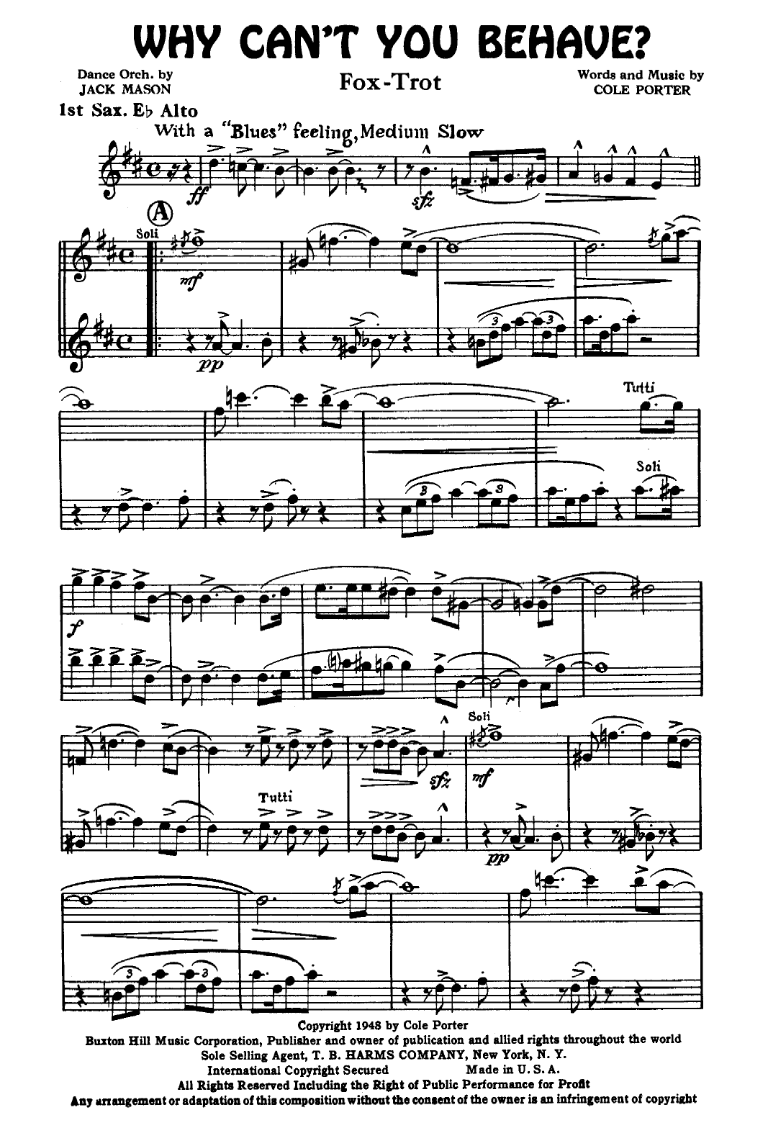
Why Can't You Behave (J.Mason)
Composed by Cole Porter
Arranged by Jack Mason
- Ensemble: Big Band
- Pages: 43
- Instruments (17): 1st Sax. Eb Alto, 2nd Sax. Bb Tenor, 3rd Sax. Eb Alto, 4th Sax. Bb Tenor, 5th Sax. Eb Baritone, 1st Trombone, 2nd Trombone, 3rd Trombone, 1st Bb Trumpet, 2nd Bb Trumpet, 3rd Bb Trumpet, Piano, Guitar, Bass, Drums, Violins A-B, Violin C
- Difficulty: medium
- Content: Individual Parts
- Format: PDF Download (Instant)
- Price: $24.99
Cole Porter originally crafted "Why Can't You Behave" for the landmark 1948 Broadway musical *Kiss Me, Kate*, where it quickly transcended its theatrical origins to become a celebrated vehicle for jazz interpreters. Rooted in the Great American Songbook, the tune captures Porter’s signature sophisticated harmonic palette and witty, bittersweet lyricism. Over the decades, it has been embraced by legendary jazz artists ranging from classic vocalists to instrumental modernists, cementing its status as a versatile standard that thrives in both small-group settings and expansive big band formats. Jack Mason’s tailored big band setting approaches the standard with a sophisticated medium-swing groove in 4/4 time, driven by a crisp, conversational rhythm section foundation. The mood oscillates between smoky, late-night introspection and bright, brass-led exuberance. Mason expertly balances rich, extended harmonies in the reeds with punchy, counter-punching brass figures that evoke the classic Count Basie and Duke Ellington traditions while maintaining a fresh, contemporary sectional interplay. The arrangement builds organically, using subtle dynamic shifts to transition from moody, understated verses into full-ensemble statements that command attention without ever rushing the tempo. The structural design of the chart distributes melodic responsibilities dynamically across the 7-instrument ensemble, featuring the alto and tenor saxophones in lush, interwoven counterpoint before handing the lead to the trumpet and trombone. Solo space is thoughtfully integrated, allowing featured horn players to stretch out over traditional changes while the rhythm section provides a buoyant, supportive carpet. Technical demands center on clean articulation, precise swing subdivision, and nuanced blend rather than breakneck velocities. Players must navigate crisp syncopations, subtle-to-robust dynamic contrasts, and articulate phrasing to capture the sophisticated swing era aesthetic embedded in Mason’s writing. Advanced high school ensembles, collegiate jazz orchestras, and professional community big bands will find this arrangement an ideal centerpiece for concert programs or festival adjudications. Because the orchestration is tightly knit across the 7 essential parts rather than bloated with redundant doubling, every player functions as a vital soloist within the collective sound. This transparent texture exposes intonation and balance, offering an invaluable educational workout for developing groups while giving seasoned professionals enough harmonic and stylistic depth to deliver a polished, unforgettable performance. Conductors should establish a comfortable, relaxed medium-swing tempo around quarter note equals 120–126 BPM, ensuring the rhythm section locks into an unhurried, driving triplet feel. A primary technical challenge lies in maintaining crisp articulation during sustained dynamic crescendos; the brass section must execute accented punch figures without overblowing or distorting the warm, dark acoustic blend required by Mason's voicings. Saxophone players should focus on smooth, seamless voice-leading in the solis, paying meticulous attention to internal balance so the passing tones resonate clearly against the piano's comping. Rehearsal time is best spent isolating the syncopated ensemble hits in the shout chorus to lock in absolute rhythmic unity. Encourage the rhythm pianist to avoid overly dense chord clusters, leaving space for the bass and drums to propel the swing forward naturally. Q: What instruments and parts are included in this arrangement? A: The chart is scored for a 7-instrument ensemble featuring Alto Saxophone, Tenor Saxophone, Trumpet, Trombone, Piano, Bass, and Drums, spread across a comprehensive 43-page score and parts set. Q: What is the difficulty level of this Jack Mason arrangement? A: It is graded as medium-advanced, making it ideal for skilled high school groups, college jazz bands, and professional ensembles looking for a polished, highly idiomatic swing chart. Q: What is the historical background and musical style of "Why Can't You Behave"? A: Originally composed by Cole Porter for the 1948 Broadway musical *Kiss Me, Kate*, this arrangement treats the timeless melody in a classic, sophisticated medium-swing jazz style. Q: What makes this specific arrangement by Jack Mason unique? A: Mason distills the power of a full big band into a tight 7-instrument framework, utilizing clever voicing and transparent textures that highlight individual players while maintaining a rich, full-ensemble sound. Q: What is the approximate performance duration and tempo feel? A: The piece performs in roughly 3 to 4 minutes at a relaxed, driving medium-swing tempo (approx. 120–126 BPM) that emphasizes groove, precision, and stylistic nuance.
Questions and answers
- What is included in the Why Can't You Behave (J.Mason) PDF?
- The verified current file contains individual parts across 43 pages.
- How many instruments or parts are listed for Why Can't You Behave (J.Mason)?
- The verified instrumentation list contains 17 entries for this Big Band arrangement.
- Who is credited for Why Can't You Behave (J.Mason)?
- Composer: Cole Porter. Arranger: Jack Mason.
- What difficulty is listed for Why Can't You Behave (J.Mason)?
- The verified difficulty level is medium.
- Can I preview Why Can't You Behave (J.Mason) before buying?
- Yes. The product page provides a preview generated from the current PDF file.
- How is Why Can't You Behave (J.Mason) delivered?
- After successful payment, the digital PDF is made available for download. The displayed price is $24.99.
Musicians Also Search For
Why Can't You Behave Jack Mason PDF • Why Can't You Behave Jack Mason sheet music • Why Can't You Behave arranged by Jack Mason • Jack Mason big band charts • Jack Mason jazz arrangements PDF • Why Can't You Behave Cole Porter sheet music • Why Can't You Behave Cole Porter big band arrangements • Cole Porter big band charts • Why Can't You Behave big band arrangements • Why Can't You Behave big band PDF download • Why Can't You Behave jazz sheet music • big band sheet music download • Why Can't You Behave individual parts download • Why Can't You Behave sheet music PDF • buy Why Can't You Behave sheet music • download Why Can't You Behave PDF • Why Can't You Behave jazz charts • best Jack Mason big band arrangements • Cole Porter arranged by Jack Mason • Why Can't You Behave printable sheet music • big band repertoire PDF