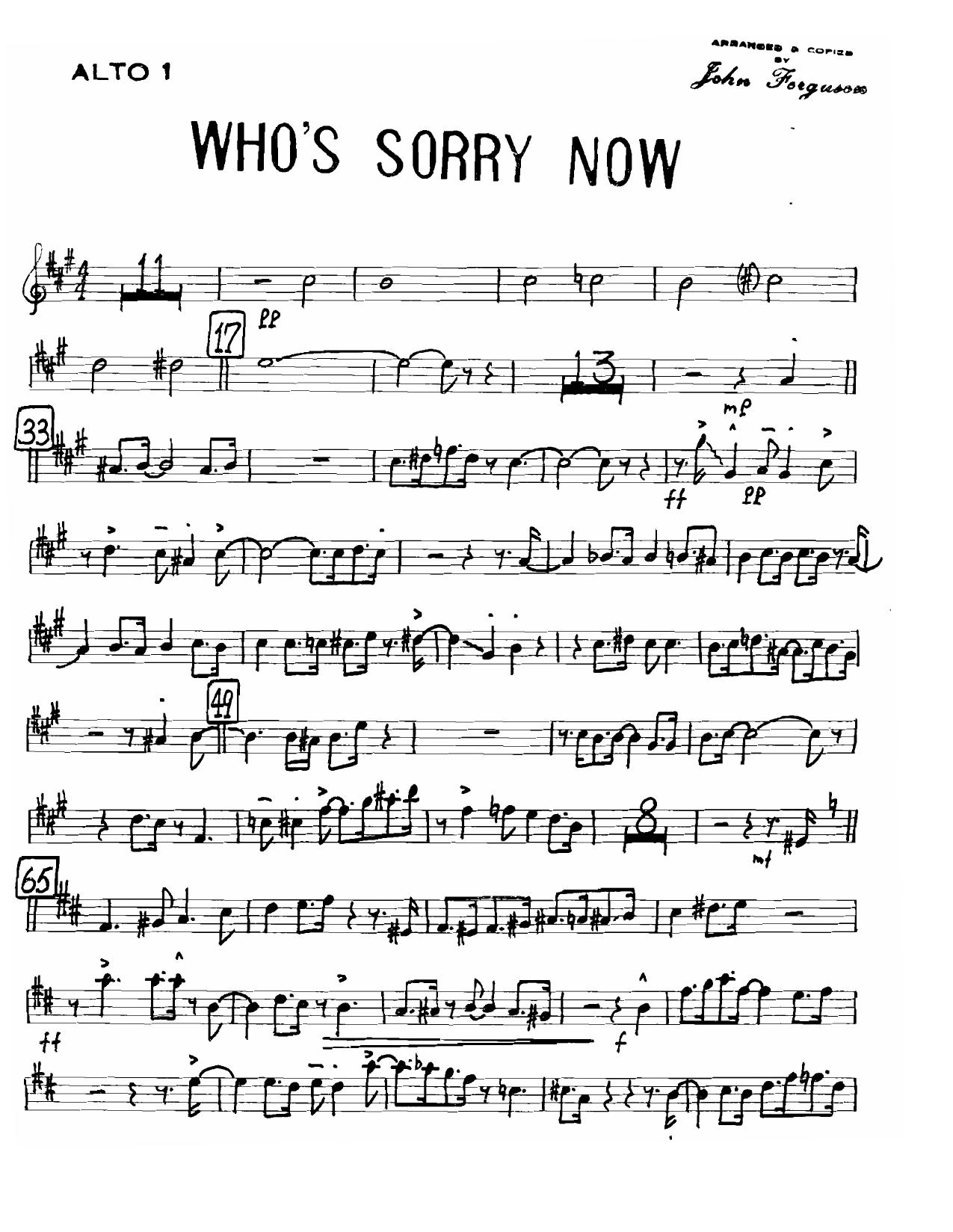
Who's Sorry Now (J.Ferguson) sheet music preview

Who's Sorry Now (J.Ferguson)

Composed by Ted Snyder

Arranged by J.Ferguson

  • Ensemble: Big Band
  • Style: Jazz Standard
  • Pages: 35
  • Instruments (17): Alto 1, Tenor 1, Alto 2, Tenor 2, Baritone, Trumpet 1, Trumpet 2, Trumpet 3, Trumpet 4, Trombone 1, Trombone 2, Trombone 3, Trombone 4, Piano, Bass, Guitar, Drums
  • Difficulty: medium
  • Content: Individual Parts
  • Format: PDF Download (Instant)
  • Price: $24.99

Ted Snyder’s timeless 1923 composition "Who's Sorry Now"—with lyrics by Bert Kalmar and Harry Ruby—holds a celebrated place in the American Songbook, transitioning from a Tin Pan Alley tearjerker into an enduring vehicle for jazz improvisation. While originally popularized by artists like Marion Harris and later cemented as a swing-era staple through iconic interpretations by Harry James and Connie Francis, the tune possesses an inherently flexible harmonic framework that invites creative reimagining. Its deceptive simplicity, built upon a classic 32-bar AABA form, provides a fertile canvas for jazz arrangers seeking to balance nostalgic warmth with modern compositional sophistication. In this masterful big band setting, arranger J.Ferguson breathes fresh vitality into the standard with a driving medium-swing feel that balances infectious, foot-tapping groove with sophisticated harmonic coloring. The arrangement opens with a sultry, understated intro that hints at the main theme before the ensemble locks into a robust 4/4 pocket. The mood shifts fluidly between breezy, relaxed swing passages and high-energy, brass-heavy declarations, evoking the vibrant atmosphere of a 1940s ballroom filtered through a contemporary compositional lens. Rich extended voicings in the saxophone and brass sections elevate the harmonic language, introducing unexpected chromatic passing tones and lush suspended chords that keep both performers and listeners thoroughly engaged. Ferguson’s distinct structural approach shines through in the clever distribution of thematic material and dynamic contrast. The standard opens with the woodwinds carrying the initial statement of the melody, supported by subtle, tasteful background figures from the lower brass. A tightly knit sax soli section serves as the arrangement's emotional core, showcasing intricate counterpoint and seamless voice-leading that demands precision and stylistic unity. As the chart builds toward a powerful, climactic shout chorus, the brass section takes command with stinging accents, dynamic swells, and classic swing-era articulation. Open solo sections for key instruments provide ample space for creative improvisation over standard changes, while carefully orchestrated transitional interludes ensure the energy never flags. Advanced high school, collegiate, and professional jazz ensembles will find this chart an exceptionally rewarding addition to their repertoire. While the technical demands—particularly concerning rhythmic precision, balance within the sax soli, and endurance in the high brass—require a mature ensemble, the payoff is immense. The arrangement offers a masterclass in ensemble breathing, section blend, and stylistic articulation, making it an ideal showcase piece for festival adjudication, formal concerts, or club performances. Success with J.Ferguson’s chart hinges on maintaining an authentic, relaxed medium-swing feel without letting the tempo drag or rush. Aim for a metronome marking of approximately 120-126 BPM, ensuring the eighth notes are properly swung with natural weight placed on the upbeat. Key technical challenges center around the intricate sax soli; the section must practice passages meticulously at slower tempos to achieve flawless blend and articulation uniformity before integrating with the full band. Brass players should pay close attention to dynamic markings, particularly during the transition from the subdued backgrounds to the explosive shout chorus, avoiding overblowing in the middle register. Incorporate stylistic nuances such as controlled doits, subtle falls, and precise plunger or cup mute effects where indicated in the trumpet and trombone parts to capture the authentic vintage color. Rehearsal time should be divided evenly between isolating section-specific blend issues and ensuring that the rhythm section—especially the ride cymbal and walking bassline—drives the ensemble forward with unwavering momentum. Q: What instruments and parts are included in this big band arrangement? A: The arrangement is scored for a standard 17-instrument big band instrumentation, featuring Alto Saxophone 1, Alto Saxophone 2, Tenor Saxophone 1, Tenor Saxophone 2, and Baritone Saxophone, alongside standard brass (trumpets and trombones) and a full rhythm section. The complete package spans 35 pages of professionally engraved score and parts. Q: What is the difficulty level of this arrangement? A: This arrangement is graded as advanced, making it best suited for college ensembles, advanced high school jazz bands, and professional community big bands. It requires strong section playing, solid improvisers, and rhythmic maturity to execute the sophisticated voicings and dynamic contrasts effectively. Q: What style and historical era does this arrangement draw from? A: It is rooted in the traditional jazz standard idiom, drawing heavy inspiration from the classic swing era of the 1930s and 1940s. However, J.Ferguson's contemporary harmonic approach bridges traditional swing aesthetics with modern arranging sensibilities. Q: What makes J.Ferguson's arrangement unique compared to other versions of this standard? A: This setting stands out due to its clever re-harmonization, sophisticated saxophone soli writing, and seamless transitions between understated swing grooves and high-octane shout choruses. It avoids predictable clichés by introducing fresh counter-melodies and rich extended chord voicings throughout the 32-bar form. Q: What is the approximate performance duration and tempo of the piece? A: The arrangement performs at a lively medium-swing tempo of around 120 to 126 BPM, yielding a total performance duration of approximately 3.5 to 4 minutes, depending on the length of the open solo sections.

Questions and answers

What is included in the Who's Sorry Now (J.Ferguson) PDF?
The verified current file contains individual parts across 35 pages.
How many instruments or parts are listed for Who's Sorry Now (J.Ferguson)?
The verified instrumentation list contains 17 entries for this Big Band arrangement.
Who is credited for Who's Sorry Now (J.Ferguson)?
Composer: Ted Snyder. Arranger: J.Ferguson.
What difficulty is listed for Who's Sorry Now (J.Ferguson)?
The verified difficulty level is medium.
What style is listed for Who's Sorry Now (J.Ferguson)?
The catalog lists the style as Jazz Standard.
Can I preview Who's Sorry Now (J.Ferguson) before buying?
Yes. The product page provides a preview generated from the current PDF file.
How is Who's Sorry Now (J.Ferguson) delivered?
After successful payment, the digital PDF is made available for download. The displayed price is $24.99.

Musicians Also Search For

Who's Sorry Now J.Ferguson PDFWho's Sorry Now J.Ferguson sheet musicWho's Sorry Now arranged by J.FergusonJ.Ferguson big band chartsJ.Ferguson jazz arrangements PDFWho's Sorry Now Ted Snyder sheet musicWho's Sorry Now Ted Snyder big band arrangementsTed Snyder big band chartsWho's Sorry Now big band arrangementsWho's Sorry Now big band PDF downloadWho's Sorry Now jazz sheet musicbig band sheet music downloadWho's Sorry Now individual parts downloadWho's Sorry Now sheet music PDFWho's Sorry Now Jazz Standard chartsJazz Standard big band arrangementsbuy Who's Sorry Now sheet musicdownload Who's Sorry Now PDFWho's Sorry Now jazz chartsbest J.Ferguson big band arrangementsTed Snyder arranged by J.FergusonWho's Sorry Now printable sheet musicbig band repertoire PDF

All arrangements by J.Ferguson All Ted Snyder sheet music