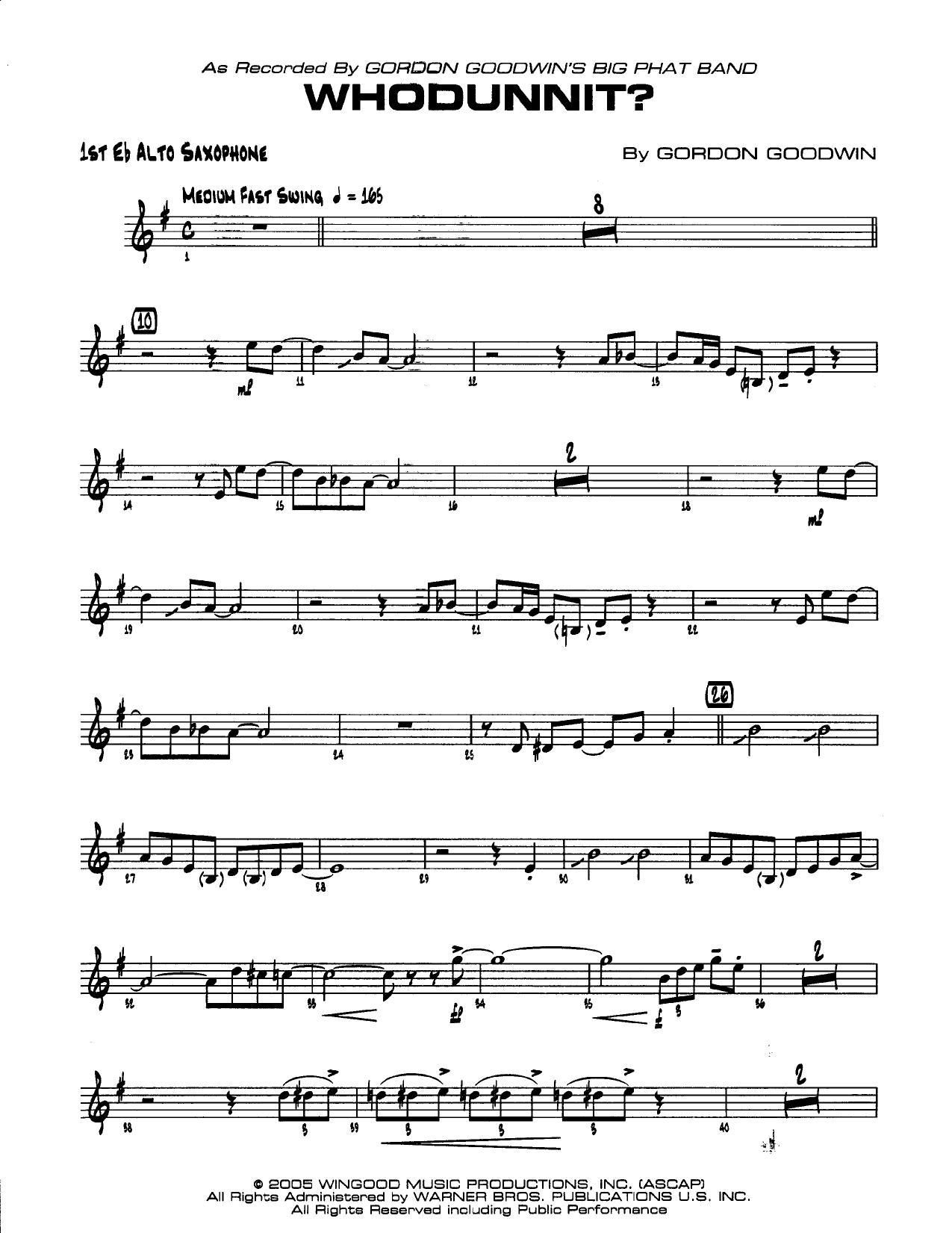
Whodunnit (G.Goodwin) sheet music preview

Whodunnit (G.Goodwin)

Composed by Gordon Goodwin

Arranged by Gordon Goodwin

  • Ensemble: Big Band
  • Pages: 105
  • Instruments (19): 1st Eb Alto Saxophone, 2nd Eb Alto Saxophone (Optional Flute), 1st Bb Tenor Saxophone, 2nd Bb Tenor Saxophone, Eb Baritone Saxophone, 1st Bb Trumpet, 2nd Bb Trumpet, 3rd Bb Trumpet, 4th Bb Trumpet, 1st Trombone, 2nd Trombone, 3rd Trombone, 4th Trombone, Guitar, Piano, Bass, Drums, Auxiliary Percussion (Triangle, Bongos, Congas), Mallet Percussion (Vibraphone/Optional Xylophone)
  • Difficulty: advanced
  • Content: Individual Parts
  • Format: PDF Download (Instant)
  • Price: $24.99

Gordon Goodwin’s "Whodunnit" stands as a masterclass in contemporary big band writing, capturing the high-octane, cinematic energy that has defined the Gordon Goodwin’s Big Phat Band sound since its emergence at the turn of the 21st century. Originally recorded to showcase the band's trademark precision, blistering technical agility, and cinematic scope, this chart bridges the gap between classic swing-era drive and modern, harmonically adventurous fusion. It reflects a vibrant era of big band renaissance where traditional section writing meets complex contemporary harmonies, odd-meter sensibilities, and relentless groove-driven momentum. Driving forward with an infectious, high-energy swing feel at a brisk tempo, "Whodunnit" evokes the atmosphere of a classic detective noir film scored through a turbo-charged modern jazz lens. The mood is mischievous, urgent, and fiercely theatrical, built upon interlocking rhythmic motifs and punchy brass stabs that keep both performers and listeners on the edge of their seats. Goodwin's writing creates an immediate sense of momentum, utilizing sharp dynamic contrasts—from whispered, secretive saxophone lines to explosive, room-filling tuttis—that heighten the narrative tension inherent in the music's title. True to Goodwin’s signature arranging style, this chart features dense, extended chord voicings, intricate woodwind doublings, and a brilliantly crafted brass soli that demands absolute unanimity of articulation. The saxophones carry much of the initial thematic weight with lightning-fast, bebop-inflected lines, while the brass section interjects with biting, aggressive accents that showcase the power of a world-class horn section. A roaring shout chorus serves as the structural climax, pushing the entire ensemble to its dynamic peak before resolving with a clever, tongue-in-cheek final cadence. Open solo sections provide a prime vehicle for featured improvisers—typically alto saxophone and piano—to stretch out over sophisticated chord changes. Advanced college, professional, and elite high school big bands will find this arrangement an exhilarating test of ensemble literacy, rhythmic precision, and stylistic versatility. Because of the sheer velocity of the secondary lines and the demands placed on the lead players, rhythm section interplay—particularly the drummer's ability to drive a contemporary big band chart with crisp articulation and dynamic sensitivity—is paramount. Bringing this chart to life offers immense artistic rewards, serving as an undeniable crowd-pleaser that pushes an ensemble's collective technique, stamina, and theatrical presentation to new heights. Conductors tackling "Whodunnit" must prioritize crisp articulation and immaculate rhythmic alignment across all sections, as the chart's effectiveness relies entirely on razor-sharp precision. The tempo must remain relentlessly steady; avoid rushing during loud ensemble passages or dragging during swung eighth-note figures. Saxophone players should ensure their fast bebop lines remain articulate and light rather than heavy-handed, while the brass section needs to balance projection with warmth, utilizing controlled, clipped staccatos and well-placed falls and doits that ornament Goodwin’s writing. Rehearsals should begin by isolating the rhythm section to lock in the underlying groove and syncopated figures before introducing the horns. Pay close attention to dynamic markings under soloists to ensure the ensemble accompaniment breathes without overpowering the featured improviser. For the shout chorus, rehearse section by section to balance the complex inner voicings, ensuring that the high lead trumpet lines project clearly without pinching tone quality. Q: What instruments and parts are included in this publication? A: This complete big band arrangement includes the official conductor score and 19 individual parts, covering standard instrumentation for 5 saxophones (with woodwind doublings), 4 trumpets, 4 trombones, and a full rhythm section including auxiliary percussion. Q: What is the difficulty level of this arrangement? A: This chart is rated as advanced, making it best suited for collegiate, professional, and elite high school jazz ensembles with strong lead players and experienced improvisers. Q: What is the musical style and historical context of "Whodunnit"? A: Composed and popularized by Gordon Goodwin’s Big Phat Band, this piece represents contemporary West Coast big band jazz, blending the swinging tradition of classic Count Basie-style charts with modern harmonic complexity and cinematic flair. Q: What makes this specific Gordon Goodwin arrangement unique? A: It features Goodwin's signature witty compositional narrative, intricate brass and saxophone interplays, dense extended harmonies, and a high-energy structural arc complete with a thrilling shout chorus and dynamic solo opportunities. Q: What is the recommended performance tempo and duration for this piece? A: "Whodunnit" is designed to be performed at a brisk, driving swing tempo that demands high technical facility, typically resulting in a performance duration of approximately 4 to 5 minutes depending on the length of the open solos.

Questions and answers

What is included in the Whodunnit (G.Goodwin) PDF?
The verified current file contains a conductor score and individual parts across 105 pages.
How many instruments or parts are listed for Whodunnit (G.Goodwin)?
The verified instrumentation list contains 19 entries for this Big Band arrangement.
Who is credited for Whodunnit (G.Goodwin)?
Composer: Gordon Goodwin. Arranger: Gordon Goodwin.
What difficulty is listed for Whodunnit (G.Goodwin)?
The verified difficulty level is advanced.
Can I preview Whodunnit (G.Goodwin) before buying?
Yes. The product page provides a preview generated from the current PDF file.
How is Whodunnit (G.Goodwin) delivered?
After successful payment, the digital PDF is made available for download. The displayed price is $24.99.

Musicians Also Search For

Whodunnit Gordon Goodwin PDFWhodunnit Gordon Goodwin sheet musicWhodunnit arranged by Gordon GoodwinGordon Goodwin big band chartsGordon Goodwin jazz arrangements PDFWhodunnit Gordon Goodwin big band arrangementsWhodunnit big band arrangementsWhodunnit big band PDF downloadWhodunnit jazz sheet musicbig band sheet music downloadWhodunnit conductor score PDFWhodunnit individual parts downloadWhodunnit sheet music PDFbuy Whodunnit sheet musicdownload Whodunnit PDFWhodunnit jazz chartsbest Gordon Goodwin big band arrangementsWhodunnit printable sheet musicbig band repertoire PDF

All arrangements by Gordon Goodwin All Gordon Goodwin sheet music