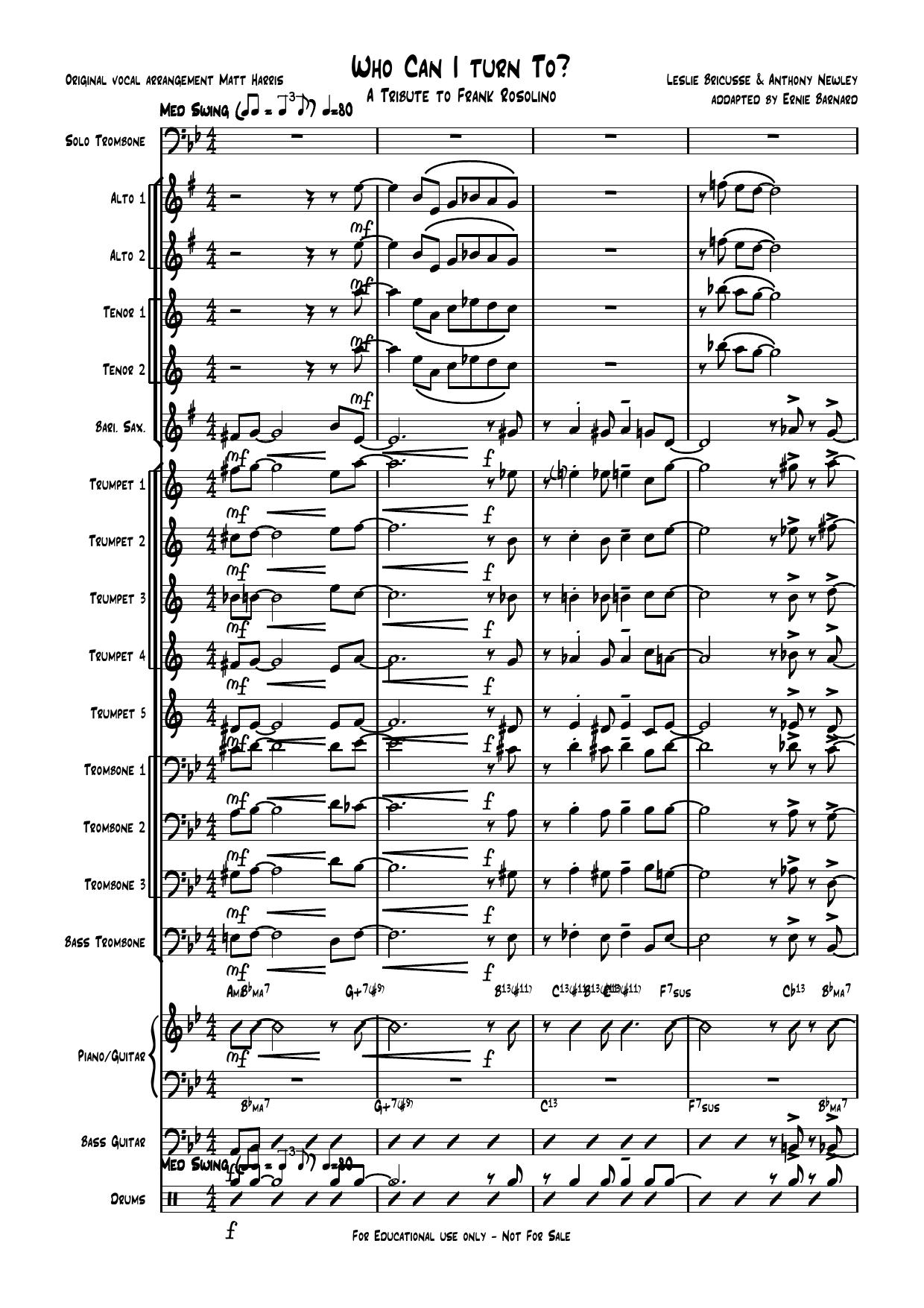
Who Can I Turn To (F.Rosolino)
Composed by Anthony Newley
Arranged by F.Rosolino
- Ensemble: Big Band
- Style: Jazz Standard
- Pages: 63
- Instruments (19): Solo Trombone, Alto Saxophone 1, Alto Saxophone 2, Tenor Saxophone 1, Tenor Saxophone 2, Baritone Saxophone, Trumpet 1, Trumpet 2, Trumpet 3, Trumpet 4, Trumpet 5, Trombone 1, Trombone 2, Trombone 3, Bass Trombone, Piano, Guitar, Bass Guitar, Drums
- Difficulty: advanced
- Content: Individual Parts
- Format: PDF Download (Instant)
- Price: $24.99
Originally written by Anthony Newley and Leslie Bricusse for the 1964 Broadway musical *The Roar of the Greasepaint – The Smell of the Crowd*, "Who Can I Turn To (When Nobody Needs Me)" was swiftly embraced by the jazz pantheon, most notably through Tony Bennett’s definitive vocal recording and dynamic instrumental interpretations by giants like Bill Evans and Wynton Kelly. This timeless standard embodies the bittersweet lyricism of mid-century American popular song, offering a harmonious blend of poignant melodic suspension and rich harmonic possibilities that naturally invite jazz exploration. It stands as a cornerstone of the standard repertoire, prized for its evocative chord changes and emotional resonance. Frank Rosolino’s masterful big band treatment infuses this classic ballad with a sophisticated, expressive intensity reflective of his legendary career as a virtuoso bebop trombonist. The arrangement navigates a lush harmonic landscape, transitioning from intimate, delicate ensemble textures to sweeping, emotionally charged climaxes. Rosolino utilizes warm, contemporary chord voicings across the full reed and brass sections, creating a rich sonic tapestry that highlights the melancholy and yearning inherent in Newley’s original melody. The scoring balances transparent, open spaces for the soloist with dense, harmonically adventurous background figures that propel the narrative forward without obscuring the lead voice. The emotional core of the chart is anchored by a prominent featured solo—traditionally tailored for trombone or a lead expressive horn—allowing a soloist to stretch out over a supportive, subtly shifting rhythmic foundation. The saxophones, featuring a double-alto and double-tenor configuration alongside baritone, frequently carry lush chordal counter-melodies, while the brass section utilizes nuanced dynamics, ranging from whispered cup-mute passages to soaring, open-bell resonance. Technical challenges lie primarily in maintaining pristine intonation during exposed, slow-moving passages and executing the subtle rubato-like phrasing required within a structured big band framework. Musicians will find profound artistic fulfillment in shaping the dynamic arcs and bringing out the sophisticated inner voices that Rosolino has carefully woven into the score. Advanced high school ensembles, collegiate jazz orchestras, and professional big bands will find this arrangement an exceptional vehicle for showcasing both ensemble sensitivity and individual solo artistry. Because it demands mature breath support, refined balance, and a deep understanding of ballad phrasing, it serves as an ideal centerpiece for festival performances or sophisticated concert programs. Conductors should approach this chart with a deep respect for elastic phrasing and rubato-leaning pacing, even within a controlled metric framework. The tempo should feel conversational and unhurried, allowing the harmonic shifts to breathe. A primary technical challenge is maintaining pristine blend and intonation during exposed, static chord voicings in the brass; players should utilize minimal vibrato until the dynamic swells. Section leaders must carefully monitor balance so that background figures never overpower the featured soloist. Mute usage should be strictly observed where indicated—typically cup or harmon mutes in the trumpets—to achieve the signature mid-era cool-jazz warmth. Rehearsal time should be heavily invested in subdividing slow passages mentally to keep the underlying pulse alive without rushing. Encourage the rhythm section to play with a sparse, supportive accompaniment style, avoiding heavy comping that might clutter Rosolino's transparent harmonic design. Q: What instruments and parts are included in this big band arrangement? A: The full 18-instrument instrumentation comprises Alto Saxophone 1, Alto Saxophone 2, Tenor Saxophone 1, Tenor Saxophone 2, Baritone Saxophone, 4 Trumpets, 4 Trombones, Piano, Guitar, Bass, Drums, and includes a comprehensive 63-page conductor score. Q: What is the difficulty level of this arrangement? A: This arrangement is rated as advanced, making it best suited for college jazz orchestras, advanced high school bands, and professional ensembles capable of handling subtle ballad phrasing and mature harmonic concepts. Q: What is the musical style and historical context of this piece? A: It is a jazz standard arrangement of Anthony Newley’s Broadway composition, reframed through the sophisticated, bop-influenced arranging lens of trombonist Frank Rosolino. Q: What makes this specific arrangement by F.Rosolino unique? A: It stands out for its lush, modern chord voicings, brilliant integration of a featured solo space with interactive background figures, and a dynamic arc that moves from intimate transparency to rich, emotive ensemble climaxes. Q: What is the typical performance duration and tempo feel? A: The piece is performed as an expressive, ballad-tempo jazz standard, generally running between 4 to 6 minutes depending on the length of the featured improvisation and the conductor's preferred rubato pacing.
Questions and answers
- What is included in the Who Can I Turn To (F.Rosolino) PDF?
- The verified current file contains a conductor score and individual parts across 63 pages.
- How many instruments or parts are listed for Who Can I Turn To (F.Rosolino)?
- The verified instrumentation list contains 19 entries for this Big Band arrangement.
- Who is credited for Who Can I Turn To (F.Rosolino)?
- Composer: Anthony Newley. Arranger: F.Rosolino.
- What difficulty is listed for Who Can I Turn To (F.Rosolino)?
- The verified difficulty level is advanced.
- What style is listed for Who Can I Turn To (F.Rosolino)?
- The catalog lists the style as Jazz Standard.
- Can I preview Who Can I Turn To (F.Rosolino) before buying?
- Yes. The product page provides a preview generated from the current PDF file.
- How is Who Can I Turn To (F.Rosolino) delivered?
- After successful payment, the digital PDF is made available for download. The displayed price is $24.99.
Musicians Also Search For
Who Can I Turn To F.Rosolino PDF • Who Can I Turn To F.Rosolino sheet music • Who Can I Turn To arranged by F.Rosolino • F.Rosolino big band charts • F.Rosolino jazz arrangements PDF • Who Can I Turn To Anthony Newley sheet music • Who Can I Turn To Anthony Newley big band arrangements • Anthony Newley big band charts • Who Can I Turn To big band arrangements • Who Can I Turn To big band PDF download • Who Can I Turn To jazz sheet music • big band sheet music download • Who Can I Turn To conductor score PDF • Who Can I Turn To individual parts download • Who Can I Turn To sheet music PDF • Who Can I Turn To Jazz Standard charts • Jazz Standard big band arrangements • buy Who Can I Turn To sheet music • download Who Can I Turn To PDF • Who Can I Turn To jazz charts • best F.Rosolino big band arrangements • Anthony Newley arranged by F.Rosolino • Who Can I Turn To printable sheet music • big band repertoire PDF