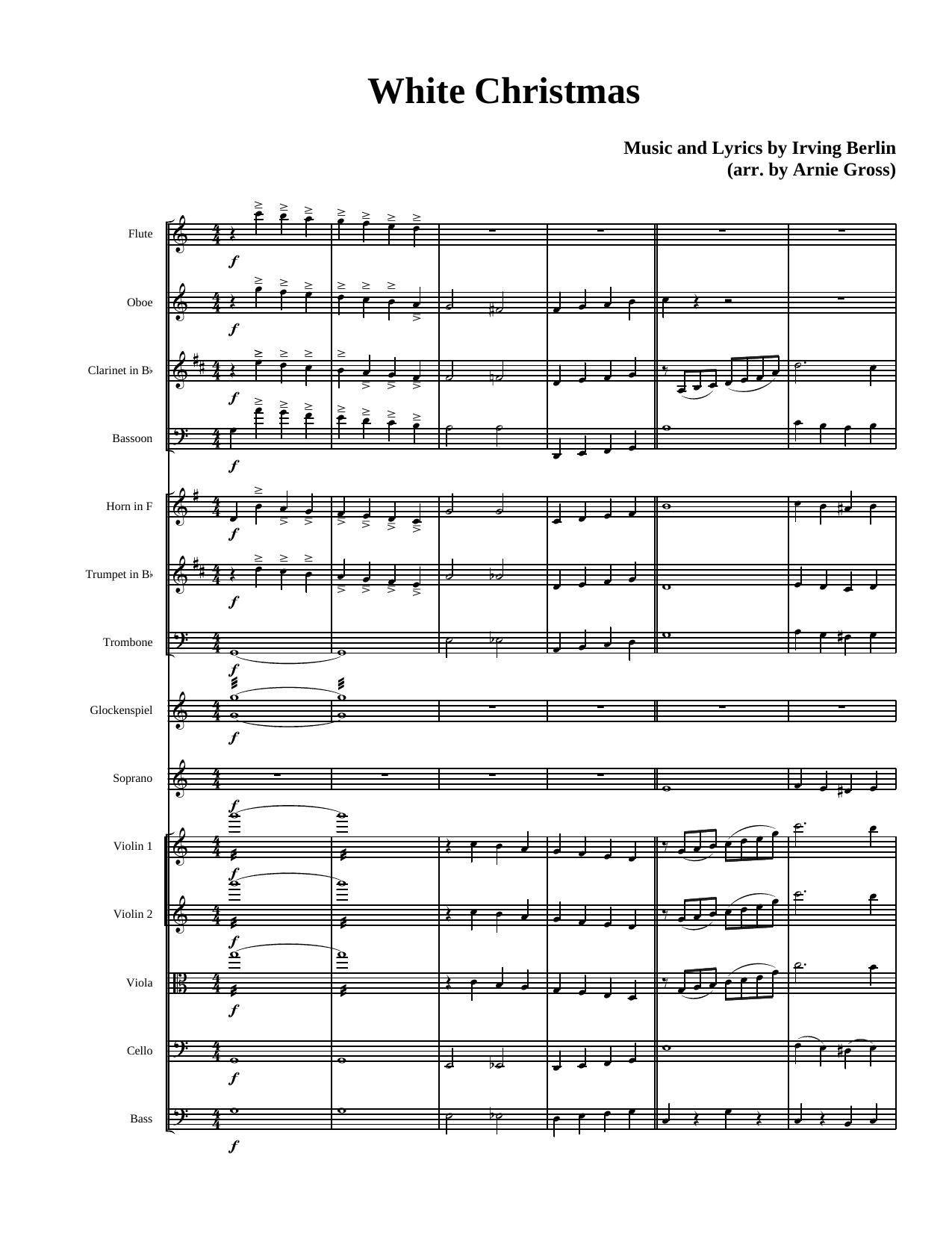
White Christmas (Gross)
Composed by Irving Berlin
Arranged by Gross
- Ensemble: Big Band
- Style: Jazz Standard
- Pages: 20
- Instruments (14): Vocal, Flute, Oboe, Clarinet in Bb, Bassoon, Horn in F, Trumpet in Bb, Trombone, Glockenspiel, Violin 1, Violin 2, Viola, Cello, Bass
- Difficulty: easy
- Content: Individual Parts
- Format: PDF Download (Instant)
- Price: $24.99
Irving Berlin’s timeless holiday masterpiece, originally introduced by Bing Crosby in the 1942 musical film *Holiday Inn*, remains one of the most widely recorded and enduring songs in the American Songbook. Evolving organically from a poignant pop ballad into a staple of the jazz repertoire through countless interpretations by vocal and instrumental icons like Ella Fitzgerald, Frank Sinatra, and Oscar Peterson, the tune possesses a harmonic depth and melancholy nostalgia that makes it exceptionally receptive to jazz reharmonization. The song captures a wistful yearning for simpler times, wrapped in a deceptively simple AABA form that invites sophisticated chord substitutions and subtle stylistic shifts. This sophisticated big band setting by arranger Gross reimagines the familiar holiday standard through a rich, modern-jazz lens, blending traditional swing sensibilities with lush, contemporary harmonic colors. Rather than relying on a straightforward, predictable reading, the arrangement opens with a rubato atmospheric introduction before settling into an elegant, laid-back medium swing groove (around quarter note = 112). The mood transitions seamlessly from reflective introspection to warm, buoyant optimism, evoking the cozy ambiance of a winter evening combined with the sophisticated sophistication of a metropolitan jazz club. Gross employs extended chord voicings—utilizing major sevenths, ninths, and altered dominants—to inject a fresh, sophisticated vitality into Berlin’s iconic melody without ever losing sight of the source material's emotional core. Gross’s compositional fingerprints are evident in the intricate textural contrasts and clever instrumental grouping throughout the chart. The woodwind doubling (utilizing Flute, Oboe, Clarinet in Bb, and Bassoon alongside the traditional horn and rhythm sections) provides a unique orchestral timbre reminiscent of late-period Claude Thornhill or Gil Evans arrangements, offering lush counter-melodies and airy pads behind the brass. The chart features a gorgeous saxophone soli that reinterprets the secondary bridge with tight, harmonized voicings, leading dynamically into a tightly wound, harmonically adventurous shout chorus. Solos are thoughtfully open for a designated horn player, backed by a sophisticated rhythm section vamp that encourages modal exploration while maintaining the underlying swing momentum. Advanced high school ensembles with strong section players, collegiate jazz orchestras, and professional big bands will find this arrangement an exceptionally rewarding centerpiece for a winter concert or seasonal jazz program. The technical demands lie primarily in blend, intonation, and stylistic cohesion rather than sheer velocity, requiring mature players who can navigate subtle dynamic shifts and intricate woodwind-brass blending. The inclusion of a comprehensive conductor score alongside the 14 distinct instrumental parts ensures that directors have total clarity when balancing the dense, multi-layered textures that make Gross’s interpretation a standout addition to the modern big band library. Balancing the unique 14-instrument instrumentation requires careful attention from the conductor, particularly when blending traditional big band brass with non-standard woodwinds like the oboe and bassoon. Ensure the woodwind voices sit comfortably inside the ensemble texture during tutti passages, using them to color the upper extensions of the harmony rather than compete with the lead trumpet. The medium-swing tempo must remain relaxed; avoid rushing the quarter-note pulse, as the chart's emotional resonance depends on a comfortable, conversational groove. Dynamics should be meticulously observed, especially during the rubato introduction and the transition into the main swing feel. Saxophones must execute their soli with a unified light articulation, avoiding heavy tongue-strokes to maintain the sophisticated, floating quality of the lines. Brass players should keep mutes ready where indicated, prioritizing warm, blended tones over aggressive edge. Q: What instruments and parts are included in this arrangement? A: The package includes a comprehensive conductor score and 14 individual parts covering Flute, Oboe, Clarinet in Bb, Bassoon, Horn in F, standard big band brass and reeds, and a complete rhythm section. Q: What is the difficulty level of this big band chart? A: This arrangement is graded as advanced-intermediate to advanced, making it best suited for college jazz ensembles, professional bands, and top-tier high school groups with strong section maturity and diverse woodwind doubling capabilities. Q: What style and historical context does this arrangement draw from? A: Rooted in the American jazz standard tradition originating from Irving Berlin's 1942 classic, this chart blends classic swing era sentiment with modern, sophisticated harmonic reharmonization and contemporary orchestral textures. Q: What makes this particular arrangement by Gross unique? A: It distinguishes itself through its unique 14-instrument scoring—incorporating orchestral woodwinds like oboe and bassoon—combined with lush extended voicings, a striking saxophone soli, and a creative harmonic arc that elevates a familiar holiday tune into modern art. Q: What is the approximate performance duration and tempo of the piece? A: The arrangement performs in approximately 4 to 5 minutes at a relaxed medium-swing tempo of roughly quarter note = 112 BPM, featuring a rubato introductory section that allows for expressive timing.
Questions and answers
- What is included in the White Christmas (Gross) PDF?
- The verified current file contains a conductor score and individual parts across 20 pages.
- How many instruments or parts are listed for White Christmas (Gross)?
- The verified instrumentation list contains 14 entries for this Big Band arrangement.
- Who is credited for White Christmas (Gross)?
- Composer: Irving Berlin. Arranger: Gross.
- What difficulty is listed for White Christmas (Gross)?
- The verified difficulty level is easy.
- What style is listed for White Christmas (Gross)?
- The catalog lists the style as Jazz Standard.
- Can I preview White Christmas (Gross) before buying?
- Yes. The product page provides a preview generated from the current PDF file.
- How is White Christmas (Gross) delivered?
- After successful payment, the digital PDF is made available for download. The displayed price is $24.99.
Musicians Also Search For
White Christmas Gross PDF • White Christmas Gross sheet music • White Christmas arranged by Gross • Gross big band charts • Gross jazz arrangements PDF • White Christmas Irving Berlin sheet music • White Christmas Irving Berlin big band arrangements • Irving Berlin big band charts • White Christmas big band arrangements • White Christmas big band PDF download • White Christmas jazz sheet music • big band sheet music download • White Christmas conductor score PDF • White Christmas individual parts download • White Christmas sheet music PDF • White Christmas Jazz Standard charts • Jazz Standard big band arrangements • buy White Christmas sheet music • download White Christmas PDF • White Christmas jazz charts • best Gross big band arrangements • Irving Berlin arranged by Gross • White Christmas printable sheet music • big band repertoire PDF