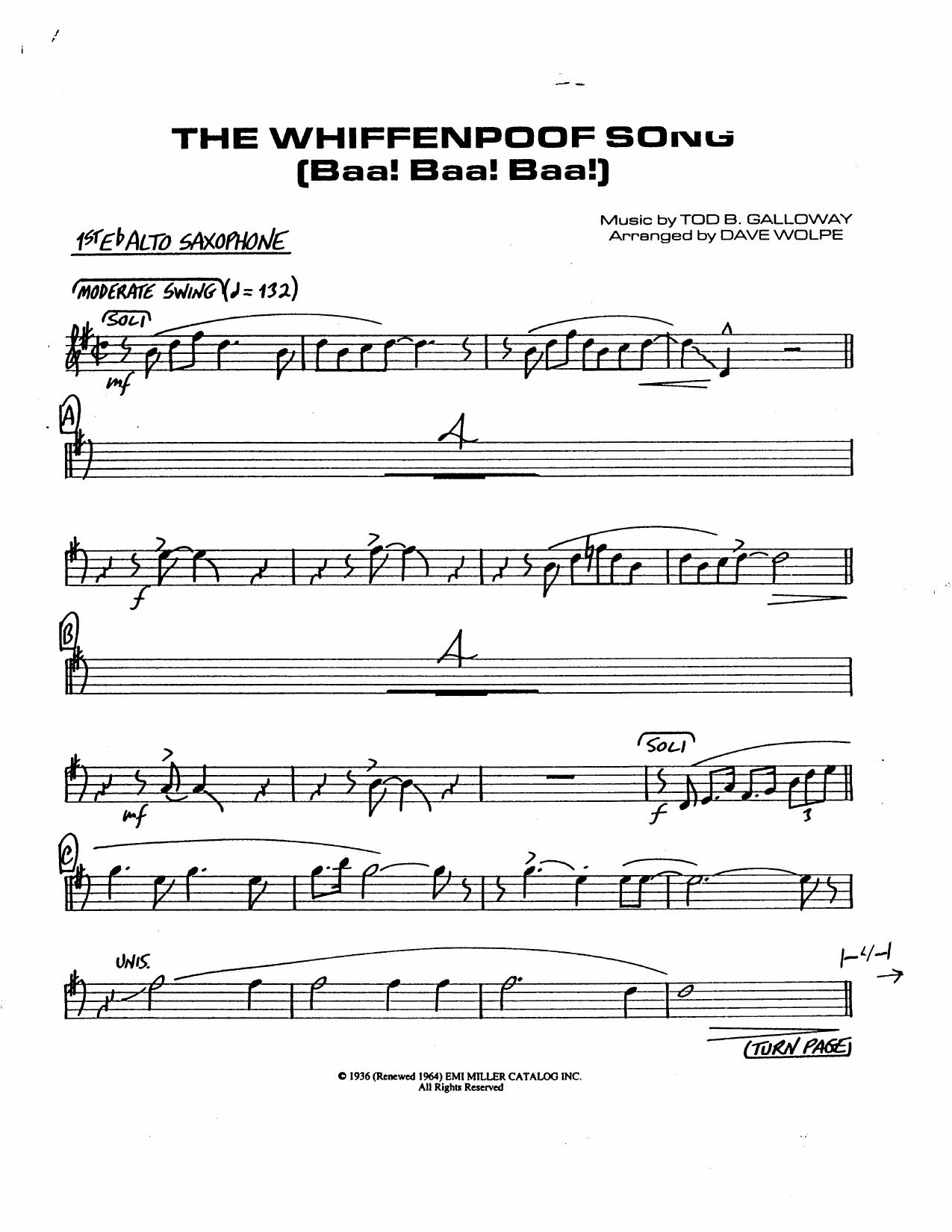
Whiffenpoof Song (D.Wolpe)
Composed by Tod Galloway
Arranged by Dave Wolpe
- Ensemble: Big Band
- Pages: 50
- Instruments (17): 1st Eb Alto Saxophone, 2nd Eb Alto Saxophone, 1st Bb Tenor Saxophone, 2nd Bb Tenor Saxophone, Eb Baritone Saxophone, 1st Bb Trumpet, 2nd Bb Trumpet, 3rd Bb Trumpet, 4th Bb Trumpet, 1st Trombone, 2nd Trombone, 3rd Trombone, Bass Trombone, Bass, Guitar, Drums, Piano
- Difficulty: advanced
- Content: Individual Parts
- Format: PDF Download (Instant)
- Price: $24.99
Rooted in the hallowed halls of early twentieth-century collegiate tradition, "The Whiffenpoof Song"—with music originally composed by Tod Galloway in 1909 to the lyrics of Meade Minnigerode and George S. Pomeroy—is most famously associated with the Yale Whiffenpoofs and immortalized by legendary crooner Bing Crosby in 1947. This timeless melody transitions seamlessly from a nostalgic collegiate anthem into a sophisticated vocal or instrumental jazz vehicle. The composition represents a poignant bridge between turn-of-the-century parlor music and the golden era of mid-century American pop-jazz standards, carrying an inherent bittersweet resonance that has captured listeners for generations. Master arranger Dave Wolpe breathes fresh life into this classic standard through a meticulously crafted big band chart tailored for a standard 16-piece instrumentation (5 saxophones, 8 brass, and a 3-piece rhythm section plus piano). Set in a lush, swinging medium tempo, Wolpe’s arrangement evokes the sophisticated ambiance of a 1950s supper club, balancing sentimental warmth with driving, polished swing grooves. The mood shifts masterfully from introspective, harmonically rich rubato-style phrasing to full-ensemble buoyant swing sections that evoke the classic Count Basie or Nelson Riddle aesthetics. The underlying harmony is spiced with gorgeous extended chord extensions—major sevenths, ninths, and altered dominants—that elevate the traditional collegiate melody into sophisticated modern jazz territory. Wolpe showcases his signature arranging genius by distributing melodic responsibility thoughtfully across the entire ensemble. The chart opens with evocative, harmonized woodwind writing before handing the primary melodic line to the saxophone section, supported by subtle brass pad voicings. A tightly knit sax soli section serves as the emotional and technical centerpiece of the arrangement, demanding precise articulation, blended intonation, and a fluid jazz concept. Brass sections get their chance to shine during a dynamic, building shout chorus that utilizes crisp dynamic contrasts and punchy syncopated figures rather than sheer volume to generate excitement. Optional solo changes allow featured instrumentalists—typically tenor saxophone or piano—to stretch out over a swinging, accessible chord progression that feels authentic to the era. Advanced high school, collegiate, and community jazz ensembles will find this 50-page publication to be an exceptionally rewarding addition to their repertoire. While the individual technical demands on range and rhythm are approachable for developing players, the chart's true educational and artistic value lies in its ensemble phrasing, balance, and stylistic execution. Directors will appreciate how the chart teaches the subtleties of medium-swing subdivision, section blend, and dynamic restraint. Delivering this chart successfully requires musicians to treat the nostalgic melody with deep lyricism while maintaining the razor-sharp articulation essential for authentic big band swing performance. Conductors should approach Dave Wolpe’s arrangement of "The Whiffenpoof Song" with an emphasis on relaxed, conversational swing rather than aggressive drive. The ideal tempo sits comfortably at a medium-swing rate around 112-120 BPM. Avoid rushing the quarter-note pulse; the chart relies heavily on a lazy, behind-the-beat feel to capture its signature vocal-jazz warmth. Technically, the primary challenge lies in the saxophone section's soli passages, which require absolute unanimity in phrasing, vibrato width, and articulation style. Trumpets and trombones must execute background figures with feather-light tongue attacks, ensuring they never overpower the lead voices. Mutes are optional, but adding cup mutes to the brass during the second chorus can enhance the intimate, retro lounge aesthetic. Rehearsal should begin with sectional work, isolating the rhythm section to lock in the lightweight, walking bass line and comping voicings before layering in the horns. Pay close attention to dynamic markings: the contrast between the hushed, intimate opening and the swelling harmonic richness of the climax is what gives this arrangement its profound emotional impact. Q: What instruments and parts are included in this 50-page big band arrangement? A: The instrumentation features a standard 16-piece big band setup: Alto Saxophone 1 & 2, Tenor Saxophone 1 & 2, Baritone Saxophone, 4 Trumpets, 4 Trombones, Piano, Guitar, Bass, and Drum Set, complete with full score and parts. Q: What is the difficulty level of this Dave Wolpe chart? A: This arrangement is graded as medium (or Grade 3.5), making it highly accessible for advanced high school, collegiate, and community big bands looking to balance technical accessibility with sophisticated jazz harmony. Q: What is the historical style and background of this piece? A: Originally a 1909 collegiate song made famous globally by Bing Crosby in 1947, this arrangement refashions the nostalgic tune into a swinging, mid-century jazz standard reminiscent of classic vocal-jazz orchestrations. Q: What makes this specific Dave Wolpe arrangement unique? A: Wolpe uniquely blends nostalgic vocal-jazz ballad textures with classic swing, featuring lush extended harmonies, an intricate saxophone soli, and a dynamic shout chorus that avoids heavy brass bombast in favor of sophisticated tonal coloring. Q: What is the recommended performance duration and tempo for this arrangement? A: The piece is designed to be performed at a relaxed medium-swing tempo of approximately 116 BPM, resulting in a performance duration of roughly 3 to 4 minutes depending on solo extensions.
Questions and answers
- What is included in the Whiffenpoof Song (D.Wolpe) PDF?
- The verified current file contains individual parts across 50 pages.
- How many instruments or parts are listed for Whiffenpoof Song (D.Wolpe)?
- The verified instrumentation list contains 17 entries for this Big Band arrangement.
- Who is credited for Whiffenpoof Song (D.Wolpe)?
- Composer: Tod Galloway. Arranger: Dave Wolpe.
- What difficulty is listed for Whiffenpoof Song (D.Wolpe)?
- The verified difficulty level is advanced.
- Can I preview Whiffenpoof Song (D.Wolpe) before buying?
- Yes. The product page provides a preview generated from the current PDF file.
- How is Whiffenpoof Song (D.Wolpe) delivered?
- After successful payment, the digital PDF is made available for download. The displayed price is $24.99.
Musicians Also Search For
Whiffenpoof Song Dave Wolpe PDF • Whiffenpoof Song Dave Wolpe sheet music • Whiffenpoof Song arranged by Dave Wolpe • Dave Wolpe big band charts • Dave Wolpe jazz arrangements PDF • Whiffenpoof Song Tod Galloway sheet music • Whiffenpoof Song Tod Galloway big band arrangements • Tod Galloway big band charts • Whiffenpoof Song big band arrangements • Whiffenpoof Song big band PDF download • Whiffenpoof Song jazz sheet music • big band sheet music download • Whiffenpoof Song individual parts download • Whiffenpoof Song sheet music PDF • buy Whiffenpoof Song sheet music • download Whiffenpoof Song PDF • Whiffenpoof Song jazz charts • best Dave Wolpe big band arrangements • Tod Galloway arranged by Dave Wolpe • Whiffenpoof Song printable sheet music • big band repertoire PDF