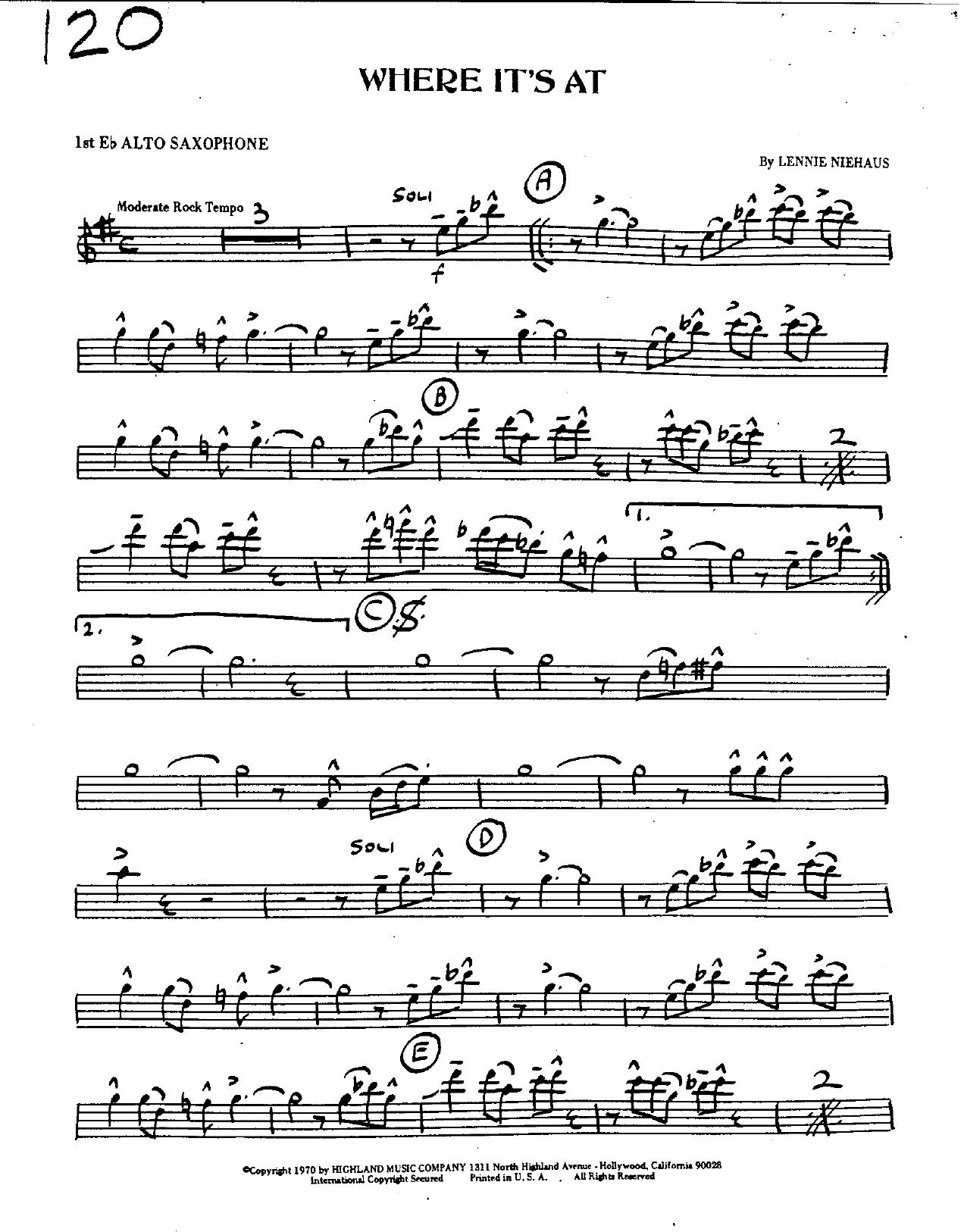
Where It's At (L.Niehaus) sheet music preview

Where It's At (L.Niehaus)

Composed by Lennie Niehaus

Arranged by Lennie Niehaus

  • Ensemble: Big Band
  • Pages: 33
  • Instruments (16): 1st Eb Alto Saxophone, 2nd Eb Alto Saxophone, 1st Bb Tenor Saxophone, 2nd Bb Tenor Saxophone, Eb Baritone Saxophone, 1st Bb Trumpet, 2nd Bb Trumpet, 3rd Bb Trumpet, 4th Bb Trumpet, 1st Trombone, 2nd Trombone, 3rd Trombone, 4th Trombone, Piano, Bass, Drums
  • Difficulty: medium
  • Content: Individual Parts
  • Format: PDF Download (Instant)
  • Price: $24.99

Lennie Niehaus’s "Where It's At" stands as a quintessential exemplar of West Coast cool jazz meeting the swinging drive of modern mainstream big band writing. Emerging from an era where Niehaus was a towering figure—both as a legendary alto saxophonist with the Stan Kenton Orchestra and as a prolific West Coast arranger—this composition captures the sophisticated harmonic language and pristine counterpoint that defined the California jazz scene of the 1950s and 60s. While maintaining deep roots in traditional bebop and blues-inflected structures, Niehaus infuses the writing with a refined architectural clarity that elevates it far beyond a standard stock arrangement. Driven by an infectious, buoyant medium-up swing groove, "Where It's At" projects an upbeat, confident persona characterized by sparkling brass counterlines and tight, harmonically rich saxophone solis. The chart opens with a snappy, rhythmic hook that immediately establishes the buoyant mood, utilizing clever interval leaps and crisp articulation. Niehaus weaves linear, modal-leaning harmonizations through the reed section, creating a crystalline texture where every voice moves with distinct melodic purpose. The emotional arc transitions smoothly from playful, driving swagger during the head statements to high-octane excitement as the chart builds toward its dynamic climax. True to Niehaus's signature compositional style, the arrangement showcases masterclass voice-leading and sectional independence. Rather than relying on heavy, monolithic block chords, Niehaus frequently employs polyphonic interludes and conversational interplay between the brass and saxophones. The shout chorus serves as a structural masterpiece, building tension incrementally through delayed resolutions and interlocking rhythmic figures before releasing into a roaring full-ensemble statement. Featured solo space allows competent improvisers to stretch out over standard changes, supported by crisp, non-intrusive background figures that maintain the momentum of the rhythm section without muddying the harmonic texture. Advanced high school ensembles, collegiate jazz orchestras, and professional community big bands will find this 16-instrument chart to be an exceptionally rewarding addition to their repertoire. The primary technical demands center on rhythmic precision, clean articulation of intricate bebop-infused eighth-note lines, and maintaining a relaxed yet driving time-feel at a brisk tempo. Because the scoring relies heavily on section blend and immaculate intonation rather than sheer volume, it acts as a phenomenal pedagogical tool for teaching stylistic uniformity. Directors will appreciate how naturally the chart sits on the instruments, allowing students to focus on swing phrasing, dynamic contrast, and stylistic authenticity. Executing "Where It's At" successfully requires meticulous attention to the stylistic tenets of West Coast swing. The rhythm section must anchor the ensemble with a light, propulsive ride cymbal pattern and an unhurried, buoyant bass line; avoid a heavy, "crunchy" big band style in favor of a cooler, more horizontal drive. The tempo should remain steady and forward-moving, ensuring that eighth notes are swung naturally with a light articulation rather than over-accentuated tonguing. In the saxophone section, the intricate soli passages demand absolute rhythmic unison and a unified concept of tone—bright yet controlled. Brass players should approach high register entrances with warmth, utilizing controlled vibrato and avoiding harsh, brassy blasts unless specifically indicated by dynamic accents. Rehearsals should initially focus on sectional balancing, isolating the inner-voice harmony in the saxophones and trombones to ensure the countermelodies project clearly beneath the primary thematic statements. Pay close attention to dynamic markings; the contrast between whispered background figures and roaring tutti bursts is what gives this Lennie Niehaus chart its remarkable dramatic shape. Q: What instruments and parts are included in this arrangement? A: This chart is scored for a standard 16-instrument big band lineup, comprising 2 alto saxophones, 2 tenor saxophones, 1 baritone saxophone, 4 trumpets, 4 trombones, and a standard rhythm section of piano, bass, and drums. Q: What is the difficulty level of "Where It's At"? A: This arrangement is graded as advanced-intermediate to advanced, making it ideal for strong high school bands, collegiate jazz ensembles, and professional community big bands seeking a substantive challenge. Q: What musical style and historical era does this piece represent? A: Composed and arranged by Lennie Niehaus, the piece embodies the sophisticated West Coast cool jazz and modern mainstream big band style of the 1950s and 1960s, balancing bebop harmonic sophistication with West Coast clarity. Q: What makes this particular Lennie Niehaus arrangement unique? A: Its uniqueness lies in Niehaus's signature linear counterpoint, transparent reed voicings, and conversational interplay between sections, which avoids heavy block-chord writing in favor of agile, polyphonic textures. Q: What is the recommended tempo and performance duration for this piece? A: The arrangement is designed to be performed at a brisk, driving medium-up swing tempo (approximately quarter note = 180-192 BPM), with a total performance duration of roughly 4 to 5 minutes depending on solo choruses.

Questions and answers

What is included in the Where It's At (L.Niehaus) PDF?
The verified current file contains individual parts across 33 pages.
How many instruments or parts are listed for Where It's At (L.Niehaus)?
The verified instrumentation list contains 16 entries for this Big Band arrangement.
Who is credited for Where It's At (L.Niehaus)?
Composer: Lennie Niehaus. Arranger: Lennie Niehaus.
What difficulty is listed for Where It's At (L.Niehaus)?
The verified difficulty level is medium.
Can I preview Where It's At (L.Niehaus) before buying?
Yes. The product page provides a preview generated from the current PDF file.
How is Where It's At (L.Niehaus) delivered?
After successful payment, the digital PDF is made available for download. The displayed price is $24.99.

Musicians Also Search For

Where It's At Lennie Niehaus PDFWhere It's At Lennie Niehaus sheet musicWhere It's At arranged by Lennie NiehausLennie Niehaus big band chartsLennie Niehaus jazz arrangements PDFWhere It's At Lennie Niehaus big band arrangementsWhere It's At big band arrangementsWhere It's At big band PDF downloadWhere It's At jazz sheet musicbig band sheet music downloadWhere It's At individual parts downloadWhere It's At sheet music PDFbuy Where It's At sheet musicdownload Where It's At PDFWhere It's At jazz chartsbest Lennie Niehaus big band arrangementsWhere It's At printable sheet musicbig band repertoire PDF

All arrangements by Lennie Niehaus All Lennie Niehaus sheet music