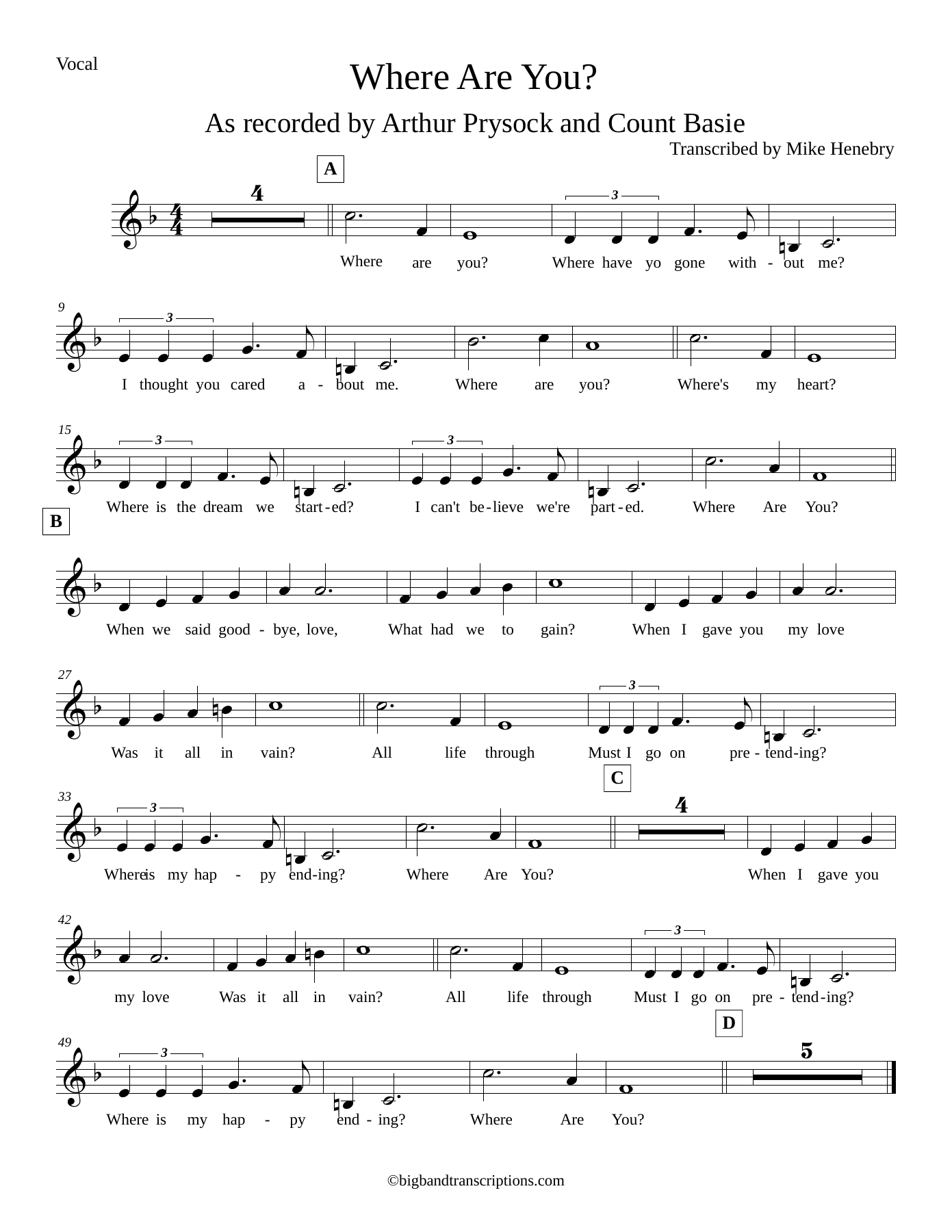
Where Are You (M.Henebry) C.Basie-A.Prysock voc sheet music preview

Where Are You (M.Henebry) C.Basie-A.Prysock voc

Composed by Matt Henebry

Arranged by Count Basie

  • Ensemble: Big Band
  • Style: Jazz Standard
  • Pages: 32
  • Instruments (18): Vocal, Alto Sax 1, Alto Sax 2, Tenor Sax 1, Tenor Sax 2, Baritone Sax, Trumpet in Bb 1, Trumpet in Bb 2, Trumpet in Bb 3, Trumpet in Bb 4, Trombone 1, Trombone 2, Trombone 3, Trombone 4, Piano, Guitar, Acoustic Bass, Drum Set
  • Difficulty: medium
  • Content: Individual Parts
  • Format: PDF Download (Instant)
  • Price: $24.99

"Where Are You (M.Henebry) C.Basie-A.Prysock voc" presents a captivating big band arrangement by the legendary Count Basie, featuring a vocal part suitable for a male or female vocalist in the style of Arthur Prysock. While the title suggests Matt Henebry as the composer, the jazz standard "Where Are You?" is more commonly attributed to the 1936 song by Harold Adamson and Jimmy McHugh, or the 1957 Frank Sinatra album of the same name. This arrangement likely reimagines a classic ballad through the distinctive lens of the Basie Orchestra, an ensemble that defined the Kansas City Swing style and became one of the most influential big bands in jazz history, known for its tight arrangements, rhythmic drive, and improvisation. Musically, this piece is best approached as a slow, expressive ballad, allowing ample space for the vocalist and the ensemble to convey a mood of poignant reflection or yearning. The Basie band's hallmark "economy of motion" and "relaxed, swinging feel" would imbue this ballad with a deep, unhurried groove, emphasizing lyrical phrasing over overt technical flash. Expect a rich, warm harmonic palette, likely in a comfortable key for the vocalist, designed to evoke a sense of introspection and emotional depth. The overall energy, though subdued, will possess the inherent swing and dynamic subtlety characteristic of Basie's "foot stomping 4/4 swing" and "unparalleled use of dynamic contrasts". Count Basie's arranging approach is renowned for its clarity, powerful yet simple foundations, and effective use of call-and-response patterns between sections. For a vocal feature, Basie's treatment would typically involve the vocalist carrying the primary melody, supported by lush, carefully voiced brass and reed pads. Expect characteristic Basie-isms such as understated piano fills, particularly from the leader himself, and perhaps subtle horn riffs that punctuate the vocal lines. While extended, complex harmonies are less common in traditional Basie charts, the voicings would be rich and full, providing a sophisticated backdrop. Soli sections might feature the saxophones or trombones echoing or complementing vocal phrases, building to a gently swelling shout chorus that provides emotional emphasis without overpowering the vocalist. Technical challenges would center on precise ensemble blend, dynamic control, and maintaining a consistent, relaxed tempo, rather than rapid-fire technical passages. The reward lies in performing a piece with profound emotional resonance and the timeless, irresistible swing that is the essence of the Basie sound. This arrangement is highly suitable for college, community, and professional big bands. High school bands with strong lead players and a mature understanding of ballad interpretation can also find it rewarding. Its focus on musicality, blend, and rhythmic subtlety makes it an excellent vehicle for developing ensemble cohesion and expressive performance, offering a departure from more overtly challenging, up-tempo charts. Approaching this ballad requires a deep focus on breath support and sustained phrasing, particularly for the vocalist and the lead alto saxophone, which often doubles or complements the vocal line. The tempo should be a relaxed, medium-slow swing, emphasizing a smooth, unhurried feel rather than a strict metronomic pulse. The rhythm section is paramount; the bass and drums must lay down a solid, yet flexible, foundation with a consistent 4/4 swing, while the piano and guitar provide sparse, tasteful comping, adhering to Basie's "economy of motion". Dynamic control is crucial: ensure brass and reed sections provide warm, supportive pads for the vocalist, swelling gently in soli sections and receding to allow the vocal to shine. Pay close attention to cut-offs and releases, aiming for unified, soft decays. Rehearsal tips include isolating the rhythm section to establish the core groove, then adding horns in sections to perfect blend and balance. Encourage musicians to listen across the ensemble, especially to the vocalist, to ensure their lines enhance, rather than compete with, the main melody. Q: What instruments are included in this arrangement? A: This arrangement is scored for a standard big band with 18 instruments, including Vocal, Alto Saxophone 1, Alto Saxophone 2, Tenor Saxophone 1, Tenor Saxophone 2, Baritone Saxophone, Trumpet 1, Trumpet 2, Trumpet 3, Trumpet 4, Trombone 1, Trombone 2, Trombone 3, Bass Trombone, Piano, Bass, Drums, and Guitar. Q: What is the difficulty level of this arrangement? A: This arrangement is rated as medium to medium-advanced. While not technically demanding in terms of speed, it requires mature musicality, precise ensemble blend, excellent dynamic control, and a sophisticated understanding of jazz ballad interpretation. Q: What is the musical style and historical context of this piece? A: This is a jazz standard arranged in the classic Count Basie big band style, characteristic of the Kansas City Swing era. It embodies the relaxed, blues-infused, and rhythm-driven sound that Basie's orchestra made famous from the 1930s onwards. Q: What makes this Count Basie arrangement unique? A: This arrangement showcases Count Basie's signature approach to vocal features, emphasizing a strong rhythmic foundation, lush horn voicings that support the vocalist, and a focus on emotional depth and swing over complex technical passages. It allows the band to demonstrate nuanced dynamics and expressive phrasing. Q: What is the typical performance duration and tempo for this arrangement? A: As a slow ballad, the typical performance duration would be approximately 4-5 minutes, depending on the number of solo choruses. The tempo should be a relaxed, medium-slow swing, allowing for expressive melodic and harmonic development.

Questions and answers

What is included in the Where Are You (M.Henebry) C.Basie-A.Prysock voc PDF?
The verified current file contains a conductor score and individual parts across 32 pages.
How many instruments or parts are listed for Where Are You (M.Henebry) C.Basie-A.Prysock voc?
The verified instrumentation list contains 18 entries for this Big Band arrangement.
Who is credited for Where Are You (M.Henebry) C.Basie-A.Prysock voc?
Composer: Matt Henebry. Arranger: Count Basie.
What difficulty is listed for Where Are You (M.Henebry) C.Basie-A.Prysock voc?
The verified difficulty level is medium.
What style is listed for Where Are You (M.Henebry) C.Basie-A.Prysock voc?
The catalog lists the style as Jazz Standard.
Can I preview Where Are You (M.Henebry) C.Basie-A.Prysock voc before buying?
Yes. The product page provides a preview generated from the current PDF file.
How is Where Are You (M.Henebry) C.Basie-A.Prysock voc delivered?
After successful payment, the digital PDF is made available for download. The displayed price is $24.99.

Musicians Also Search For

Where Are You Count Basie PDFWhere Are You Count Basie sheet musicWhere Are You arranged by Count BasieCount Basie big band chartsCount Basie jazz arrangements PDFWhere Are You Matt Henebry sheet musicWhere Are You Matt Henebry big band arrangementsMatt Henebry big band chartsWhere Are You big band arrangementsWhere Are You big band PDF downloadWhere Are You jazz sheet musicbig band sheet music downloadWhere Are You conductor score PDFWhere Are You individual parts downloadWhere Are You sheet music PDFWhere Are You Jazz Standard chartsJazz Standard big band arrangementsbuy Where Are You sheet musicdownload Where Are You PDFWhere Are You jazz chartsbest Count Basie big band arrangementsMatt Henebry arranged by Count BasieWhere Are You printable sheet musicbig band repertoire PDF

All arrangements by Count Basie All Matt Henebry sheet music