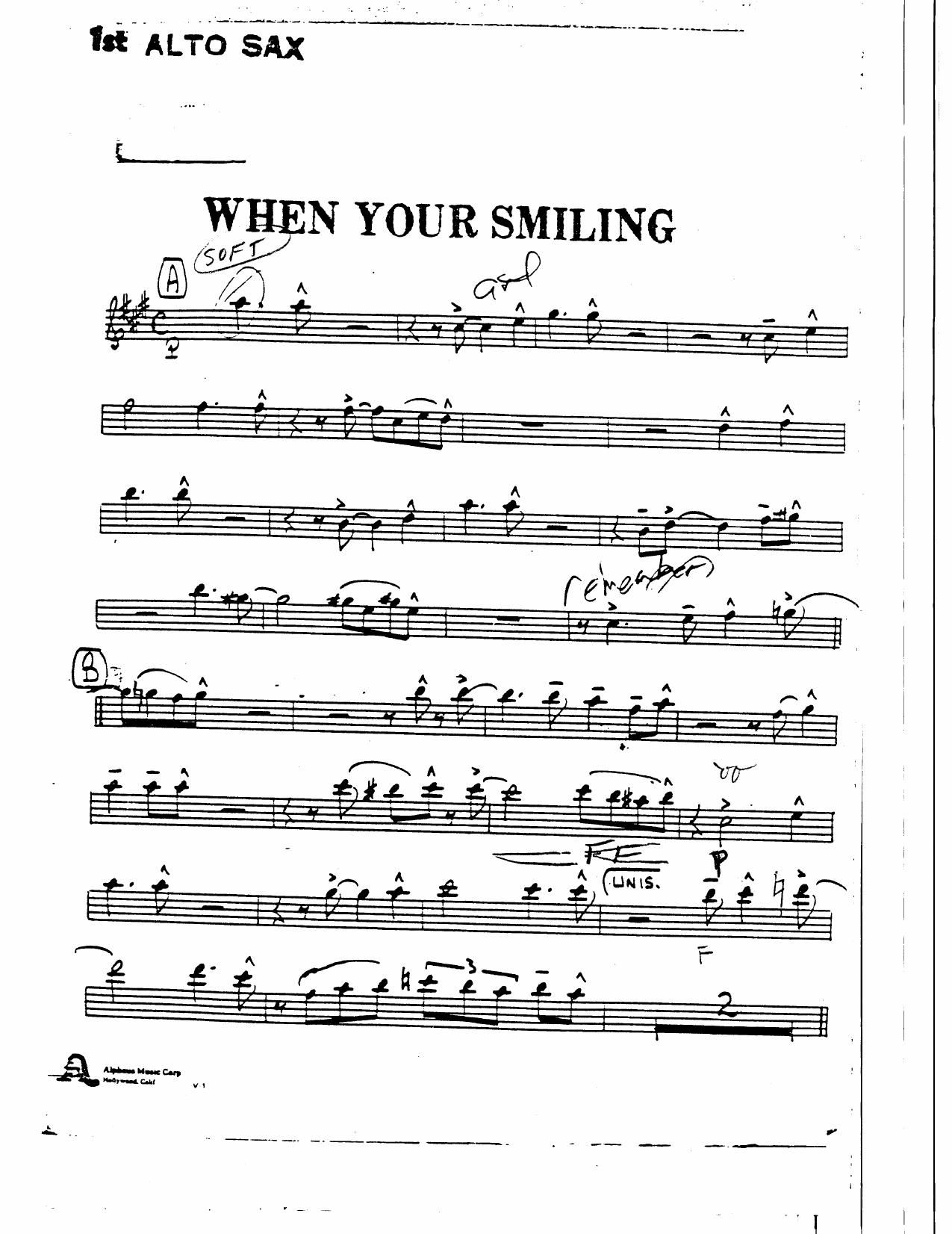
When You're Smiling
Composed by Larry Shay
Arranged by Unknown
- Ensemble: Big Band
- Style: Jazz Standard
- Pages: 54
- Instruments (17): 1st Alto Sax, 2nd Alto Sax, 1st Tenor Sax, 2nd Tenor Sax, Baritone Sax, 1st Trumpet, 2nd Trumpet, 3rd Trumpet, 4th Trumpet, 1st Trombone, 2nd Trombone, 3rd Trombone, 4th Trombone, Piano, Guitar, Bass, Drums
- Difficulty: advanced
- Content: Individual Parts
- Format: PDF Download (Instant)
- Price: $24.99
Penned in 1928 by Larry Shay, Mark Fisher, and Joe Goodwin, "When You're Smiling (The Whole World Smiles With You)" rapidly transcended its Tin Pan Alley origins to become a foundational vehicle for early jazz and swing interpreters. Immortalized most famously by Louis Armstrong in his 1929 recordings—and later revisited across generations by vocalists and instrumentalists alike—the tune embodies the unbridled optimism and infectious bounce of the late 1920s jazz age. Its durable, cyclical chord progression and inherently joyful melody have made it a timeless jam-session favorite, equally suited to dixieland romps and driving mid-century big band configurations. Radiating an upbeat, effervescent medium swing feel in 4/4 time, this chart captures the buoyant optimism of the classic swing era while maintaining a sophisticated harmonic palette. The arrangement opens with a bright, inviting intro that sets an energetic groove, quickly establishing a vibrant pocket driven by the rhythm section. Throughout the form, the mood shifts seamlessly between breezy, conversational ensemble interplay and high-energy, brass-heavy punctuations. The emotional arc is unapologetically uplifting, evoking the carefree atmosphere of a 1930s ballroom while offering enough dynamic contrast to keep both performers and listeners thoroughly engaged from the downbeat to the final tag. The scoring displays a masterful grasp of traditional big band architecture, utilizing rich, block-chord sax solis and punchy, interjecting brass figures that recall the classic writing styles of the mid-20th century. The arranger distributes melodic interest democratically across the ensemble; the reeds handle fluid, harmonized statements of the head, while the brass section provides crisp, articulate countermelodies and dynamic responses. A standout shout chorus near the climax builds tension through clever chromatic voice-leading and rhythmic syncopation before resolving into a triumphant, full-ensemble finale. Featured solo opportunities are thoughtfully integrated into the arrangement's middle stretch, providing ample space for a featured horn player to stretch out over standard swing changes. Advanced high school ensembles, collegiate jazz orchestras, and professional community big bands will find this chart to be an ideal programming choice. It strikes an optimal balance between accessibility and technical challenge, demanding crisp articulation, strong section blend, and an authentic feel for traditional swing phrasing without imposing excessive range demands on the lead trumpet. The 54-page complete score and parts offer a comprehensive, professionally styled roadmap that rewards meticulous rehearsal, making it a reliable crowd-pleaser for festival performances, formal concerts, and vintage-themed dances alike. Achieving an authentic performance of this arrangement requires careful attention to the classic medium swing feel, avoiding any tendency to rush the tempo. The rhythm section is the engine room: the drummer should maintain a steady, feather-light ride cymbal pattern with a crisp hi-hat closure on beats two and four, while the bass player walks a traditional four-to-the-bar line with strong quarter-note articulation. Wind players must prioritize uniform articulation across sections. Pay close attention to short, accented notes (staccatos) and ensure that swing eighth notes are properly interpreted with natural triplet phrasing rather than even eighths. Section leaders should unify dynamic swells, particularly during the transition into the shout chorus, ensuring the brass does not overpower the moving lines in the saxophones. Special care should be given to the dynamic contrast between ensemble backgrounds and featured solo sections; the rhythm section and horns must drop dynamic levels dynamically to support the soloist without losing forward momentum. Rehearsal should begin slowly with a metronome clicking on beats two and four to lock in the groove before opening up the tempo to performance speed. Q: What specific instruments and parts are included in this arrangement? A: The complete 54-page set is scored for a standard 17-instrument big band lineup, consisting of 5 saxophones (Alto 1, Alto 2, Tenor 1, Tenor 2, Baritone), 4 trumpets, 4 trombones, and a 4-piece rhythm section featuring piano, guitar, bass, and drums. Q: What is the difficulty level of this chart? A: This arrangement is graded as medium-advanced, making it an excellent fit for accomplished high school groups, collegiate jazz bands, and professional community ensembles that possess solid section control and a comfortable grasp of swing phrasing. Q: What historical style does this arrangement emulate? A: It draws heavily from the classic 1930s and 1940s swing tradition, channeling the joyful, driving energy popularized by big bands of the golden era while incorporating polished, tightly voiced ensemble writing. Q: What makes this particular arrangement unique? A: It features a clever balance of classic block-voiced sax solis and dynamic brass interjections, culminating in a brilliantly structured shout chorus that modernizes the 1928 Larry Shay standard without losing its vintage charm. Q: What is the recommended performance tempo and duration? A: The arrangement is designed for a comfortable medium-swing tempo—typically around 120 to 126 beats per minute—resulting in a performance duration of approximately 3 to 4 minutes depending on solo choruses.
Questions and answers
- What is included in the When You're Smiling PDF?
- The verified current file contains individual parts across 54 pages.
- How many instruments or parts are listed for When You're Smiling?
- The verified instrumentation list contains 17 entries for this Big Band arrangement.
- Who is credited for When You're Smiling?
- Composer: Larry Shay. Arranger: Unknown.
- What difficulty is listed for When You're Smiling?
- The verified difficulty level is advanced.
- What style is listed for When You're Smiling?
- The catalog lists the style as Jazz Standard.
- Can I preview When You're Smiling before buying?
- Yes. The product page provides a preview generated from the current PDF file.
- How is When You're Smiling delivered?
- After successful payment, the digital PDF is made available for download. The displayed price is $24.99.
Musicians Also Search For
When You're Smiling Unknown PDF • When You're Smiling Unknown sheet music • When You're Smiling arranged by Unknown • Unknown big band charts • Unknown jazz arrangements PDF • When You're Smiling Larry Shay sheet music • When You're Smiling Larry Shay big band arrangements • Larry Shay big band charts • When You're Smiling big band arrangements • When You're Smiling big band PDF download • When You're Smiling jazz sheet music • big band sheet music download • When You're Smiling individual parts download • When You're Smiling sheet music PDF • When You're Smiling Jazz Standard charts • Jazz Standard big band arrangements • buy When You're Smiling sheet music • download When You're Smiling PDF • When You're Smiling jazz charts • best Unknown big band arrangements • Larry Shay arranged by Unknown • When You're Smiling printable sheet music • big band repertoire PDF