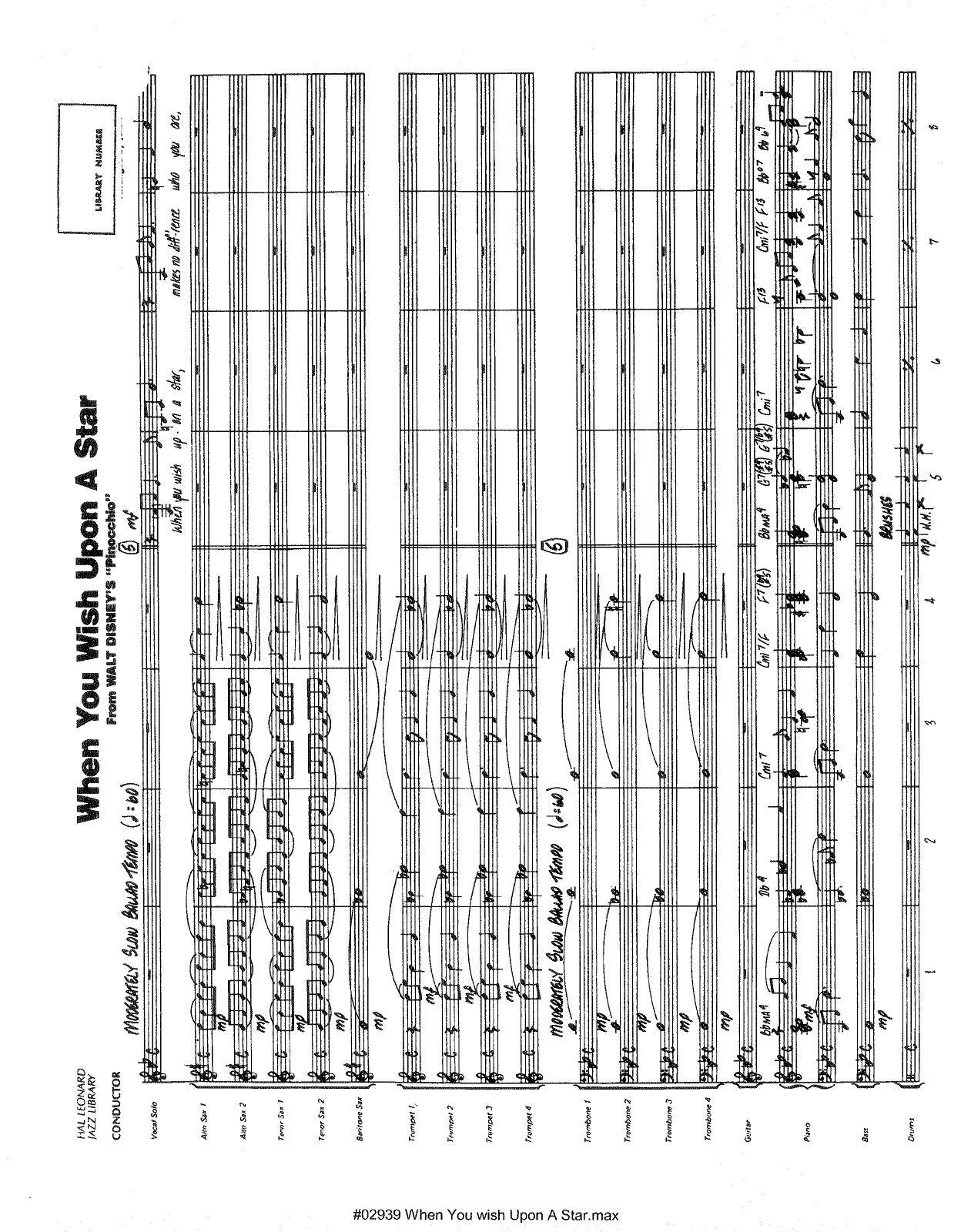
When You Wish Upon A Star (J.Nowak) voc
Composed by Jerry Nowak
Arranged by Frank Sinatra & Nelson Riddle
- Ensemble: Big Band
- Pages: 38
- Instruments (18): Vocal Solo, Alto Sax 1, Alto Sax 2, Tenor Sax 1, Tenor Sax 2, Baritone Sax, Trumpet 1, Trumpet 2, Trumpet 3, Trumpet 4, Trombone 1, Trombone 2, Trombone 3, Trombone 4, Guitar, Piano, Bass, Drums
- Difficulty: medium
- Content: Individual Parts
- Format: PDF Download (Instant)
- Price: $24.99
Originally penned by Leigh Harline and Ned Washington for Disney’s 1940 animated feature *Pinocchio*, "When You Wish Upon a Star" quickly transcended its cinematic origins to become one of the most cherished entries in the Great American Songbook. While countless vocalists have interpreted its timeless melody, the definitive mid-century jazz vocal treatment is inextricably linked to the legendary partnership between Frank Sinatra and arranger Nelson Riddle. Riddle’s signature lush string-writing, sophisticated harmonic extensions, and clever counter-melodies transformed standard pop tunes into cinematic masterpieces. This adaptation captures that exact sophisticated aesthetic, reimagining the beloved Disney classic through the lens of a classic 1950s Capitol Records swing session. Unfolding as a warm, flowing ballad with a gentle, floating swing undercurrent, this arrangement opens with an atmospheric, rubato introduction before settling into a relaxed, pulsing 4/4 meter. The emotional arc moves from nostalgic wonder to sweeping, cinematic grandeur, evoking the sophisticated nightlife of mid-century Las Vegas or a smoky Los Angeles studio. Riddle’s scoring relies heavily on rich, dense chord voicings in the woodwinds and muted brass, creating a pillow of sound that supports the vocalist without ever crowding the sonic space. Subtle chromatic passing tones and unexpected modal shifts elevate the harmonic palette far beyond the simple children's tune format, offering a masterclass in vocal accompaniment arranging. The vocal lead sits firmly at the center of the texture, driving the narrative while the instrumentalists act as active conversational partners. The saxophone section—featuring parts for alto, tenor, and baritone—frequently utilizes warm, breathy subtones and rich block harmonies that echo Riddle’s trademark woodwind writing. Brass entries are handled with utmost delicacy, utilizing cup and straight mutes to maintain an intimate atmosphere during the verses before expanding into a rich, full-ensemble glow during the transitional bridges. Though designed primarily to showcase a capable front-person, the arrangement features intricate background figures and delicate counter-lines that demand attentive listening and refined blend from every section in the band. Advanced high school, collegiate, and professional big bands will find this chart to be an invaluable addition to their library, particularly for concerts featuring a guest vocalist. While the individual technical demands on range are moderate, the true challenge lies in the stylistic execution: maintaining an immaculate legato feel, balancing delicate dynamic shifts, and capturing the authentic, unhurried swing phrasing of the Riddle era. Performing this piece rewards the ensemble with a profound exercise in ensemble listening, tonal warmth, and expressive dynamic control, making it an undeniable highlight of any traditional jazz vocal program. Achieving the authentic Nelson Riddle sound requires strict attention to a relaxed, behind-the-beat swing feel, even at slower ballad tempos. The conductor should establish a flowing, unhurried pulse around 72 to 80 BPM, ensuring that eighth notes are gently rounded rather than rigidly dotted. Key technical challenges involve blend and intonation within the saxophones and muted brass during exposed, quiet passages. Players must exercise extreme dynamic restraint, keeping the background figures at a true accompaniment volume (mezzo-piano or softer) so the vocal line remains crystal clear. Watch out for subtle modulations and chromatic shifts in the middle section; tuning chords carefully will prevent the lush Riddle harmonies from sounding muddy. Rehearsals should begin with the rhythm section establishing a warm, floating foundation—particularly the piano and bass, whose interconnected movement drives the subtle harmonic shifts. Horn players should practice their entrances with soft, breathy articulation, avoiding any harsh tongue attacks. Encourage the vocalist to lean into the lyrical phrasing with conversational freedom, while the band locks tightly into the micro-groove beneath them. Q: What specific instruments and parts are included in this arrangement? A: This chart is scored for an 11-instrument ensemble comprising a vocal lead, alto saxophone, tenor saxophone, baritone saxophone, a full trumpet section, and accompanying rhythm section parts. Q: What is the difficulty level of this arrangement? A: It is rated at an intermediate-to-advanced level, primarily due to the intense focus required for stylistic phrasing, dynamic control, and ensemble blend rather than extreme technical speed. Q: What is the historical style and context of this chart? A: The arrangement mirrors the sophisticated, cinematic jazz vocal style pioneered by arranger Nelson Riddle for Frank Sinatra during the golden era of Capitol Records in the 1950s. Q: What makes this specific arrangement unique? A: It transforms a classic Disney melody into a sophisticated jazz standard using lush, extended chord voicings, delicate muted brass textures, and intricate woodwind counter-melodies reminiscent of classic Riddle scoring. Q: What is the performance duration and recommended tempo? A: The arrangement runs approximately 3.5 to 4 minutes and is best performed at a relaxed, flowing ballad tempo with a gentle swing feel around 76 BPM.
Questions and answers
- What is included in the When You Wish Upon A Star (J.Nowak) voc PDF?
- The verified current file contains a conductor score and individual parts across 38 pages.
- How many instruments or parts are listed for When You Wish Upon A Star (J.Nowak) voc?
- The verified instrumentation list contains 18 entries for this Big Band arrangement.
- Who is credited for When You Wish Upon A Star (J.Nowak) voc?
- Composer: Jerry Nowak. Arranger: Frank Sinatra & Nelson Riddle.
- What difficulty is listed for When You Wish Upon A Star (J.Nowak) voc?
- The verified difficulty level is medium.
- Can I preview When You Wish Upon A Star (J.Nowak) voc before buying?
- Yes. The product page provides a preview generated from the current PDF file.
- How is When You Wish Upon A Star (J.Nowak) voc delivered?
- After successful payment, the digital PDF is made available for download. The displayed price is $24.99.
Musicians Also Search For
When You Wish Upon A Star Frank Sinatra & Nelson Riddle PDF • When You Wish Upon A Star Frank Sinatra & Nelson Riddle sheet music • When You Wish Upon A Star arranged by Frank Sinatra & Nelson Riddle • Frank Sinatra & Nelson Riddle big band charts • Frank Sinatra & Nelson Riddle jazz arrangements PDF • When You Wish Upon A Star Jerry Nowak sheet music • When You Wish Upon A Star Jerry Nowak big band arrangements • Jerry Nowak big band charts • When You Wish Upon A Star big band arrangements • When You Wish Upon A Star big band PDF download • When You Wish Upon A Star jazz sheet music • big band sheet music download • When You Wish Upon A Star conductor score PDF • When You Wish Upon A Star individual parts download • When You Wish Upon A Star sheet music PDF • buy When You Wish Upon A Star sheet music • download When You Wish Upon A Star PDF • When You Wish Upon A Star jazz charts • best Frank Sinatra & Nelson Riddle big band arrangements • Jerry Nowak arranged by Frank Sinatra & Nelson Riddle • When You Wish Upon A Star printable sheet music • big band repertoire PDF