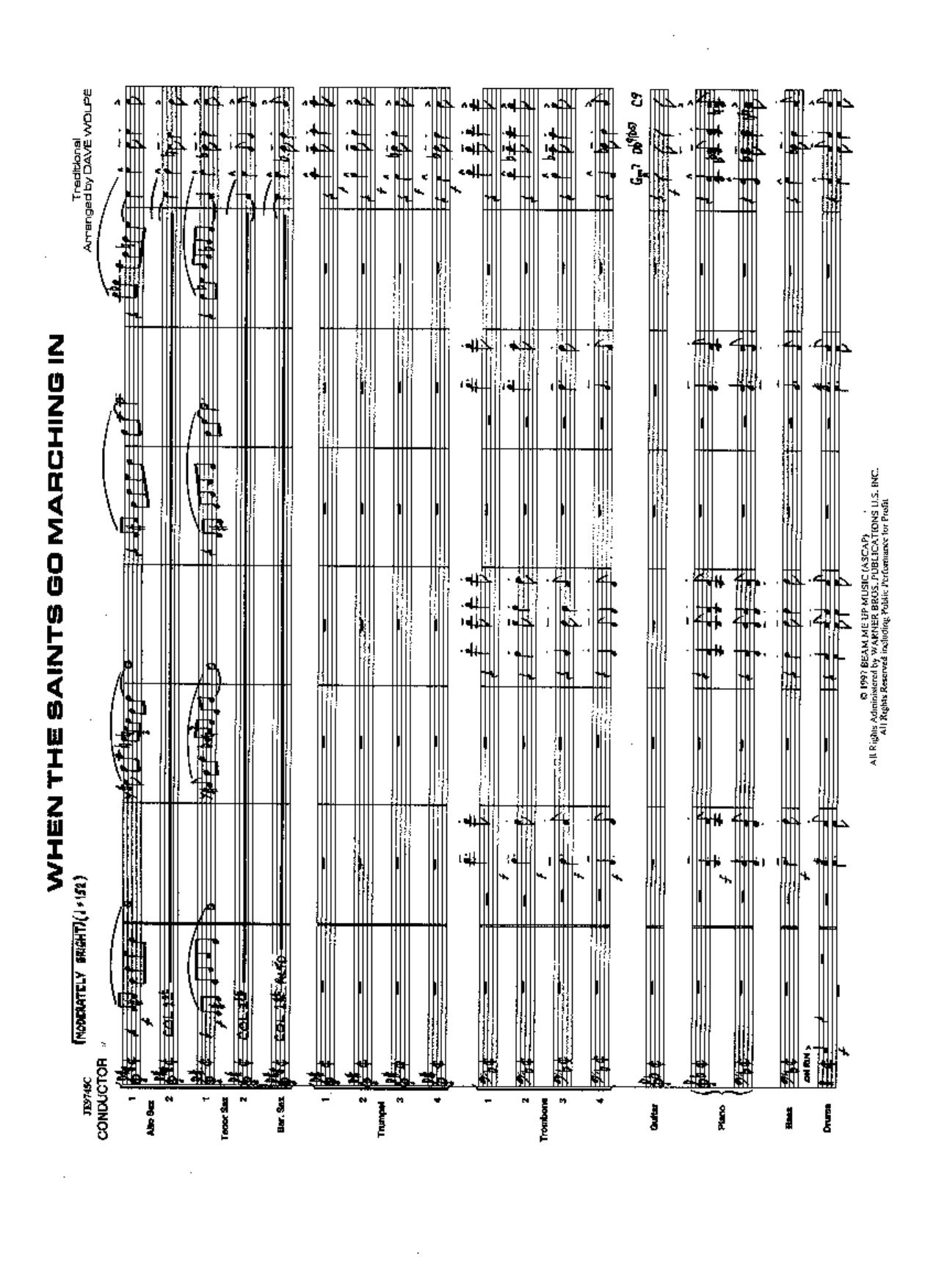
When The Saints Go Marching In (D.Wolpe)
Composed by Traditional
Arranged by Dave Wolpe
- Ensemble: Big Band
- Pages: 56
- Instruments (17): 1st Eb Alto Saxophone, 2nd Eb Alto Saxophone, 1st Bb Tenor Saxophone, 2nd Bb Tenor Saxophone, Eb Baritone Saxophone, 1st Bb Trumpet, 2nd Bb Trumpet, 3rd Bb Trumpet, 4th Bb Trumpet, 1st Trombone, 2nd Trombone, 3rd Trombone, Bass Trombone, Piano, Guitar, Bass, Drums
- Difficulty: advanced
- Content: Individual Parts
- Format: PDF Download (Instant)
- Price: $24.99
Rooted in the rich soil of early New Orleans jazz and spiritual tradition, "When The Saints Go Marching In" evolved from a sacred hymn into one of the most recognizable secular jazz anthems of the twentieth century. While its exact origins remain murky—blending traditional spiritual motifs with late-nineteenth-century funeral march customs—the tune was immortalized globally by Louis Armstrong and His All-Stars in 1938. It quickly became an indispensable warhorse of traditional Dixieland repertoire. Over the decades, the standard has transitioned from small-group polyphonic romps to vibrant big band charts, symbolizing the ultimate celebratory expression in jazz performance. Dave Wolpe’s masterful big band adaptation breathes fresh life into the traditional melody by setting it in a driving, high-energy medium-bright swing groove (approx. 152 BPM). Opening with a tantalizingly understated brass statement, the arrangement quickly builds momentum through punchy sectional interplay and rich, contemporary extended harmonies. Wolpe eschews predictable predictability by injecting unexpected harmonic turns, sophisticated chromatic passing tones, and a robust, swinging rhythm section foundation that propels the ensemble forward. The mood shifts effortlessly from playful irreverence to roaring, unbridled excitement, evoking the festive atmosphere of a second-line parade filtered through a modern jazz lens. Throughout the 56-page score, the melodic weight is cleverly distributed across the entire ensemble. The saxophones introduce crisp, harmonized lines before handing off to soaring brass countermelodies. A standout feature of this chart is the expertly crafted sax soli, which demands tight intonation and nimble articulation, leading seamlessly into a powerhouse shout chorus designed to push the brass section to its dynamic peak. While rhythm changes and syncopated figures require precision, Wolpe provides ample breathing room for featured improvised solos—typically allotted to trumpet and tenor saxophone—allowing soloists to stretch out over standard blues-infused changes. Advanced high school, collegiate, and community jazz ensembles will find this arrangement an ideal centerpiece for festival programs or concert sets. It strikes a rare balance: accessible enough for developing players to grasp the fundamental swing vernacular, yet sophisticated enough—thanks to Wolpe’s clever scoring and dynamic contrast—to challenge seasoned musicians. The chart rewards meticulous attention to articulation, section balance, and stylistic unity, ensuring that audiences familiar with the basic melody will be thoroughly captivated by this fresh, swinging reimagining. Executing Dave Wolpe’s arrangement of "When The Saints Go Marching In" successfully requires a disciplined approach to swing articulation and dynamic contrast. The tempo should sit comfortably at a medium-bright swing (around 152 BPM); pushing it too fast will muddy the intricate inner voicings of the brass. Rhythm section players must lock in tightly: the drummer should maintain a crisp ride cymbal pattern with a feathered bass drum, while the bass player walks a strong, quarter-note pulse that anchors the ensemble's harmonic shifts. Horn players need to pay close attention to short, accented notes (staccatos) versus connected lines, ensuring that eighth notes are properly swung rather than straight or overly dotted. Special stylistic techniques play a crucial role here. Brass players should utilize controlled falls and doits sparingly to accent the celebratory shout chorus without sacrificing tone quality. Rehearsals should begin section by section, isolating the saxophone soli to ensure flawless blend and articulation before integrating the full ensemble. Finally, rehearse the dynamic dips prior to the final chorus; the sudden drop in volume before the ultimate crescendo creates the high-impact dramatic tension that defines Wolpe’s signature arranging style. Q: What instrumentation and parts are included in this arrangement? A: This 56-page big band publication is scored for a standard 16-instrument ensemble, including Alto Sax 1, Alto Sax 2, Tenor Sax 1, Tenor Sax 2, Baritone Sax, 4 Trumpets, 4 Trombones, Piano, Guitar, Bass, and Drums. Q: What is the difficulty level of this Dave Wolpe arrangement? A: This chart is graded as medium to medium-advanced, making it exceptionally well-suited for high school extension groups, collegiate bands, and community jazz orchestras looking for solid stylistic training. Q: What musical style and historical context does this chart represent? A: It is a dynamic, modern big band swing interpretation of a foundational New Orleans jazz standard originally made famous globally by Louis Armstrong during the swing era and beyond. Q: What makes this specific arrangement unique compared to other versions? A: Wolpe elevates a simple traditional tune by incorporating sophisticated extended harmonies, a demanding saxophone soli, clever sectional counterpoint, and a powerhouse shout chorus. Q: What is the recommended performance duration and tempo for this piece? A: The arrangement runs approximately 3 to 4 minutes and is best performed at a driving medium-bright swing tempo around 152 beats per minute.
Questions and answers
- What is included in the When The Saints Go Marching In (D.Wolpe) PDF?
- The verified current file contains a conductor score and individual parts across 56 pages.
- How many instruments or parts are listed for When The Saints Go Marching In (D.Wolpe)?
- The verified instrumentation list contains 17 entries for this Big Band arrangement.
- Who is credited for When The Saints Go Marching In (D.Wolpe)?
- Composer: Traditional. Arranger: Dave Wolpe.
- What difficulty is listed for When The Saints Go Marching In (D.Wolpe)?
- The verified difficulty level is advanced.
- Can I preview When The Saints Go Marching In (D.Wolpe) before buying?
- Yes. The product page provides a preview generated from the current PDF file.
- How is When The Saints Go Marching In (D.Wolpe) delivered?
- After successful payment, the digital PDF is made available for download. The displayed price is $24.99.
Musicians Also Search For
When The Saints Go Marching In Dave Wolpe PDF • When The Saints Go Marching In Dave Wolpe sheet music • When The Saints Go Marching In arranged by Dave Wolpe • Dave Wolpe big band charts • Dave Wolpe jazz arrangements PDF • When The Saints Go Marching In Traditional sheet music • When The Saints Go Marching In Traditional big band arrangements • Traditional big band charts • When The Saints Go Marching In big band arrangements • When The Saints Go Marching In big band PDF download • When The Saints Go Marching In jazz sheet music • big band sheet music download • When The Saints Go Marching In conductor score PDF • When The Saints Go Marching In individual parts download • When The Saints Go Marching In sheet music PDF • buy When The Saints Go Marching In sheet music • download When The Saints Go Marching In PDF • When The Saints Go Marching In jazz charts • best Dave Wolpe big band arrangements • Traditional arranged by Dave Wolpe • When The Saints Go Marching In printable sheet music • big band repertoire PDF