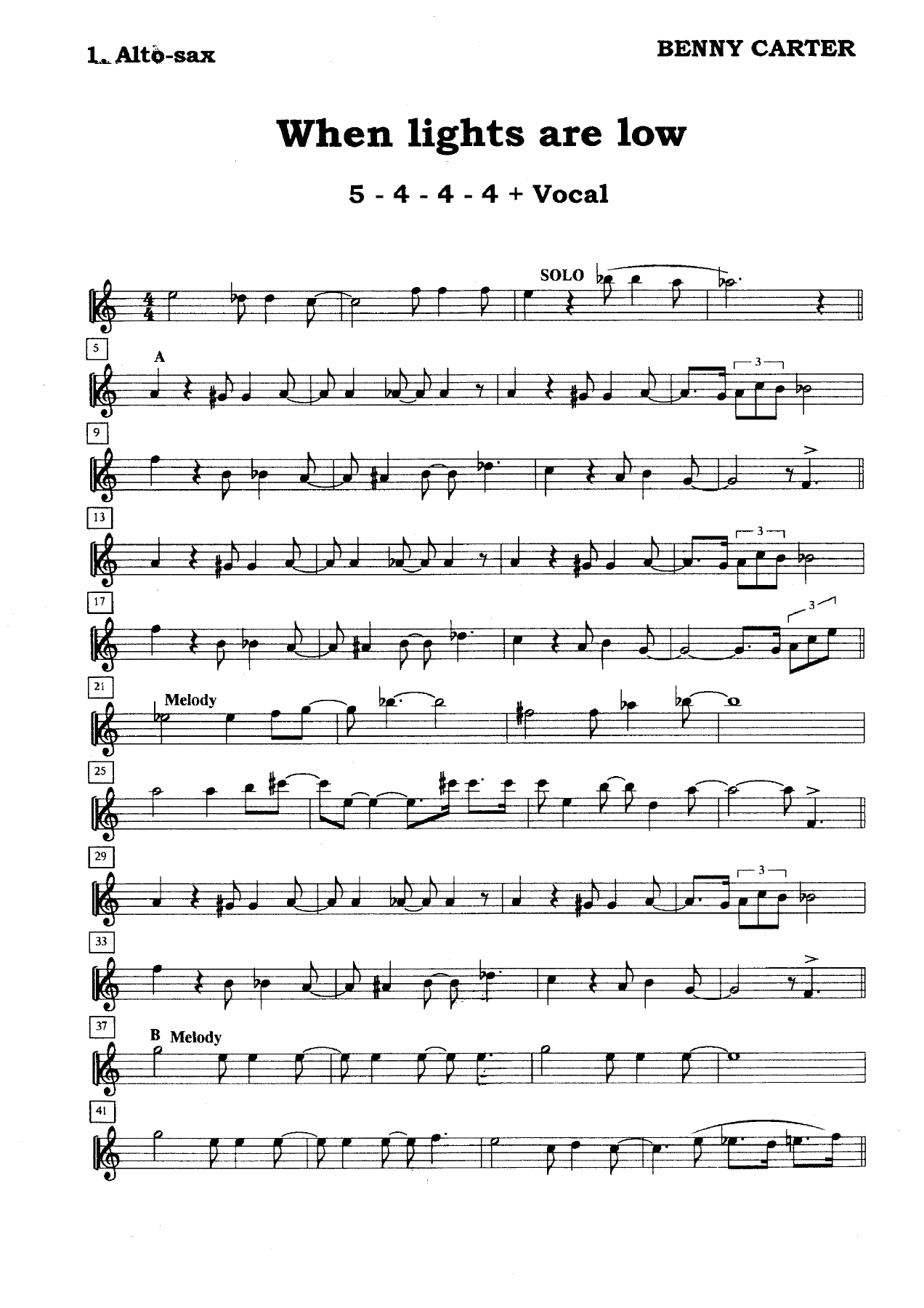
When Lights Are Low (B.Carter) Voc sheet music preview

When Lights Are Low (B.Carter) Voc

Composed by Benny Carter

Arranged by Benny Carter

  • Ensemble: Big Band
  • Style: Jazz Standard
  • Pages: 81
  • Instruments (17): Alto Saxophone 1, Alto Saxophone 2, Tenor Saxophone 1, Tenor Saxophone 2, Baritone Saxophone, Trumpet 1, Trumpet 2, Trumpet 3, Trumpet 4, Trombone 1, Trombone 2, Trombone 3, Bass Trombone, Guitar, Piano, Bass, Drums
  • Difficulty: advanced
  • Content: Individual Parts
  • Format: PDF Download (Instant)
  • Price: $24.99

"When Lights Are Low," penned by the legendary Benny Carter in 1936, stands as a quintessential jazz standard, emblematic of the Swing Era's melodic sophistication and harmonic richness. Emerging from a period when big bands dominated the popular music landscape, this composition quickly became a favorite for its elegant, flowing melody and accessible, yet nuanced, harmonic progression. Carter himself, a prodigious multi-instrumentalist and arranger, recorded it numerous times, solidifying its place in the jazz canon. Its enduring appeal lies in its timeless beauty, offering a perfect canvas for improvisation and lush big band orchestration, embodying the refined artistry that characterized the best of 1930s jazz. This arrangement of "When Lights Are Low" presents the piece as a medium swing vocal feature, set in the key of F major, radiating a warm, inviting, and subtly romantic mood. The tempo is comfortably relaxed, encouraging a smooth, unhurried delivery of the melody and a relaxed, yet propulsive, swing feel. The overall energy is one of sophisticated charm, allowing the vocal soloist to shine while being enveloped by Carter's characteristic orchestral textures. The arrangement opens with a classic big band introduction, establishing the mood before the vocalist enters with the iconic melody. Benny Carter's genius as an arranger is unmistakably evident throughout this chart. His signature voicings, renowned for their clarity and warmth, are on full display, particularly in the saxophone section soli passages that interweave with the vocal line. Expect meticulously crafted counter-melodies and rich harmonic pads that support the soloist without ever overpowering. Carter masterfully employs call-and-response figures between sections, creating dynamic interplay. While the vocal takes center stage for the initial statement and subsequent choruses, there are opportunities for instrumental solos, typically featuring a tenor saxophone or trumpet, allowing for further improvisational expression within Carter's carefully constructed framework. The arrangement builds subtly, culminating in a satisfying, full-band statement before a gentle close. Performing this arrangement is a deeply rewarding experience for a big band. The primary technical challenge lies in achieving the precise balance and blend inherent in Carter's voicings, particularly in the saxophone section's soli work, which demands excellent intonation and unified articulation. The rhythm section must maintain a consistent, relaxed medium swing feel, providing a solid yet supple foundation. This chart is ideally suited for college-level jazz ensembles, advanced community big bands, and professional groups seeking to perform an authentic and beautifully crafted Swing Era vocal feature. Its educational value is immense, offering insights into the melodic and harmonic language of a jazz master and the art of big band arranging. Conductors should emphasize a relaxed, medium swing feel from the outset, ensuring the rhythm section lays down a steady, unhurried groove. Articulation is key; saxophones and brass should strive for a unified, legato approach on sustained notes, with precise, light accents on swing eighths. Pay close attention to dynamics, particularly in the ensemble support for the vocalist, ensuring the band breathes with the soloist. There are no special mute requirements beyond standard brass mutes (straight, cup, harmon, plunger) which should be used judiciously for color. Rehearsal time should focus on balancing the intricate inner voicings and achieving seamless transitions between vocal and instrumental sections, ensuring the melody always remains paramount. Q: What instruments are included in this arrangement? A: This arrangement is scored for a standard 17-piece big band, including five saxophones (Alto 1, Alto 2, Tenor 1, Tenor 2, Baritone), four trumpets, four trombones, and a four-piece rhythm section (piano, bass, drums, guitar), plus a vocal soloist part. Q: What is the difficulty level of "When Lights Are Low (B.Carter) Voc"? A: This arrangement is rated as medium-advanced. It requires proficient instrumentalists capable of navigating intricate voicings, precise articulation, and a nuanced understanding of the medium swing style. Q: What is the musical style and historical context of this piece? A: "When Lights Are Low" is a classic jazz standard from the Swing Era, composed by Benny Carter in 1936. This arrangement captures the sophisticated, melodic big band sound characteristic of that period, featuring a vocal soloist. Q: What makes this particular arrangement unique or distinctive? A: This arrangement is unique because it is an authentic Benny Carter original chart, showcasing his unparalleled skill in big band orchestration. It features his signature warm voicings, elegant counter-melodies, and masterful balance between the vocal and instrumental sections. Q: What is the typical performance duration and tempo for this arrangement? A: The typical performance duration for this arrangement is approximately 3-4 minutes, depending on the length of any improvised solos. It is performed at a relaxed, medium swing tempo, generally around 120-130 beats per minute.

Musicians Also Search For

When Lights Are Low Benny Carter PDFWhen Lights Are Low Benny Carter sheet musicWhen Lights Are Low arranged by Benny CarterBenny Carter big band chartsBenny Carter jazz arrangements PDFWhen Lights Are Low Benny Carter big band arrangementWhen Lights Are Low big band arrangementWhen Lights Are Low big band PDF downloadWhen Lights Are Low jazz ensemble sheet musicbig band sheet music instant downloadWhen Lights Are Low individual parts downloadWhen Lights Are Low sheet music with partsWhen Lights Are Low Jazz Standard chartJazz Standard big band arrangementsbuy When Lights Are Low sheet music onlinedownload When Lights Are Low PDFWhen Lights Are Low jazz chartbest Benny Carter big band arrangementsWhen Lights Are Low printable sheet musicbig band repertoire PDF

All arrangements by Benny Carter All Benny Carter sheet music