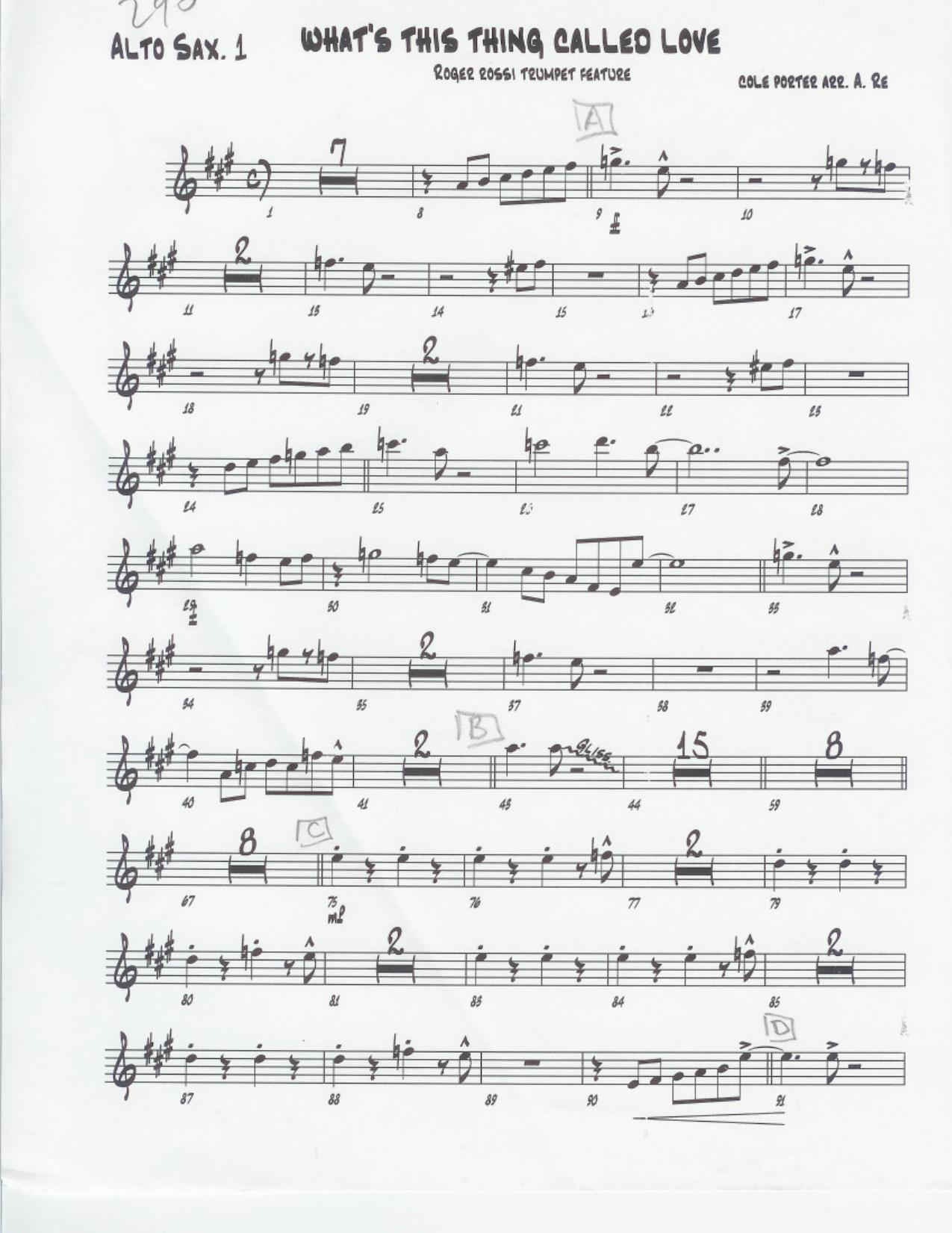
What's This Thing Called Love (A.Re)
Composed by Cole Porter
Arranged by A.Re
- Ensemble: Big Band
- Style: Jazz Standard
- Pages: 39
- Instruments (16): Alto Sax. 1, Alto Sax. 2, Tenor Sax. 1, Tenor Sax. 2, Baritone Sax., Roger Rossi (Trumpet Feature), Trumpet in Bb 1, Trumpet in Bb 3, Trumpet in Bb 4, Trombone 1, Trombone 2, Trombone 3, Bass Trombone, Piano, Bass, Drum Set 2
- Difficulty: medium
- Content: Individual Parts
- Format: PDF Download (Instant)
- Price: $24.99
Cole Porter’s timeless 1929 standard "What Is This Thing Called Love?" occupies a revered position in the jazz canon, having transitioned from the Broadway musical *Wake Up and Dream* into one of the most frequently explored vehicles for harmonic improvisation in jazz history. Built upon a deceptively sophisticated minor-key framework with characteristically ingenious chromatic voice-leading, the composition achieved legendary status during the bebop era, where icons like Clifford Brown, Sonny Rollins, and Lennie Tristano utilized its cyclical changes to push the boundaries of modern phrasing and harmonic extension. In this compelling big band adaptation by arranger A.Re, the standard is reimagined through a lens that balances hard-driving modern swing vitality with a sophisticated contemporary harmonic palette. Set at a brisk, communicative medium-up tempo, the arrangement crackles with an urbane energy, evoking the smoky sophistication of a late-night New York jazz club while maintaining the explosive, brass-heavy punch characteristic of advanced large-ensemble writing. The mood shifts masterfully between tight, introspective harmonic suspensions in the muted brass and thunderous, wide-open tutti explosions that showcase the sheer kinetic power of the 15-piece instrumentation. A.Re’s distinctive approach shines through meticulous attention to dynamic contrast and interlocking counterpoint between the saxophone and brass sections. The arrangement features a tightly woven, harmonically rich sax soli that pays homage to classic bebop vocabulary while integrating contemporary extensions and altered dominants. Lush chordal voicings in the lower reeds provide a warm foundation, contrasting sharply with high-flying, articulate trumpet lines and trombone glissandi. A towering shout chorus builds organically from a subdued, rhythmic vamp, driving the ensemble toward a triumphant, high-energy climax that utilizes clever metric displacement and smart syncopation to keep both performers and listeners on the edge of their seats. Designed with advanced ensembles in mind, this chart is exceptionally well-suited for collegiate jazz orchestras, premier high school honor bands, and professional community big bands looking to challenge their section cohesion and articulation. The lead trumpet player will encounter sustained upper-register demands, while the rhythm section—particularly the drummer—must navigate shifting textural landscapes that demand both sensitive brushwork during thematic statements and commanding ride-cymbal propulsion behind the soloists. Offering dedicated space for improvised solos over the traditional form, this 39-page masterwork provides a rewarding, intellectually stimulating centerpiece for any serious contemporary jazz concert program. Conductors should approach this arrangement with a sharp focus on dynamic control and articulation uniformity across sections. The primary technical challenge lies in executing the rapid-fire bebop-inflected lines cleanly at a brisk tempo without sacrificing the relaxed, forward-moving swing feel. Ensure that eighth notes are properly swung, emphasizing the upbeats while keeping tongue strokes light and articulate. The brass section should utilize cup mutes and harmon mutes (stem out where indicated) to achieve the desired dark, smoky colors in the opening choruses, transitioning to open bell tones with controlled vibrato for the shout chorus. Pay careful attention to the dynamic markings: sudden subitos and crescendo wedges are vital for building the dramatic tension inherent in A.Re’s scoring. In rehearsal, practice the sax soli slowly with a metronome clicking on beats two and four before pushing up to tempo, ensuring every chromatic passing tone speaks clearly. The rhythm section should lock in tightly; the bassist needs to walk a strong, quarter-note pulse that anchors the chromatic harmonic shifts, while the drummer provides crisp conversational comping without cluttering the ensemble's collective breathing spaces. Q: What specific instruments and parts are included in this 15-instrument big band arrangement? A: The instrumentation comprises a 15-piece layout featuring Alto Saxophone 1, Alto Saxophone 2, Tenor Saxophone 1, Tenor Saxophone 2, and Baritone Saxophone, alongside a standard brass and rhythm section framework. Q: What is the difficulty level of this arrangement? A: This arrangement is graded as advanced, making it best suited for collegiate jazz ensembles, top-tier high school bands, and professional community big bands with strong section players and confident improvisers. Q: What is the historical style and context of this piece? A: It is a modern big band interpretation of Cole Porter's 1929 jazz standard, heavily inspired by the harmonic sophistication and driving momentum of the bebop and post-bop eras. Q: What makes A.Re's arrangement of this tune unique? A: It stands out through its clever integration of contemporary extended harmonies, a meticulously crafted saxophone soli, and a powerful, dynamically shifting shout chorus that breathes new life into the traditional form. Q: What is the recommended performance tempo and approximate duration? A: The arrangement is set at an energetic medium-up swing tempo (approximately quarter note = 208), yielding a performance duration of roughly 4 to 5 minutes depending on solo rotations.
Questions and answers
- What is included in the What's This Thing Called Love (A.Re) PDF?
- The verified current file contains individual parts across 39 pages.
- How many instruments or parts are listed for What's This Thing Called Love (A.Re)?
- The verified instrumentation list contains 16 entries for this Big Band arrangement.
- Who is credited for What's This Thing Called Love (A.Re)?
- Composer: Cole Porter. Arranger: A.Re.
- What difficulty is listed for What's This Thing Called Love (A.Re)?
- The verified difficulty level is medium.
- What style is listed for What's This Thing Called Love (A.Re)?
- The catalog lists the style as Jazz Standard.
- Can I preview What's This Thing Called Love (A.Re) before buying?
- Yes. The product page provides a preview generated from the current PDF file.
- How is What's This Thing Called Love (A.Re) delivered?
- After successful payment, the digital PDF is made available for download. The displayed price is $24.99.
Musicians Also Search For
What's This Thing Called Love A.Re PDF • What's This Thing Called Love A.Re sheet music • What's This Thing Called Love arranged by A.Re • A.Re big band charts • A.Re jazz arrangements PDF • What's This Thing Called Love Cole Porter sheet music • What's This Thing Called Love Cole Porter big band arrangements • Cole Porter big band charts • What's This Thing Called Love big band arrangements • What's This Thing Called Love big band PDF download • What's This Thing Called Love jazz sheet music • big band sheet music download • What's This Thing Called Love individual parts download • What's This Thing Called Love sheet music PDF • What's This Thing Called Love Jazz Standard charts • Jazz Standard big band arrangements • buy What's This Thing Called Love sheet music • download What's This Thing Called Love PDF • What's This Thing Called Love jazz charts • best A.Re big band arrangements • Cole Porter arranged by A.Re • What's This Thing Called Love printable sheet music • big band repertoire PDF