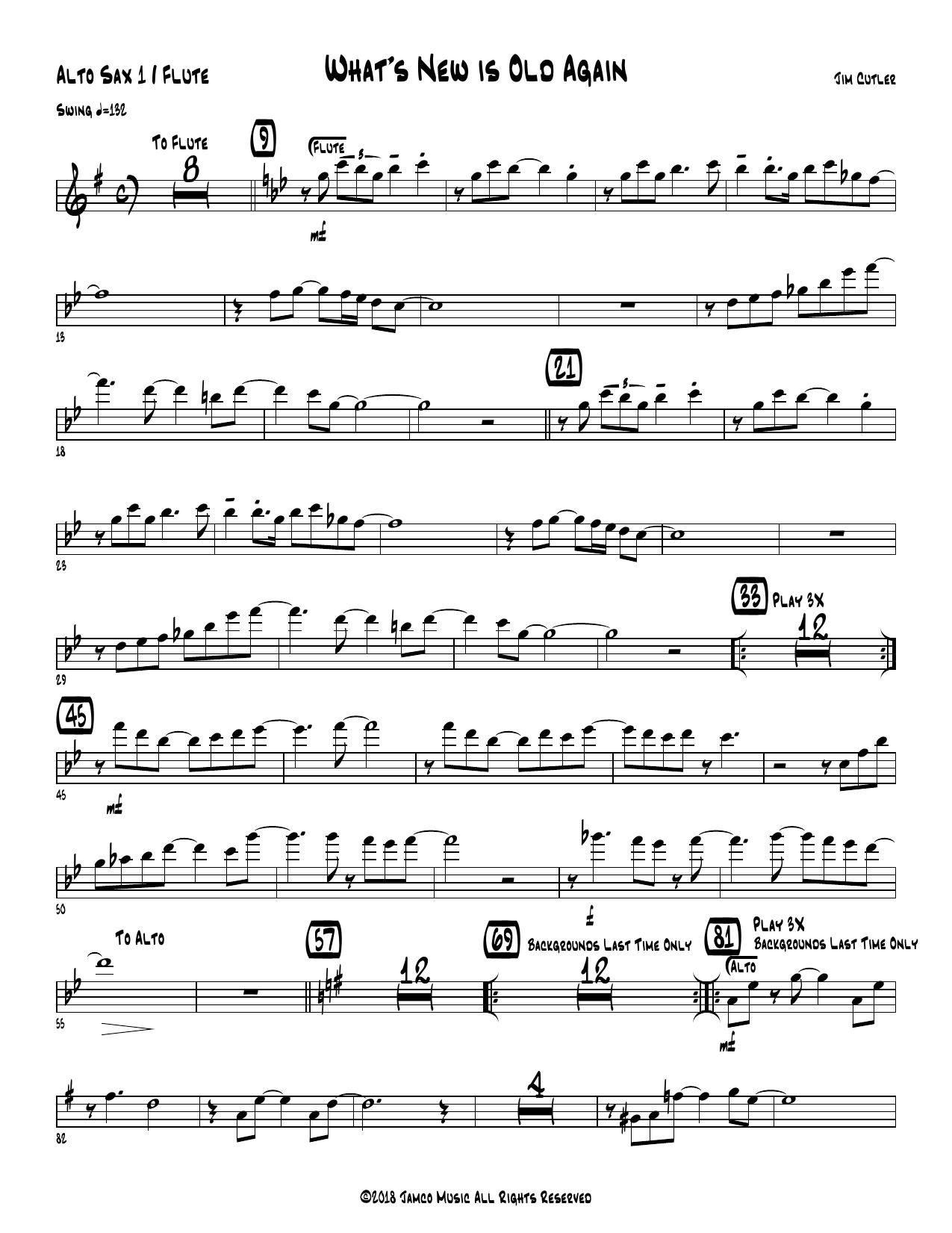
What's New Is Old Again (J.Cutler)
Composed by J. Cutler
Arranged by J.Cutler
- Ensemble: Big Band
- Style: Jazz Standard
- Pages: 48
- Instruments (18): Alto Sax 1 / Flute, Alto Sax 2, Tenor Sax 1, Tenor Sax 2, Baritone Sax, Trumpet 1, Trumpet 2, Trumpet 3, Trumpet 4 (Solo), Trombone 1, Trombone 2, Trombone 3 (Solo), Trombone 4, Guitar, Piano, Bass, Drums, Alto 1 (Substitute for Alto 1-Flute)
- Difficulty: medium
- Content: Individual Parts
- Format: PDF Download (Instant)
- Price: $24.99
Bending the nostalgic boundaries of modern jazz composition, "What's New Is Old Again," conceived and arranged by J. Cutler, bridges the gap between mid-century post-bop harmonic sophistication and contemporary big band propulsion. Rooted in the rich lineage of classic jazz standards yet fearlessly modern in its chromatic explorations, this composition evokes the smoky sophistication of a late-night urban jazz club while injecting the sheer adrenaline of a modern powerhouse ensemble. Cutler’s writing captures a distinct mood of contemplative retrospection that rapidly gives way to bursts of exuberant, driving momentum, creating a dynamic narrative arc that keeps both performers and audiences completely transfixed from the first downbeat to the final sustained chord. Driving this 17-instrument arrangement is a sophisticated medium-up swing groove characterized by an infectious, forward-leaning pulse in 4/4 time. Cutler establishes a rich harmonic palette built upon extended tertian structures, altered dominants, and subtle modal shifts that challenge the ensemble to balance lush, impressionistic voicings with razor-sharp rhythmic articulation. The primary melody is initially introduced with understated elegance by the lead alto saxophone—doubling gracefully on flute—before being seamlessly passed to a tightly interlocked sax soli that showcases Cutler’s mastery of contemporary horn writing. Throughout the chart, the brass section alternates between muted textural backgrounds and roaring, brass-heavy counter-lines that frame the unfolding harmonic narrative without ever obscuring the core thematic material. At the heart of the arrangement lies an expansive blowing section designed to feature dynamic improvised solos for tenor saxophone and trumpet, backed by an interactive rhythm section comping blueprint that encourages modal exploration. The climax of the chart is a textbook modern shout chorus, building layer by layer through cascading woodwind figures and punchy brass stabs before culminating in a soaring, high-energy ensemble tutti. Cutler expertly utilizes dynamic contrast, utilizing whispered subtones and cascading scalar runs to make the explosive full-ensemble moments hit with maximum emotional and sonic impact. Advanced high school ensembles with strong section leaders, as well as collegiate and professional big bands, will find this 48-page publication an immensely rewarding addition to their repertoire. While the chart demands rhythmic precision, strong intonation within the saxophone and brass sections, and stylistic versatility, the meticulous attention to detail in the included full conductor score ensures that directors have all the tools necessary to unlock the music's full expressive potential. Navigating "What's New Is Old Again" successfully requires careful attention to articulation and dynamic balance, particularly during the transition from the subdued, legato opening statements to the punchy, aggressive swing sections. Conductors should emphasize a relaxed, forward-moving medium-up swing feel, ensuring the rhythm section maintains a crisp, unhurried ride cymbal pulse that anchors the complex horn voicings. The saxophones must pay close attention to blend and intonation during the intricate soli passages, keeping vibrato controlled and modern. Brass players should utilize cup mutes where indicated in the introductory choruses to achieve a warm, diffuse timbre, reserving open horns for the shout chorus where maximum brilliance is required. Pay special attention to the dynamic markings leading into the solo changes; the rhythm section should drop to a supportive whisper behind the soloists to allow for effortless acoustic projection. Q: What instruments and parts are included in this publication? A: The complete 17-instrument big band instrumentation includes 5 saxophones (Alto 1/Flute, Alto 2, Tenor 1, Tenor 2, Baritone), 4 trumpets, 4 trombones, and a standard 4-piece rhythm section (piano, guitar, bass, drums), accompanied by a comprehensive 48-page conductor score. Q: What is the difficulty level of this arrangement? A: This arrangement is rated as advanced, making it best suited for accomplished high school top bands, collegiate jazz orchestras, and professional big bands that possess strong section cohesion and improvisational capabilities. Q: What is the musical style and historical context of the piece? A: Written in the style of a contemporary jazz standard, the piece blends traditional post-bop harmonic language with modern big band arranging techniques, echoing the sophistication of mid-century jazz composition updated for the twenty-first century. Q: What makes J.Cutler’s arrangement unique? A: The chart stands out due to its seamless integration of woodwind-doubling textures, sophisticated extended harmonies, an interactive rhythm section concept, and a masterfully constructed shout chorus that drives the ensemble to an unforgettable climax. Q: What is the performance duration and recommended tempo for this arrangement? A: The piece is structured for a performance duration of approximately 5 to 6 minutes, anchored by a recommended medium-up swing tempo of around 180 beats per minute.
Questions and answers
- What is included in the What's New Is Old Again (J.Cutler) PDF?
- The verified current file contains a conductor score and individual parts across 48 pages.
- How many instruments or parts are listed for What's New Is Old Again (J.Cutler)?
- The verified instrumentation list contains 18 entries for this Big Band arrangement.
- Who is credited for What's New Is Old Again (J.Cutler)?
- Composer: J. Cutler. Arranger: J.Cutler.
- What difficulty is listed for What's New Is Old Again (J.Cutler)?
- The verified difficulty level is medium.
- What style is listed for What's New Is Old Again (J.Cutler)?
- The catalog lists the style as Jazz Standard.
- Can I preview What's New Is Old Again (J.Cutler) before buying?
- Yes. The product page provides a preview generated from the current PDF file.
- How is What's New Is Old Again (J.Cutler) delivered?
- After successful payment, the digital PDF is made available for download. The displayed price is $24.99.
Musicians Also Search For
What's New Is Old Again J.Cutler PDF • What's New Is Old Again J.Cutler sheet music • What's New Is Old Again arranged by J.Cutler • J.Cutler big band charts • J.Cutler jazz arrangements PDF • What's New Is Old Again J. Cutler sheet music • What's New Is Old Again J. Cutler big band arrangements • J. Cutler big band charts • What's New Is Old Again big band arrangements • What's New Is Old Again big band PDF download • What's New Is Old Again jazz sheet music • big band sheet music download • What's New Is Old Again conductor score PDF • What's New Is Old Again individual parts download • What's New Is Old Again sheet music PDF • What's New Is Old Again Jazz Standard charts • Jazz Standard big band arrangements • buy What's New Is Old Again sheet music • download What's New Is Old Again PDF • What's New Is Old Again jazz charts • best J.Cutler big band arrangements • J. Cutler arranged by J.Cutler • What's New Is Old Again printable sheet music • big band repertoire PDF