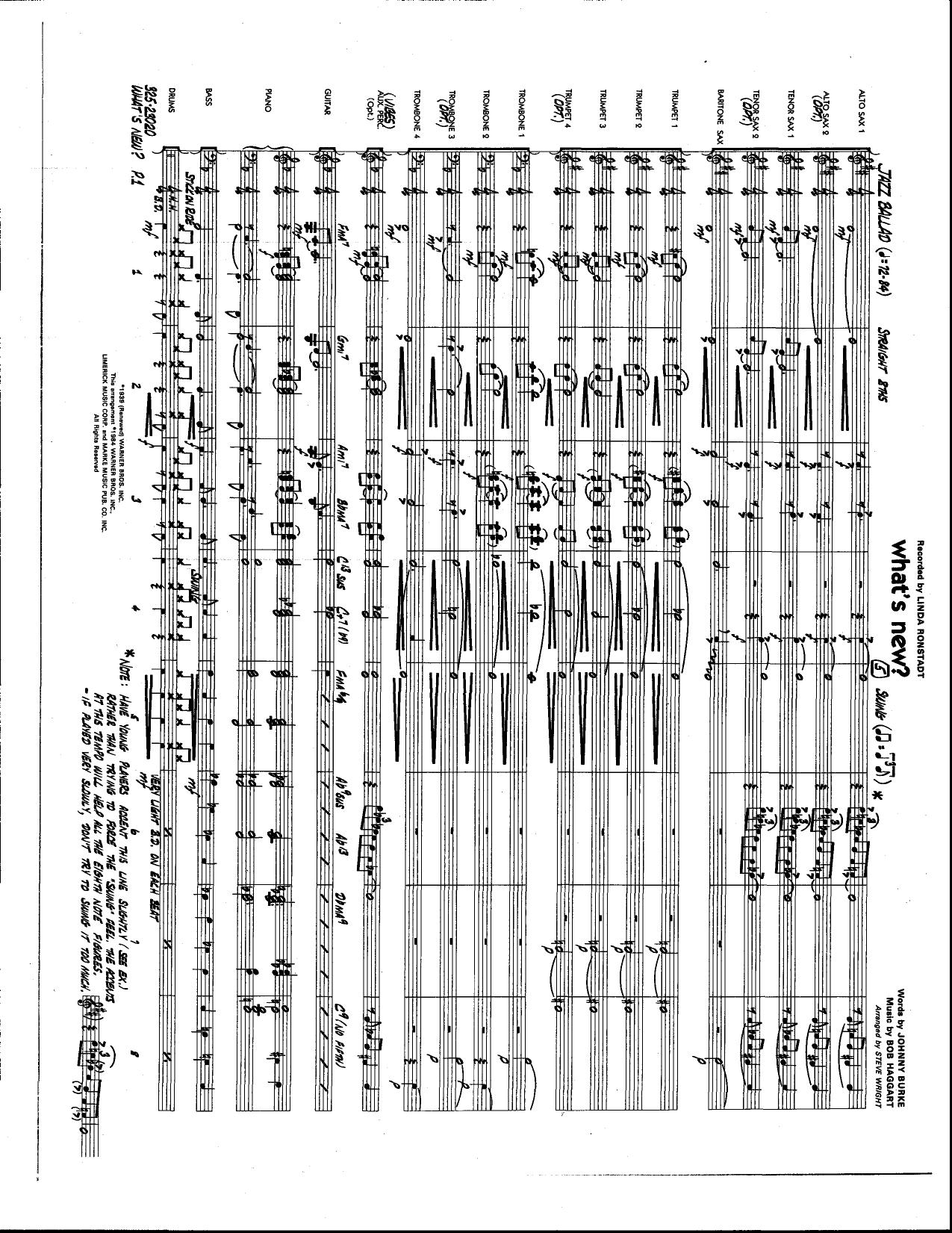
What's New (S.Wright) sheet music preview

What's New (S.Wright)

Composed by Bob Haggart

Arranged by S.Wright

  • Ensemble: Big Band
  • Style: Jazz Standard
  • Pages: 24
  • Instruments (18): Alto Sax 1, Alto Sax 2, Tenor Sax 1, Tenor Sax 2, Baritone Sax, Trumpet 1, Trumpet 2, Trumpet 3, Trumpet 4, Trombone 1, Trombone 2, Trombone 3, Trombone 4, Bass, Drums, Piano, Guitar, Vibes
  • Difficulty: medium
  • Content: Individual Parts
  • Format: PDF Download (Instant)
  • Price: $24.99

Composed in 1938 by bassist Bob Haggart with lyrics later added by Johnny Burke, "What's New" stands as one of the most enduring ballads in the Great American Songbook. Initially introduced by the Bob Crosby Orchestra—where Haggart originally penned it as an instrumental trumpet feature titled "I'm Free"—the tune achieved definitive jazz standard status through immortal recordings by Bing Crosby, Billie Holiday, and notably, Linda Ronstadt's lush 1984 vocal rendition, as well as definitive instrumental treatments by master stylists like John Coltrane and Art Pepper. The composition captures the bittersweet pangs of a chance encounter with a former lover, projecting a narrative of sophisticated nostalgia, lingering affection, and quiet introspection that defines the golden era of swing-to-bebop transition jazz. In this masterful 19-instrument big band setting, S.Wright treats the iconic melody with profound harmonic reverence while injecting a fresh, contemporary textural warmth. Moving at a relaxed, introspective ballad tempo, the chart opens with a delicate, rubato-infused preamble before settling into a steady, floating 4/4 medium-slow swing feel. The emotional core of the piece hinges on lush, impressionistic brass voicings and rich saxophone block harmonies that evoke the dense, sophisticated colors of the classic Nelson Riddle or Johnny Mandel scoring traditions. S.Wright utilizes subtle harmonic reharmonizations in the bridge to heighten the emotional tension, steering the ensemble through cascading dynamic swells that naturally amplify the melancholic beauty of Haggart’s original changes. The arrangement brilliantly balances ensemble weight with exposed lyrical moments. The lead alto saxophone and flugelhorn (or muted trumpet) share primary melodic duties through the opening choruses, leading into a tightly knit saxophone soli that showcases S.Wright’s signature penchant for linear fluidity and inner-voice movement. A soaring, emotive improvised solo space is provided for tenor saxophone or trombone, allowing featured soloists to stretch across the open, lush background pads. Technically, the challenges lie not in raw velocity, but in breath control, intonation across extreme dynamic ranges, and maintaining a unified, languid swing feel that never drags. The rhythm section is tasked with an understated, feather-light ride cymbal pulse and walking bassline that anchors the floating harmonic superstructure above it. Advanced high school ensembles, collegiate jazz orchestras, and professional community big bands will find this arrangement an invaluable repertoire builder. It serves as an ideal vehicle for teaching stylistic maturity, rubato phrasing, and sensitive ballad playing—skills that are frequently overshadowed by aggressive, up-tempo chart work. Performing this piece demands a high degree of listening across sections, making it a powerful pedagogical tool for developing mature ensemble blend and expressive nuance while offering audiences a deeply moving, sophisticated concert highlight. The primary technical challenge in executing this arrangement lies in sustaining a rich, warm ensemble tone at ultra-soft dynamic levels. Conductors must insist on absolute intonation stability during the dense, extended-chord passages in the brass. The tempo should remain a relaxed, breathing ballad pulse—avoiding any tendency to rush the turnaround measures. Rhythm section players should approach their parts with extreme restraint; the drummer should utilize brushes or a very light stick touch on the ride cymbal, while the piano and guitar should comp sparsely using rootless, open voicings to leave ample sonic space for the horns. Pay close attention to balance during the saxophone soli, ensuring the inner voices do not obscure the lead alto. No special mutes are strictly mandatory, though straight mutes for trumpets can be effectively utilized in select background sections to achieve an authentic vintage color if desired. Q: What instruments and parts are included in this 19-instrument big band arrangement? A: The instrumentation comprises a standard 19-piece big band layout: 5 saxophones (2 altos, 2 tenors, 1 baritone), 4 trumpets, 4 trombones, guitar, piano, bass, drums, and a comprehensive full conductor score across 48 pages. Q: What is the difficulty level of this S.Wright arrangement? A: This chart is graded as advanced-intermediate to advanced, making it best suited for college jazz orchestras, advanced high school bands, and professional community ensembles with strong section leaders. Q: What is the historical background and musical style of "What's New"? A: Originally composed in 1938 by bassist Bob Haggart for the Bob Crosby Orchestra, this piece is a cornerstone ballad of the Great American Songbook, styled here as an evocative, lush medium-slow swing arrangement. Q: What makes this specific arrangement by S.Wright unique? A: S.Wright blends traditional swing-era ballad sensibilities with modern, impressionistic harmonic reharmonizations, featuring intricate saxophone solis and lushly voiced backgrounds that elevate the emotional narrative. Q: What is the performance duration and recommended tempo for this piece? A: The arrangement runs approximately 4 to 5 minutes depending on the length of the open improvised solo, and should be performed at a relaxed, flowing ballad tempo of around 72 to 80 beats per minute.

Questions and answers

What is included in the What's New (S.Wright) PDF?
The verified current file contains a conductor score and individual parts across 24 pages.
How many instruments or parts are listed for What's New (S.Wright)?
The verified instrumentation list contains 18 entries for this Big Band arrangement.
Who is credited for What's New (S.Wright)?
Composer: Bob Haggart. Arranger: S.Wright.
What difficulty is listed for What's New (S.Wright)?
The verified difficulty level is medium.
What style is listed for What's New (S.Wright)?
The catalog lists the style as Jazz Standard.
Can I preview What's New (S.Wright) before buying?
Yes. The product page provides a preview generated from the current PDF file.
How is What's New (S.Wright) delivered?
After successful payment, the digital PDF is made available for download. The displayed price is $24.99.

Musicians Also Search For

What's New S.Wright PDFWhat's New S.Wright sheet musicWhat's New arranged by S.WrightS.Wright big band chartsS.Wright jazz arrangements PDFWhat's New Bob Haggart sheet musicWhat's New Bob Haggart big band arrangementsBob Haggart big band chartsWhat's New big band arrangementsWhat's New big band PDF downloadWhat's New jazz sheet musicbig band sheet music downloadWhat's New conductor score PDFWhat's New individual parts downloadWhat's New sheet music PDFWhat's New Jazz Standard chartsJazz Standard big band arrangementsbuy What's New sheet musicdownload What's New PDFWhat's New jazz chartsbest S.Wright big band arrangementsBob Haggart arranged by S.WrightWhat's New printable sheet musicbig band repertoire PDF

All arrangements by S.Wright All Bob Haggart sheet music