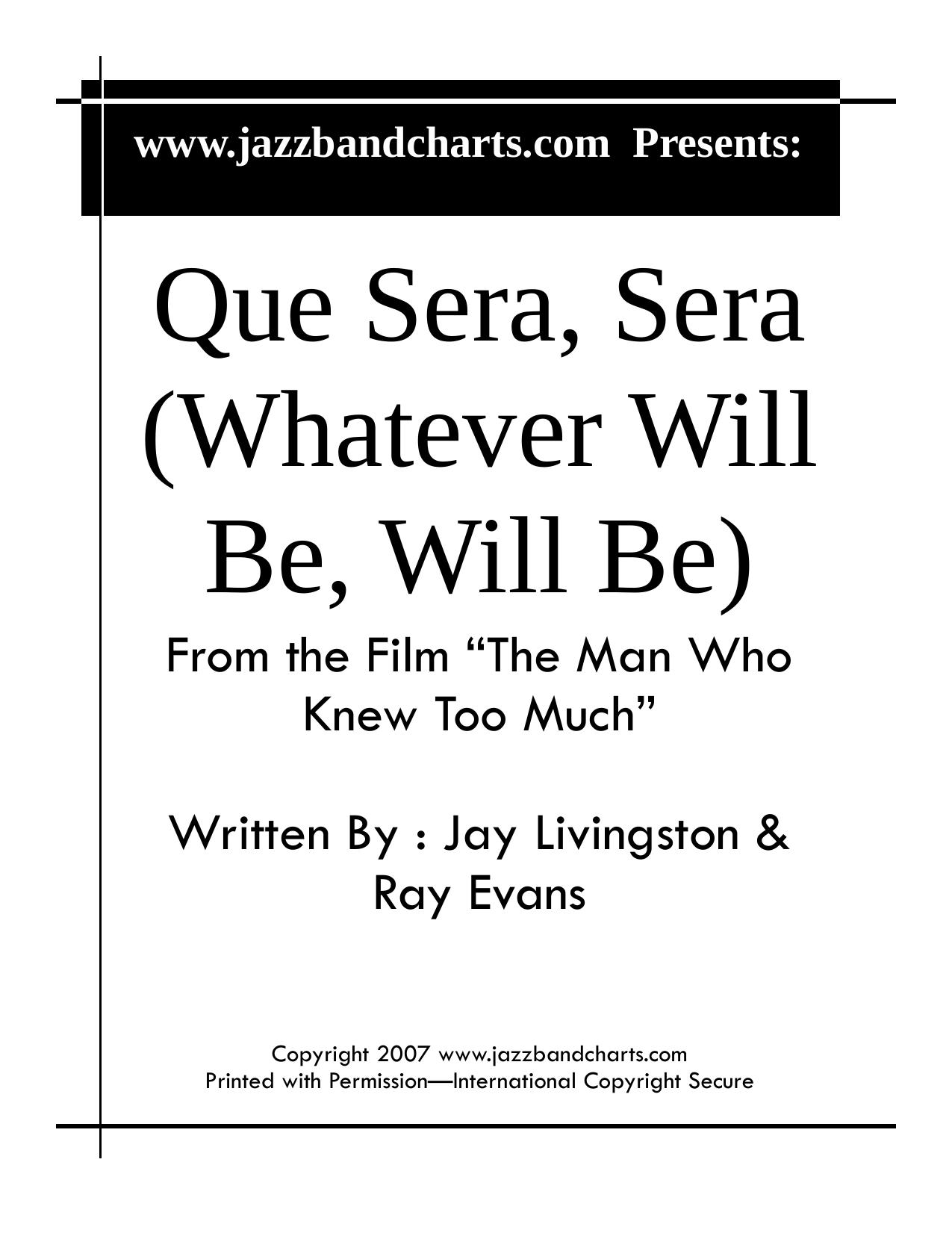
Whatever Will Be,Will Be (J.Livingston)
Composed by Jay Livingston
Arranged by J.Livingston
- Ensemble: Big Band
- Style: Jazz Standard
- Pages: 45
- Instruments (17): Alto Sax. 1, Alto Sax. 2, Tenor Sax. 1, Tenor Sax. 2, Baritone Sax., Trumpet 1, Trumpet 2, Trumpet 3, Trumpet 4, Trombone 1, Trombone 2, Trombone 3, Trombone 4, Guitar, Piano, Bass, Drum Set
- Difficulty: medium
- Content: Individual Parts
- Format: PDF Download (Instant)
- Price: $24.99
Originally penned by the legendary songwriting duo Jay Livingston and Ray Evans, "Que Sera, Sera (Whatever Will Be, Will Be)" earned an Academy Award for Best Original Song in 1956 after being introduced by Doris Day in Alfred Hitchcock’s suspense film *The Man Who Knew Too Much*. While cemented in Hollywood history as a beloved pop standard, the tune’s inherent melodic strength, cyclical harmonic progression, and natural swing phrasing have long invited jazz interpreters to recontextualize it. Over the decades, the composition transitioned effortlessly from cinematic nostalgia to a versatile vehicle for jazz improvisation, embraced by small combos and large ensembles alike for its memorable, descending-resolution cadence and engaging lyrical contour. This sophisticated big band setting reimagines the familiar melody through a vibrant, mid-tempo swing lens. Operating at a comfortable, driving groove in 4/4 time, the arrangement balances nostalgic warmth with modern harmonic color. The mood shifts effortlessly from playful, swinging counterlines to rich, Ellingtonian brass sonorities and lush saxophone soli passages. The harmonic vocabulary expands upon the original diatonic framework with clever secondary dominants, chromatic passing chords, and extended upper-structure voicings that give the ensemble a contemporary yet timeless palette, evoking the sophisticated atmosphere of post-war metropolitan jazz clubs. Jay Livingston’s arrangement approaches the canonical material with structural ingenuity, avoiding a simple head-and-chorus routine by integrating inventive transitional interludes and dynamic contrasting textures. The chart opens with a moody, harmonized saxophone introduction before settling into a steady, cymbal-driven groove carried by the rhythm section. A striking, full-ensemble shout chorus near the climax showcases brilliant brass and reed interplay, utilizing tight block-chord voicings and well-placed dynamic swells. Throughout the chart, the melody is intelligently shared across sections, transitioning fluidly from muted trumpets to a sultry tenor saxophone feature, ensuring that every section of the ensemble remains musically engaged. Advanced high school, collegiate, and professional community big bands will find this chart an exceptionally rewarding addition to their repertoire. The arrangement requires a rhythm section capable of maintaining a subtle, driving pocket, as well as a horn section comfortable with precise articulations, dynamic control, and balanced blend within tight harmonic clusters. Solo space is provided for featured improvisers, allowing featured players to stretch out over standard changes. With its 45-page comprehensive package—including a fully realized conductor score and all 17 standard big band instrumental parts—this publication offers a masterclass in reharmonization, sectional balance, and large-ensemble storytelling. The primary technical challenge in this arrangement lies in maintaining a relaxed yet driving medium-swing feel without rushing the tempo. The rhythm section must anchor the groove, with the drummer utilizing crisp ride-cymbal phrasing and tasteful hi-hat chokes on beats two and four to keep the momentum light and buoyant. Horn players should pay close attention to precision in articulation; short notes must be clipped and clean, while longer lines require a smooth, vocal legato that mimics the original lyricism of the tune. Rehearsal should begin by isolating the saxophone soli to ensure flawless intonation and rhythmic unison before integrating the brass. Pay careful attention to the dynamic markings during the transitional sections; the arrangement relies heavily on stark contrasts between hushed, sub-tone reed passages and explosive, brass-heavy climaxes. Conductors should encourage soloists to reference the vocal phrasing of the melody during the first half of their improvisations before developing more chromatic, modal ideas over the ensemble's background figures. Q: What instruments and parts are included in this publication? A: This complete 17-instrument big band arrangement includes full parts for Alto Saxophone 1 & 2, Tenor Saxophone 1 & 2, Baritone Saxophone, Trumpets 1 through 4, Trombones 1 through 4, Guitar, Piano, Bass, and Drums, alongside a comprehensive conductor score spanning 45 total pages. Q: What is the difficulty level of this arrangement? A: This chart is graded as intermediate-advanced (suitable for advanced high school, collegiate, and professional community big bands), requiring solid sight-reading, strong section blend, and rhythmic precision in a swing style. Q: What musical style and historical context does this chart represent? A: It is a jazz standard arrangement based on Jay Livingston and Ray Evans' 1956 Academy Award-winning composition, reimagined here in a classic mid-tempo big band swing style reminiscent of post-war jazz orchestration. Q: What makes this specific arrangement unique? A: It elevates a traditional cinematic pop song into a sophisticated jazz vehicle through inventive reharmonization, dynamic textural contrasts between sections, and a powerful, modern shout chorus that reinterprets the familiar melody. Q: What is the recommended performance duration and tempo? A: The arrangement is designed for a medium swing tempo (approximately 116–124 BPM) and typically runs around 3.5 to 4.5 minutes, depending on the length of the improvised solos taken during the middle chorus.
Questions and answers
- What is included in the Whatever Will Be,Will Be (J.Livingston) PDF?
- The verified current file contains a conductor score and individual parts across 45 pages.
- How many instruments or parts are listed for Whatever Will Be,Will Be (J.Livingston)?
- The verified instrumentation list contains 17 entries for this Big Band arrangement.
- Who is credited for Whatever Will Be,Will Be (J.Livingston)?
- Composer: Jay Livingston. Arranger: J.Livingston.
- What difficulty is listed for Whatever Will Be,Will Be (J.Livingston)?
- The verified difficulty level is medium.
- What style is listed for Whatever Will Be,Will Be (J.Livingston)?
- The catalog lists the style as Jazz Standard.
- Can I preview Whatever Will Be,Will Be (J.Livingston) before buying?
- Yes. The product page provides a preview generated from the current PDF file.
- How is Whatever Will Be,Will Be (J.Livingston) delivered?
- After successful payment, the digital PDF is made available for download. The displayed price is $24.99.
Musicians Also Search For
Whatever Will Be,Will Be J.Livingston PDF • Whatever Will Be,Will Be J.Livingston sheet music • Whatever Will Be,Will Be arranged by J.Livingston • J.Livingston big band charts • J.Livingston jazz arrangements PDF • Whatever Will Be,Will Be Jay Livingston sheet music • Whatever Will Be,Will Be Jay Livingston big band arrangements • Jay Livingston big band charts • Whatever Will Be,Will Be big band arrangements • Whatever Will Be,Will Be big band PDF download • Whatever Will Be,Will Be jazz sheet music • big band sheet music download • Whatever Will Be,Will Be conductor score PDF • Whatever Will Be,Will Be individual parts download • Whatever Will Be,Will Be sheet music PDF • Whatever Will Be,Will Be Jazz Standard charts • Jazz Standard big band arrangements • buy Whatever Will Be,Will Be sheet music • download Whatever Will Be,Will Be PDF • Whatever Will Be,Will Be jazz charts • best J.Livingston big band arrangements • Jay Livingston arranged by J.Livingston • Whatever Will Be,Will Be printable sheet music • big band repertoire PDF