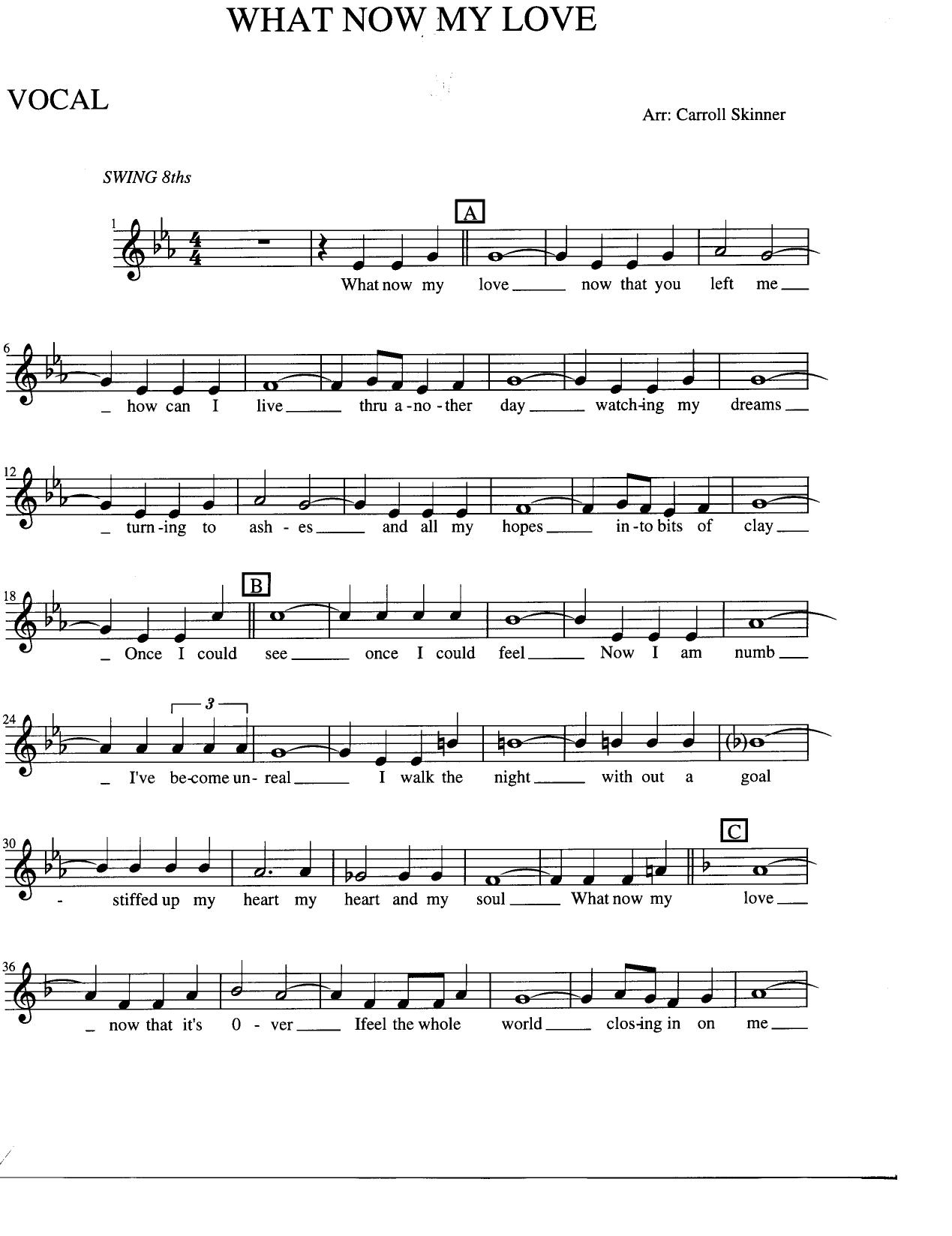
What Now My Love (C.Skinner)
Composed by C. Skinner
Arranged by Frank Sinatra & Nelson Riddle
- Ensemble: Big Band
- Pages: 31
- Instruments (18): VOCAL, ALTO SAX 1, ALTO SAX 2, TENOR SAX 1, TENOR SAX 2, BARITONE SAX, TRUMPET 1, TRUMPET 2, TRUMPET 3, TRUMPET 4, TROMBONE 1, TROMBONE 2, TROMBONE 3, BASS TROMBONE, PIANO, GUITAR, BASS, DRUMS
- Difficulty: medium
- Content: Individual Parts
- Format: PDF Download (Instant)
- Price: $24.99
"What Now My Love"—originally adapted from the French chanson "Et Maintenant" by Gilbert Bécaud with English lyrics by Carl Sigman—found its definitive mid-century vocal masterpiece status through the iconic collaboration between Frank Sinatra and arranger Nelson Riddle. Released on Sinatra’s 1966 Grammy-winning album *Strangers in the Night*, this specific chart represents the pinnacle of 1960s sophisticated pop-orchestral jazz. The era defined a lush, cinematic approach to big band writing where swing sensibilities met sweeping, dramatic string-substitute brass and woodwind textures. It stands as a monumental vocal-jazz standard that tests an ensemble's command of pacing, dynamic control, and emotional gravity. The musical character of this chart unfolds as a smoldering, dramatic ballad that gradually intensifies into a driving, impassioned bolero-swing hybrid. Built upon a relentless, mounting rhythmic pulse, the piece evokes a profound sense of romantic desperation and high-stakes theatricality. The arrangement opens with an atmospheric, tension-building introduction before settling into a brooding groove characterized by pulsing basslines and dark horn voicings. As the chart progresses, the harmonic language expands through unexpected modulations and rich, extended chord structures that push the emotional intensity to a breathtaking climax. Nelson Riddle’s signature arranging fingerprint is stamped all over this score, featuring his trademark low-register woodwind blend, soaring brass counter-melodies, and meticulously crafted dynamic arcs. Riddle famously utilizes the saxophone section—comprising Alto, Tenor, and Baritone—to create warm, organ-like pads underneath biting muted trumpet interjections. There is no traditional lightweight shout chorus; instead, Riddle constructs a massive, cumulative tutti swell that exploits the full dynamic spectrum of the 10-piece instrumentation, forcing every player to balance individual tone quality with a cohesive ensemble blend. Carrying the narrative weight, the horn section frequently alternates between lush harmonic accompaniment and pointed, dramatic punctuation marks that echo a vocalist's phrasing. Technical challenges lie primarily in sustaining a whispered intensity at ultra-soft dynamics and maintaining immaculate intonation during the shifting chromatic harmonies. High school groups with advanced sections, as well as collegiate and professional ensembles, will find this 31-page arrangement deeply rewarding because it demands mature musicality over mere technical velocity. Success with this chart relies entirely on a band's ability to treat every phrase as a vocal utterance, making it an unforgettable centerpiece for any sophisticated concert program. Conductors approaching this Nelson Riddle masterpiece must prioritize dynamic restraint during the opening phrases; the tension of the piece depends entirely on how quietly the ensemble can execute the initial thematic statements. The tempo should maintain a steady, unhurried pulse that mimics a slow, heavy heartbeat, resisting any temptation to drag during the quiet sections or rush the eventual crescendo. Technically, the brass players should utilize warm, rounded tones with minimal vibrato in the lower registers to emulate Riddle's scoring for French horns and low reeds. Trumpets must be comfortable executing precise, dry staccato punches that contrast sharply against the legato lines of the trombones and saxophones. In rehearsal, isolate the transitional modulation sections to ensure seamless voice-leading across the ensemble before integrating the dynamic peaks. Emphasize horizontal phrasing rather than vertical beat-stamping to capture the dramatic, cinematic arc of the original Sinatra recording. Q: What instruments and parts are included in this 10-instrument arrangement? A: The instrumentation features a 10-piece contemporary big band lineup, specifically scoring for Alto Saxophone, Tenor Saxophone, Baritone Saxophone, Trumpet, and Trombone, alongside a full rhythm section. The comprehensive 31-page score provides tightly interleaved parts designed to maximize the harmonic depth of a smaller ensemble. Q: What is the designated difficulty level of this chart? A: This arrangement is calibrated for advanced high school, collegiate, and professional jazz ensembles. The primary challenges involve complex chromatic harmonies, demanding endurance at extreme dynamic contrasts, and the requirement for mature ensemble blend rather than raw technical speed. Q: What is the historical style and background of this piece? A: This chart embodies the lush, cinematic 1960s vocal-jazz style pioneered by arranger Nelson Riddle for Frank Sinatra. It adapts the dramatic European cabaret aesthetic into a sophisticated American big band idiom characterized by mounting tension and theatrical grandeur. Q: What makes this specific Nelson Riddle arrangement unique? A: Unlike standard swinging big band charts, this arrangement utilizes a driving bolero-esque rhythmic pulse and rich, extended chord voicings in place of a traditional shout chorus. Riddle's signature use of low woodwind textures and biting brass interjections creates a uniquely moody, vocal-driven atmosphere. Q: What is the performance duration and tempo feel of the piece? A: The arrangement runs approximately 3 to 4 minutes and is performed at a smoldering, deliberate ballad tempo with a driving, cumulative pulse. Conductors should maintain strict control over the underlying groove to support the dramatic crescendos without rushing.
Questions and answers
- What is included in the What Now My Love (C.Skinner) PDF?
- The verified current file contains individual parts across 31 pages.
- How many instruments or parts are listed for What Now My Love (C.Skinner)?
- The verified instrumentation list contains 18 entries for this Big Band arrangement.
- Who is credited for What Now My Love (C.Skinner)?
- Composer: C. Skinner. Arranger: Frank Sinatra & Nelson Riddle.
- What difficulty is listed for What Now My Love (C.Skinner)?
- The verified difficulty level is medium.
- Can I preview What Now My Love (C.Skinner) before buying?
- Yes. The product page provides a preview generated from the current PDF file.
- How is What Now My Love (C.Skinner) delivered?
- After successful payment, the digital PDF is made available for download. The displayed price is $24.99.
Musicians Also Search For
What Now My Love Frank Sinatra & Nelson Riddle PDF • What Now My Love Frank Sinatra & Nelson Riddle sheet music • What Now My Love arranged by Frank Sinatra & Nelson Riddle • Frank Sinatra & Nelson Riddle big band charts • Frank Sinatra & Nelson Riddle jazz arrangements PDF • What Now My Love C. Skinner sheet music • What Now My Love C. Skinner big band arrangements • C. Skinner big band charts • What Now My Love big band arrangements • What Now My Love big band PDF download • What Now My Love jazz sheet music • big band sheet music download • What Now My Love individual parts download • What Now My Love sheet music PDF • buy What Now My Love sheet music • download What Now My Love PDF • What Now My Love jazz charts • best Frank Sinatra & Nelson Riddle big band arrangements • C. Skinner arranged by Frank Sinatra & Nelson Riddle • What Now My Love printable sheet music • big band repertoire PDF