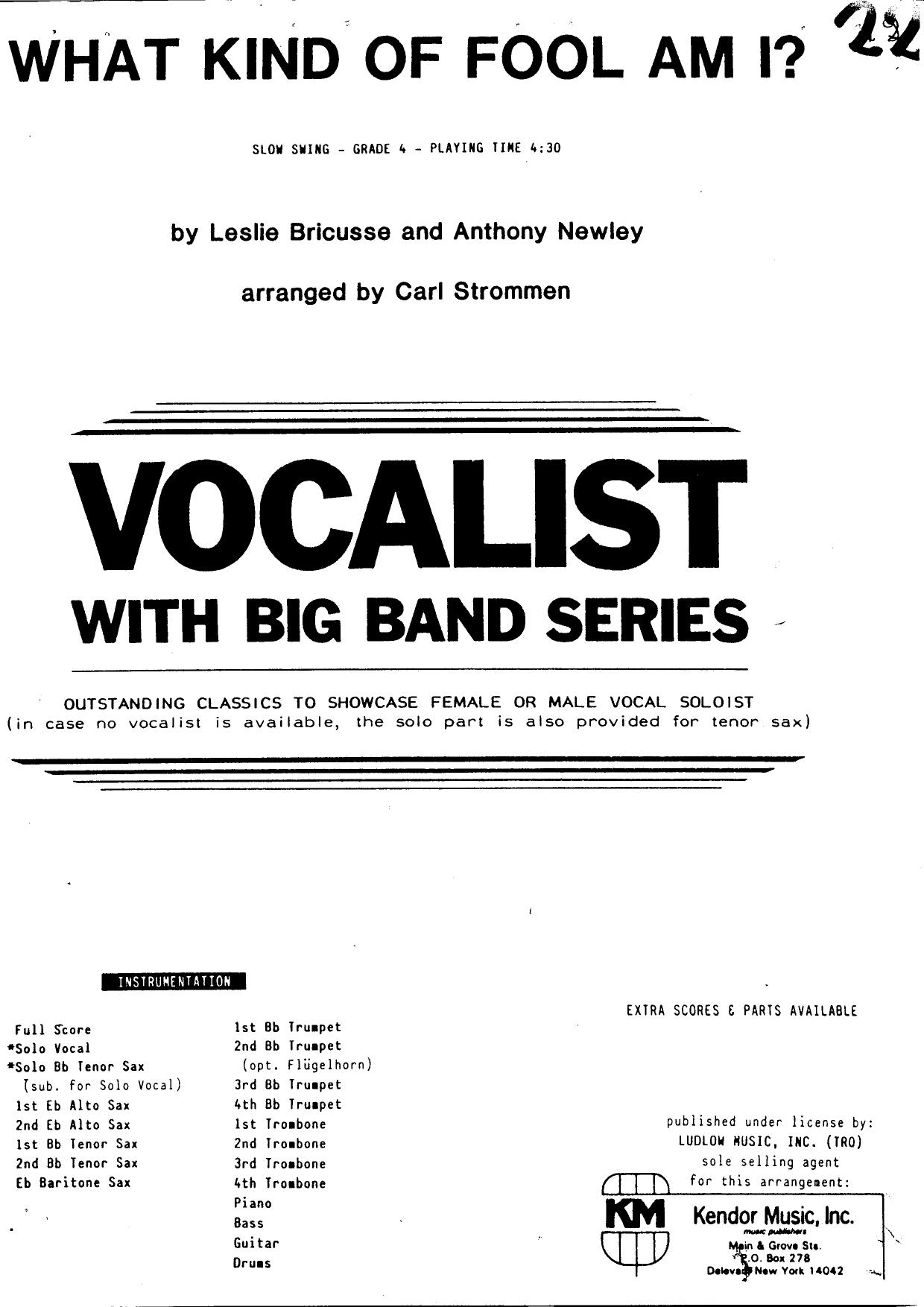
What Kind Of Fool Am I (C.Strommen)
Composed by Leslie Bricusse
Arranged by Carl Strommen
- Ensemble: Big Band
- Pages: 38
- Instruments (19): Solo Vocal, Solo Bb Tenor Sax (substitute for solo vocal), 1st Eb Alto Sax, 2nd Eb Alto Sax, 1st Bb Tenor Sax, 2nd Bb Tenor Sax, Eb Baritone Sax, 1st Bb Trumpet, 2nd Bb Trumpet (opt. Flugelhorn), 3rd Bb Trumpet, 4th Bb Trumpet, 1st Trombone, 2nd Trombone, 3rd Trombone, 4th Trombone, Guitar, Piano, Bass, Drums
- Difficulty: medium
- Content: Individual Parts
- Format: PDF Download (Instant)
- Price: $24.99
Leslie Bricusse and Anthony Newley penned "What Kind of Fool Am I" for the 1961 Broadway musical *Stop the World – I Want to Get Off*, where it quickly transcended its theatrical origins to become a staple of the Great American Songbook. Immortalized by definitive vocal interpretations from Sammy Davis Jr., Frank Sinatra, and Tony Bennett, the tune established itself as a vehicle for profound introspection and soaring, dramatic delivery. Within the jazz idiom, instrumentalists and arrangers alike have long gravitated toward its lush harmonic framework and poignant melodic contour, transforming a Broadway ballad into a canvas for sophisticated big band expression. Carl Strommen’s masterful big band adaptation reimagines the timeless melody as a captivating, expressive medium swing that balances deep emotional resonance with subtle harmonic sophistication. Opening with an evocative, atmospheric introduction, the arrangement gently unfolds into a steady, persuasive groove that invites the ensemble into a rich tapestry of extended harmonies and warm brass voicings. The mood shifts effortlessly from introspective melancholy to uplifting, cinematic expansiveness, capturing the theatrical DNA of the original composition while grounding it firmly in contemporary jazz band aesthetics. The harmonic language utilizes clever chromatic sub-dominants and lush chord extensions that give the traditional changes a fresh, modern sheen without alienating purists of the genre. The arrangement shines a spotlight on dynamic ensemble interplay, featuring lush sax solis and deftly integrated counter-melodies that keep all seventeen voices actively engaged. The lead alto sax and first trumpet carry the primary melodic weight through the opening statements, building toward a meticulously crafted shout chorus that avoids sheer volume in favor of textural density and emotional climax. Solo opportunities are thoughtfully integrated, providing a featured instrumentalist—typically tenor saxophone or piano—ample room to stretch over a harmonically rich, supportive background. Technical demands center less on breakneck fingerbusters and more on tonal blending, dynamic control, and maintaining an even, relaxed swing eighth-note feel throughout transitional passages. Advanced high school ensembles, collegiate jazz orchestras, and professional community big bands will find this chart an ideal vehicle for developing maturity, lyrical phrasing, and ensemble listening skills. Because the arrangement relies heavily on nuanced rubato-to-tempo transitions and subtle dynamic shifts rather than brute technical force, it serves as an exceptional educational tool for teaching stylistic maturity. Performers and audiences alike will find the chart deeply rewarding, as it offers a masterclass in pacing a jazz ballad-turned-swing-tune while honoring one of the 20th century's most enduring melodies. Directors should approach Carl Strommen’s setting of "What Kind of Fool Am I" with a primary focus on lyrical line continuity and relaxed, conversational swing phrasing. The tempo should settle comfortably into a medium groove; dragging the quarter-note will rob the chart of its forward momentum, while rushing will dilute its inherent introspection. Pay meticulous attention to the dynamic markings in the brass section during the muted passages, ensuring that cup and harmon mutes blend smoothly into the reed section's background pads without pinching the sound. Rehearsal time is best spent isolating the transitional rubato sections, ensuring the entire ensemble breathes together when transitioning back into the primary groove. Saxophones must work on a unified concept of tone during the soli, prioritizing intonation on altered upper-structure chords. Finally, use the shout chorus not as an excuse to overblow, but as an exercise in sheer harmonic resonance, letting the rich chord voicings speak naturally over a solid, understated rhythm section foundation. Q: What instruments and parts are included in this 17-instrument big band arrangement? A: The instrumentation comprises a standard 17-piece big band layout: 2 alto saxophones, 2 tenor saxophones, 1 baritone saxophone, 4 trumpets, 4 trombones, guitar, piano, bass, and drums. Full conductor score and individual transposed parts are included in the 38-page publication. Q: What is the difficulty level of this arrangement? A: This arrangement is graded as medium (Grade 3.5 to 4), making it well-suited for advanced high school, collegiate, and skilled community big bands that have developed foundational ensemble blend and stylistic flexibility. Q: What is the musical style and historical background of this piece? A: Originally composed by Leslie Bricusse for the 1961 Broadway musical *Stop the World – I Want to Get Off*, this arrangement recasts the classic theatrical standard into a sophisticated, expressive medium jazz swing idiom popularized by mid-century vocal and instrumental icons. Q: What makes Carl Strommen's arrangement unique? A: Strommen expertly balances the theatrical, dramatic narrative of the original melody with lush, contemporary big band harmonies, utilizing evocative dynamic shifts, warm voicings, and a thoughtfully constructed shout chorus that avoids heavy-handedness. Q: What is the performance duration and recommended tempo for this chart? A: While performance time varies slightly based on the length of improvised solos and chosen rubato pacing, conductors should aim for a relaxed medium swing tempo of approximately 116 to 124 beats per minute, resulting in a duration of roughly 4 to 5 minutes.
Questions and answers
- What is included in the What Kind Of Fool Am I (C.Strommen) PDF?
- The verified current file contains a conductor score and individual parts across 38 pages.
- How many instruments or parts are listed for What Kind Of Fool Am I (C.Strommen)?
- The verified instrumentation list contains 19 entries for this Big Band arrangement.
- Who is credited for What Kind Of Fool Am I (C.Strommen)?
- Composer: Leslie Bricusse. Arranger: Carl Strommen.
- What difficulty is listed for What Kind Of Fool Am I (C.Strommen)?
- The verified difficulty level is medium.
- Can I preview What Kind Of Fool Am I (C.Strommen) before buying?
- Yes. The product page provides a preview generated from the current PDF file.
- How is What Kind Of Fool Am I (C.Strommen) delivered?
- After successful payment, the digital PDF is made available for download. The displayed price is $24.99.
Musicians Also Search For
What Kind Of Fool Am I Carl Strommen PDF • What Kind Of Fool Am I Carl Strommen sheet music • What Kind Of Fool Am I arranged by Carl Strommen • Carl Strommen big band charts • Carl Strommen jazz arrangements PDF • What Kind Of Fool Am I Leslie Bricusse sheet music • What Kind Of Fool Am I Leslie Bricusse big band arrangements • Leslie Bricusse big band charts • What Kind Of Fool Am I big band arrangements • What Kind Of Fool Am I big band PDF download • What Kind Of Fool Am I jazz sheet music • big band sheet music download • What Kind Of Fool Am I conductor score PDF • What Kind Of Fool Am I individual parts download • What Kind Of Fool Am I sheet music PDF • buy What Kind Of Fool Am I sheet music • download What Kind Of Fool Am I PDF • What Kind Of Fool Am I jazz charts • best Carl Strommen big band arrangements • Leslie Bricusse arranged by Carl Strommen • What Kind Of Fool Am I printable sheet music • big band repertoire PDF