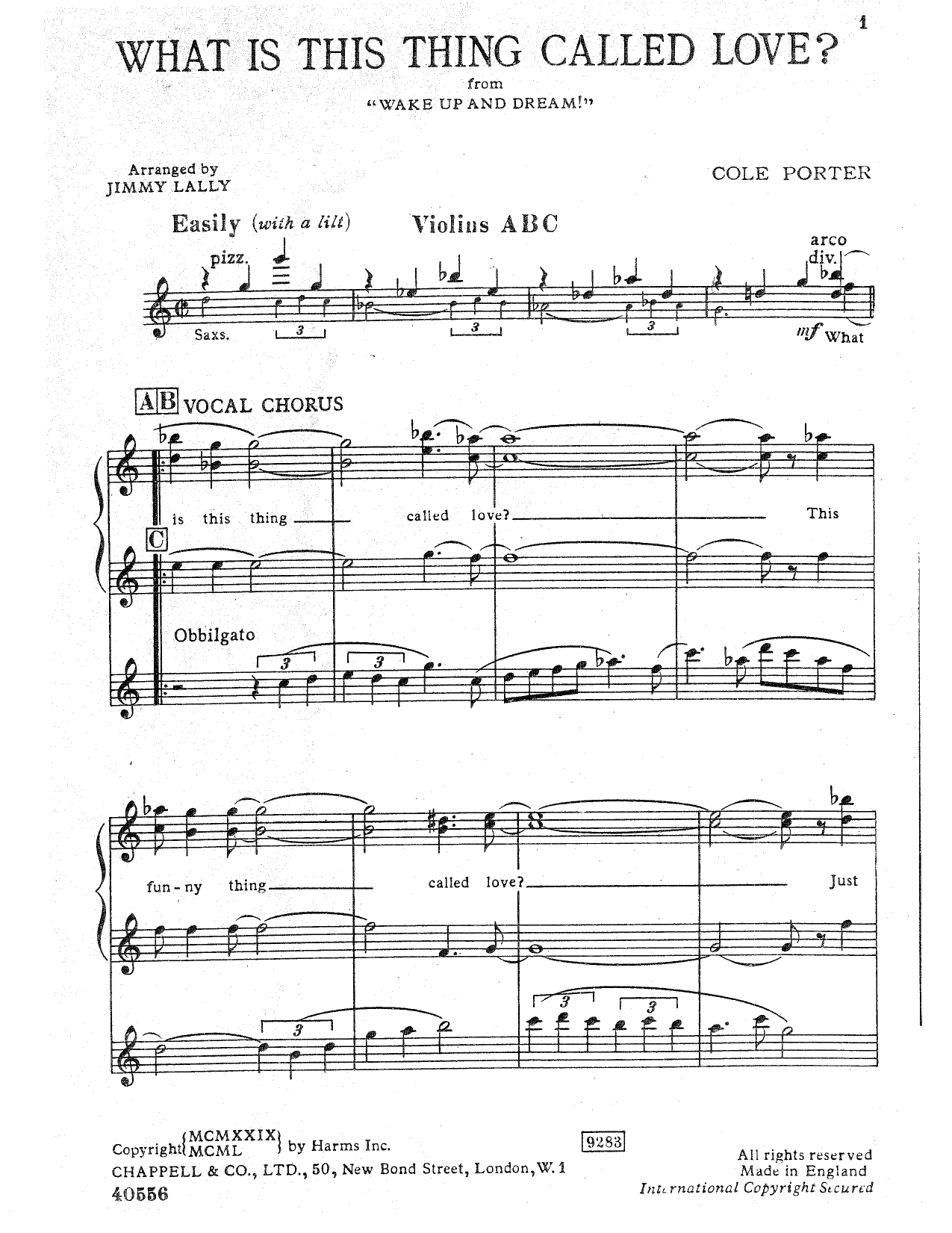
What Is This Thing Called Love (J.Lally) vocal
Composed by Cole Porter
Arranged by Jimmy Lally
- Ensemble: Big Band
- Pages: 31
- Instruments (16): Violins ABC, 1st Trumpet in Bb, 2nd Trumpet in Bb, 3rd Trumpet in Bb, 1st Trombone, 2nd Trombone, 1st Eb Alto Saxophone, 2nd Eb Alto Saxophone, 1st Bb Tenor Saxophone, 2nd Bb Tenor Saxophone, Eb Baritone Saxophone, Guitar, Piano, Bass, Drums, Vocal Chorus (cued in Piano/Violins)
- Difficulty: medium
- Content: Individual Parts
- Format: PDF Download (Instant)
- Price: $24.99
Cole Porter penned "What Is This Thing Called Love" in 1929 for the musical film *Wake Up and Dream*, transforming it almost immediately into one of the most enduring harmonic blueprints in jazz history. Built upon an intriguing, minor-key-tinted progression that moves through unexpected tonal centers, the composition quickly became a quintessential vehicle for improvisers across the bebop and mainstream jazz eras. Legendary interpretations by artists like Charlie Parker, Clifford Brown, and Ella Fitzgerald cemented its status as a cornerstone standard, praised for its sophisticated architecture and restless, searching emotional core. Jimmy Lally’s sophisticated big band setting captures the quintessential elegance of mid-century British and American dance-orchestra writing, tailored specifically to showcase a front-line vocal soloist. Set in a driving, medium-up swing groove, the arrangement balances a sophisticated, urbane mood with an underlying, high-energy pulse. The writing evokes the smoky, high-class atmosphere of a 1950s supper club while maintaining the rhythmic drive necessary to keep modern audiences engaged. Lally’s chart opens with a dramatic, atmospheric brass introduction that sets up the vocal entrance, establishing a polished harmonic framework rich with subtle chromatic passing tones and lush saxophone voicings. Throughout the chart, Lally demonstrates a masterful economy of scoring, ensuring the vocal line remains front and center without ever burying the ensemble in heavy counterpoint. The reed section—featuring alto, tenor, and baritone saxophones—acts as a flexible cushion, providing warm, close-harmony backgrounds that echo classic swing-era traditions. Brass writing is punchy yet controlled, utilizing muted textures behind the vocalist before opening up into bright, celebratory shout choruses that punctuate the form. The transition into and out of any instrumental solo space is handled with seamless modular efficiency, allowing the featured players to stretch out over standard changes while the rhythm section maintains an infectious, forward-leaning pulse. Advanced high school, collegiate, and professional community big bands will find this 31-page arrangement an exceptionally rewarding addition to their library. While the technical demands on individual horn players are moderate, the chart requires a mature sense of swing subdivision, precise dynamic control, and acute intonation within the saxophone and brass sections to truly breathe. Conductors will appreciate how naturally the arrangement sits under the fingers of the ensemble, making it an ideal choice for a formal concert setting, vocal showcase feature, or a sophisticated festival performance where stylistic polish and interpretive nuance are paramount. Achieving an authentic performance of this Jimmy Lally arrangement requires strict attention to stylistic consistency and dynamic balance, particularly in supporting the vocal soloist. The tempo should be kept at a steady, driving medium-swing—avoid rushing the quarter note, as the crispness of the articulation relies on a relaxed yet relentless pocket from the rhythm section. Drummers should maintain a feather-light bass drum pulse (four-on-the-floor) with a crisp ride cymbal pattern, utilizing subtle hi-hat chops on beats two and four. The brass section must pay close attention to mute markings where indicated, ensuring that background figures enhance rather than compete with the lyrics. Horn players should execute short notes with a clean, unaccented tongue and use natural jazz phrasing, connecting eighth notes with a smooth, flowing line rather than a rigid staccato. Rehearsals should initially focus on isolating the rhythm section and vocal soloist to lock in the form before layering in the ensemble backgrounds. Pay special attention to the dynamic swells leading into transitional phrases; balancing the inner voices of the saxophones will unlock the rich, vintage harmonic color embedded in Lally's scoring. Q: What instruments and parts are included in this arrangement? A: The 31-page instrumentation package includes a vocal lead sheet/part, alto saxophone, tenor saxophone, baritone saxophone, trumpet, and supporting rhythm section parts tailored for a classic big band lineup. Q: What is the difficulty level of this chart? A: This arrangement is graded as intermediate to advanced, making it well-suited for high school top bands, collegiate ensembles, and professional community big bands seeking a sophisticated vocal feature. Q: What style and historical era does this piece represent? A: It is written in a classic mid-century jazz big band style, drawing from the rich tradition of swing-era vocal arrangements popularized during the golden age of jazz standards. Q: What makes Jimmy Lally’s treatment of this Cole Porter standard unique? A: Lally’s arrangement expertly blends lush, sophisticated saxophone voicings and punchy brass backgrounds with a vocal-centric framework that highlights the complex harmonic shifts of Porter’s melody without overcrowding the singer. Q: What is the recommended performance tempo and duration for this arrangement? A: The chart is designed for a medium-swing tempo that swings comfortably, translating to a performance duration of approximately 3 to 4 minutes depending on the length of the instrumental solo sections.
Questions and answers
- What is included in the What Is This Thing Called Love (J.Lally) vocal PDF?
- The verified current file contains individual parts across 31 pages.
- How many instruments or parts are listed for What Is This Thing Called Love (J.Lally) vocal?
- The verified instrumentation list contains 16 entries for this Big Band arrangement.
- Who is credited for What Is This Thing Called Love (J.Lally) vocal?
- Composer: Cole Porter. Arranger: Jimmy Lally.
- What difficulty is listed for What Is This Thing Called Love (J.Lally) vocal?
- The verified difficulty level is medium.
- Can I preview What Is This Thing Called Love (J.Lally) vocal before buying?
- Yes. The product page provides a preview generated from the current PDF file.
- How is What Is This Thing Called Love (J.Lally) vocal delivered?
- After successful payment, the digital PDF is made available for download. The displayed price is $24.99.
Musicians Also Search For
What Is This Thing Called Love Jimmy Lally PDF • What Is This Thing Called Love Jimmy Lally sheet music • What Is This Thing Called Love arranged by Jimmy Lally • Jimmy Lally big band charts • Jimmy Lally jazz arrangements PDF • What Is This Thing Called Love Cole Porter sheet music • What Is This Thing Called Love Cole Porter big band arrangements • Cole Porter big band charts • What Is This Thing Called Love big band arrangements • What Is This Thing Called Love big band PDF download • What Is This Thing Called Love jazz sheet music • big band sheet music download • What Is This Thing Called Love individual parts download • What Is This Thing Called Love sheet music PDF • buy What Is This Thing Called Love sheet music • download What Is This Thing Called Love PDF • What Is This Thing Called Love jazz charts • best Jimmy Lally big band arrangements • Cole Porter arranged by Jimmy Lally • What Is This Thing Called Love printable sheet music • big band repertoire PDF