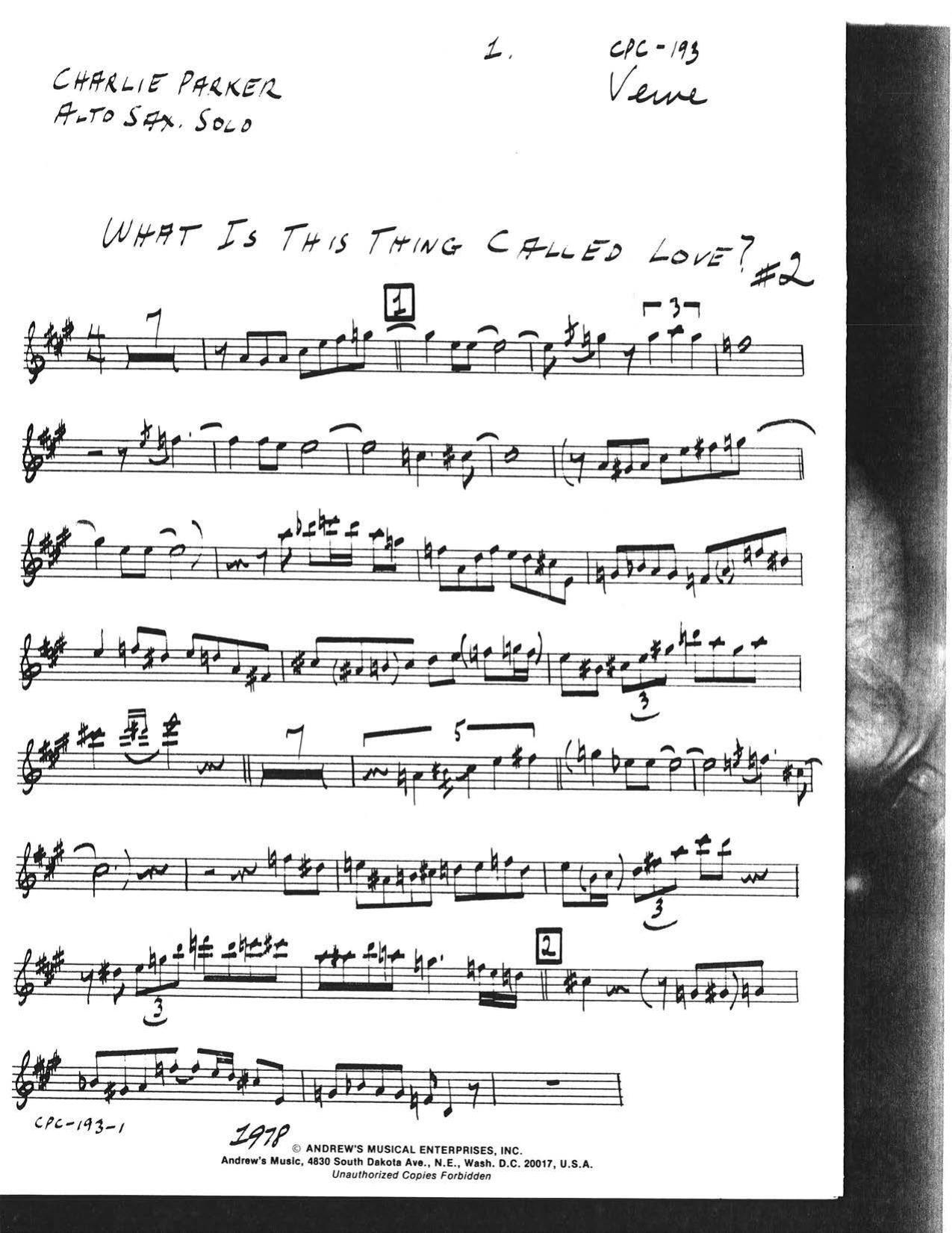
What Is This Thing Called Love (C.Paker with Strings)
Composed by Cole Porter
Arranged by Ch.Parker-String
- Ensemble: Big Band
- Pages: 76
- Instruments (13): Alto Saxophone Solo, Oboe, English Horn, Violin A, Violin B, Violin C, Viola, Cello, Double Bass, Harp, Piano, Guitar, Drums
- Difficulty: advanced
- Content: Individual Parts
- Format: PDF Download (Instant)
- Price: $24.99
Cole Porter penned "What Is This Thing Called Love" in 1929 for the musical wake *Wake Up and Dream*, transforming it almost overnight into an immutable pillar of the jazz canon. While countless vocalists and instrumentalists have tackled its haunting, minor-major harmonic shifts, the concept reaches its zenith when filtered through the lens of Charlie Parker’s groundbreaking bebop language coupled with lush, cinematic string writing. This specific synthesis bridges the gap between raw, uncompromising modern jazz improvisation and the sophisticated, sweeping orchestral palettes that defined mid-century recordings, most notably echoing the revolutionary union of bebop vernacular and classical string textures. Bebop urgency meets sophisticated orchestral poise across a medium-up tempo swing feel that balances driving rhythmic momentum with rich, melancholic harmonic color. The arrangement opens with an evocative, atmospheric intro that immediately establishes a tense yet elegant mood, driven by chromatic voice-leading and lush extended chords in the accompanying voices. As the chart settles into its primary groove, the underlying tension of Porter's descending modulations and minor-key anchor points provides a stark, dramatic canvas. The emotional landscape shifts fluidly between introspective, nocturnal reflection and high-octane bebop exhilaration, creating a sophisticated dynamic arc that captivates both connoisseurs and casual listeners alike. The scoring utilizes a tightly integrated 10-instrument ensemble (featuring alto saxophone, tenor saxophone, trumpet, trombone, and a driving rhythm section alongside string elements) that treats every voice as an essential counter-melody rather than mere background padding. The featured alto saxophone—channeling Parker’s iconic phrasing style—serves as the emotional epicentre, navigating intricate double-time passages and soaring bebop lines interwoven seamlessly with the surrounding textures. Dense chordal voicings, sophisticated contrapuntal lines, and rich harmonic extensions define the arranger's approach, demanding immaculate intonation and stylistic agility from the horn and string players alike. Solos are tightly integrated into the overarching form, ensuring that the transition from ensemble shout to intimate soloist feels organic and dramatically justified. Advanced collegiate, professional, and elite community ensembles will find this 76-page masterwork a rewarding challenge that pushes technical boundaries while offering profound artistic fulfillment. Because of the delicate balance required between rhythmic precision in the jazz front line and lyrical legato phrasing in the expanded instrumental textures, rhythm section stability and first-chair proficiency are prerequisites. Concert programmers looking to feature a virtuosic alto saxophone soloist within a strikingly unique, historically resonant, and harmonically rich orchestral framework will discover this chart to be an unforgettable centerpiece for any major performance. Navigating this arrangement requires a disciplined approach to time-feel, blending the precision of straight-ahead bebop with the breath control characteristic of classical chamber playing. The tempo must remain relentlessly steady; any dragging will deflate the harmonic tension inherent in Porter's changes. Conductors should pay close attention to the dynamic balance between the rhythm section and the horn/string voices, ensuring that complex inner voicings do not obscure the lead alto saxophone's linear statements. Horn players must master light, articulation-driven phrasing without heavy tongue accents, keeping eighth-note lines flowing effortlessly. For the rhythm section, the pianist should voice chords cleanly without overcrowding the register, leaving space for the string textures to breathe. Rehearsals should begin section by section, isolating the tricky chromatic shifts before attempting full ensemble integration at performance speed. Q: What specific instruments and parts are included in this 76-page publication? A: The arrangement is scored for a 10-instrument ensemble comprising alto saxophone, tenor saxophone, trumpet, trombone, a complete rhythm section (piano, bass, drums), and integrated string parts spanning 76 total pages of comprehensive score and individual parts. Q: What is the overall difficulty level of this arrangement? A: This chart is written for advanced collegiate, professional, and elite community ensembles, requiring sophisticated harmonic reading, precise intonation, and virtuosic command of bebop phrasing, particularly for the featured alto saxophone soloist. Q: How does this chart fit into the historical context of jazz and strings? A: It captures the spirit of Charlie Parker's historic collaboration with string orchestras, merging the intense, forward-driving language of bebop with lush, cinematic, mid-century harmonic arranging. Q: What makes this specific arrangement unique compared to standard big band charts? A: Unlike conventional horn-heavy big band arrangements, this 10-instrument chart utilizes an intricate blend of jazz horns and classical string textures to create a sophisticated, chamber-jazz hybrid soundscape. Q: What is the recommended performance tempo and duration? A: The arrangement is set at a medium-up swing tempo designed to showcase intricate bebop lines, resulting in a performance duration of approximately 4 to 5 minutes depending on solo extensions.
Questions and answers
- What is included in the What Is This Thing Called Love (C.Paker with Strings) PDF?
- The verified current file contains a conductor score and individual parts across 76 pages.
- How many instruments or parts are listed for What Is This Thing Called Love (C.Paker with Strings)?
- The verified instrumentation list contains 13 entries for this Big Band arrangement.
- Who is credited for What Is This Thing Called Love (C.Paker with Strings)?
- Composer: Cole Porter. Arranger: Ch.Parker-String.
- What difficulty is listed for What Is This Thing Called Love (C.Paker with Strings)?
- The verified difficulty level is advanced.
- Can I preview What Is This Thing Called Love (C.Paker with Strings) before buying?
- Yes. The product page provides a preview generated from the current PDF file.
- How is What Is This Thing Called Love (C.Paker with Strings) delivered?
- After successful payment, the digital PDF is made available for download. The displayed price is $24.99.
Musicians Also Search For
What Is This Thing Called Love Ch.Parker-String PDF • What Is This Thing Called Love Ch.Parker-String sheet music • What Is This Thing Called Love arranged by Ch.Parker-String • Ch.Parker-String big band charts • Ch.Parker-String jazz arrangements PDF • What Is This Thing Called Love Cole Porter sheet music • What Is This Thing Called Love Cole Porter big band arrangements • Cole Porter big band charts • What Is This Thing Called Love big band arrangements • What Is This Thing Called Love big band PDF download • What Is This Thing Called Love jazz sheet music • big band sheet music download • What Is This Thing Called Love conductor score PDF • What Is This Thing Called Love individual parts download • What Is This Thing Called Love sheet music PDF • buy What Is This Thing Called Love sheet music • download What Is This Thing Called Love PDF • What Is This Thing Called Love jazz charts • best Ch.Parker-String big band arrangements • Cole Porter arranged by Ch.Parker-String • What Is This Thing Called Love printable sheet music • big band repertoire PDF