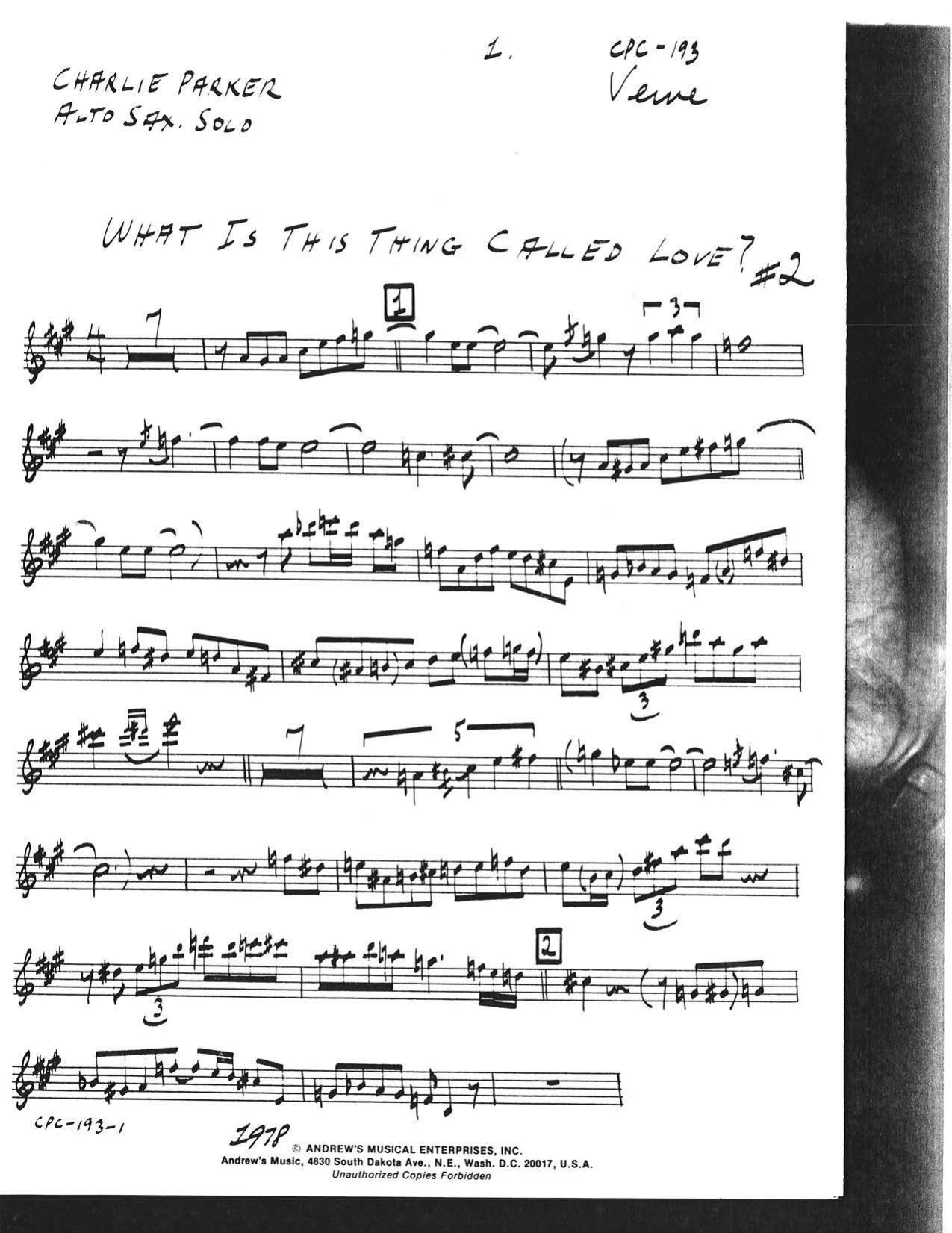
What Is This Thing Called Love (C.Paker with Strings)
Composed by Cole Porter
Arranged by Ch.Parker-String
- Ensemble: Big Band
- Pages: 76
- Instruments (13): Alto Saxophone Solo, Oboe, English Horn, Violin A, Violin B, Violin C, Viola, Cello, Double Bass, Harp, Piano, Guitar, Drums
- Difficulty: advanced
- Content: Individual Parts
- Format: PDF Download (Instant)
- Price: $24.99
Cole Porter’s timeless 1929 standard "What Is This Thing Called Love" underwent a radical harmonic and stylistic transformation when it became a cornerstone of the modern jazz vocabulary, most notably through the bebop innovations of alto saxophonist Charlie Parker. Parker famously utilized the tune's underlying chord changes as the blueprint for his iconic 1945 bebop anthem "Hot House" (co-written with Tadd Damerz) and later immortalized the song itself in his historic 1950 Vervė recording sessions with a lush string ensemble. This masterful adaptation captures the essence of that historic intersection where raw, avant-garde bebop lines meet sophisticated, cinematic string-writing aesthetics, offering ensembles a chance to explore a deeply expressive, emotionally charged landscape that moves far beyond standard big band fare. Driven by a sophisticated, supple medium-swing tempo, this arrangement bridges the gap between driving improvisational jazz and lush orchestral texture. The mood shifts dynamically between introspective, bittersweet melancholy and searing, high-energy bebop urgency. The harmonic framework is rich with altered dominants, chromatic voice-leading, and signature Parker-esque chromatic passing tones that create an atmosphere of sophisticated tension and release. The interplay between the driving rhythm section, the biting horns, and the expansive string-substitute voicings generates a dense, multi-textured sonic palette that evokes the smoke-filled intimacy of 1950s New York jazz clubs coupled with the grand scale of a concert hall. The arranger approaches this classic material by maintaining the piercing, blues-infused articulation of the bebop idiom while distributing rich, contrapuntal harmonic weights across the 10-instrument ensemble. Rather than relying on standard block-chord shout choruses, the writing utilizes intricate counterpoint, sparse and haunting background figures, and fluid ensemble solis where the alto saxophone characteristically takes the lead, channeling Bird's iconic phrasing. The arrangement demands immaculate intonation, precise balance between the rhythm section and horns, and a deep understanding of bebop phrasing where eighth-note lines must swing with an effortless, elongated feel even at demanding tempos. Designed specifically for advanced college, conservatory, and professional jazz ensembles, this 76-page publication offers a rigorous yet deeply rewarding challenge. The lead alto saxophone chair requires a player capable of navigating labyrinthine bebop lines with fluid dexterity and authentic stylistic inflection, while the rhythm section must master the subtle art of comping behind complex, shifting string-like harmonies. Featured solo space allows the soloist to stretch out over sophisticated changes, making it an extraordinary centerpiece for a serious concert program, festival performance, or recording project that seeks to showcase the depth, history, and expressive power of modern jazz. Navigating this arrangement successfully requires absolute precision in articulation and a unified stylistic vision regarding bebop phrasing. The tempo should be kept at a comfortable, driving medium swing; rushing the pulse will muddy the intricate inner voicings and destroy the relaxed urgency essential to the Parker style. Conductors should pay close attention to the balance between the horn section and the rhythm instruments, ensuring that the piano and bass do not over-articulate the quarter-note pulse, thereby preserving the floating, horizontal feel of the lines. Technically, the primary challenge lies in the execution of rapid, chromatic bebop lines in the saxophones and brass, which must be articulated with light, feathered tongue strokes rather than heavy accents. Rehearsals should begin section by section without the rhythm section, isolating the dense harmonic shifts to lock in intonation—particularly on the altered extensions and diminished passing chords. Encourage the rhythm section to listen closely to the horn voicings to mirror their dynamic contour, treating the accompaniment as a living, breathing cushion rather than a static backdrop. Q: What instruments and parts are included in this arrangement? A: The chart is scored for a 10-instrument ensemble featuring Alto Saxophone, Tenor Saxophone, Trumpet, Trombone, Piano, and accompanying rhythm/horn parts totaling 76 pages of comprehensive score and individual performance materials. Q: What is the difficulty level of this publication? A: This arrangement is rated as advanced, making it best suited for collegiate, conservatory, and professional jazz ensembles that possess strong sight-reading skills and a solid grasp of bebop vocabulary. Q: What is the historical context and musical style of this piece? A: It is styled after the legendary collaborations and aesthetic of Charlie Parker with strings from the early 1950s, transforming Cole Porter's 1929 standard into a sophisticated vehicle for modern bebop and lush, orchestral-style jazz. Q: What makes this specific arrangement unique? A: It uniquely blends the intense, linear improvisational language of bebop with expansive, contrapuntal textures that evoke a classic string-section sound, moving away from conventional big band stock shout choruses. Q: What is the performance duration and tempo feel of the arrangement? A: The piece is performed at a sophisticated medium-swing tempo, with a typical duration of approximately 4 to 6 minutes depending on the length of the improvised solo choruses.
Questions and answers
- What is included in the What Is This Thing Called Love (C.Paker with Strings) PDF?
- The verified current file contains a conductor score and individual parts across 76 pages.
- How many instruments or parts are listed for What Is This Thing Called Love (C.Paker with Strings)?
- The verified instrumentation list contains 13 entries for this Big Band arrangement.
- Who is credited for What Is This Thing Called Love (C.Paker with Strings)?
- Composer: Cole Porter. Arranger: Ch.Parker-String.
- What difficulty is listed for What Is This Thing Called Love (C.Paker with Strings)?
- The verified difficulty level is advanced.
- Can I preview What Is This Thing Called Love (C.Paker with Strings) before buying?
- Yes. The product page provides a preview generated from the current PDF file.
- How is What Is This Thing Called Love (C.Paker with Strings) delivered?
- After successful payment, the digital PDF is made available for download. The displayed price is $24.99.
Musicians Also Search For
What Is This Thing Called Love Ch.Parker-String PDF • What Is This Thing Called Love Ch.Parker-String sheet music • What Is This Thing Called Love arranged by Ch.Parker-String • Ch.Parker-String big band charts • Ch.Parker-String jazz arrangements PDF • What Is This Thing Called Love Cole Porter sheet music • What Is This Thing Called Love Cole Porter big band arrangements • Cole Porter big band charts • What Is This Thing Called Love big band arrangements • What Is This Thing Called Love big band PDF download • What Is This Thing Called Love jazz sheet music • big band sheet music download • What Is This Thing Called Love conductor score PDF • What Is This Thing Called Love individual parts download • What Is This Thing Called Love sheet music PDF • buy What Is This Thing Called Love sheet music • download What Is This Thing Called Love PDF • What Is This Thing Called Love jazz charts • best Ch.Parker-String big band arrangements • Cole Porter arranged by Ch.Parker-String • What Is This Thing Called Love printable sheet music • big band repertoire PDF