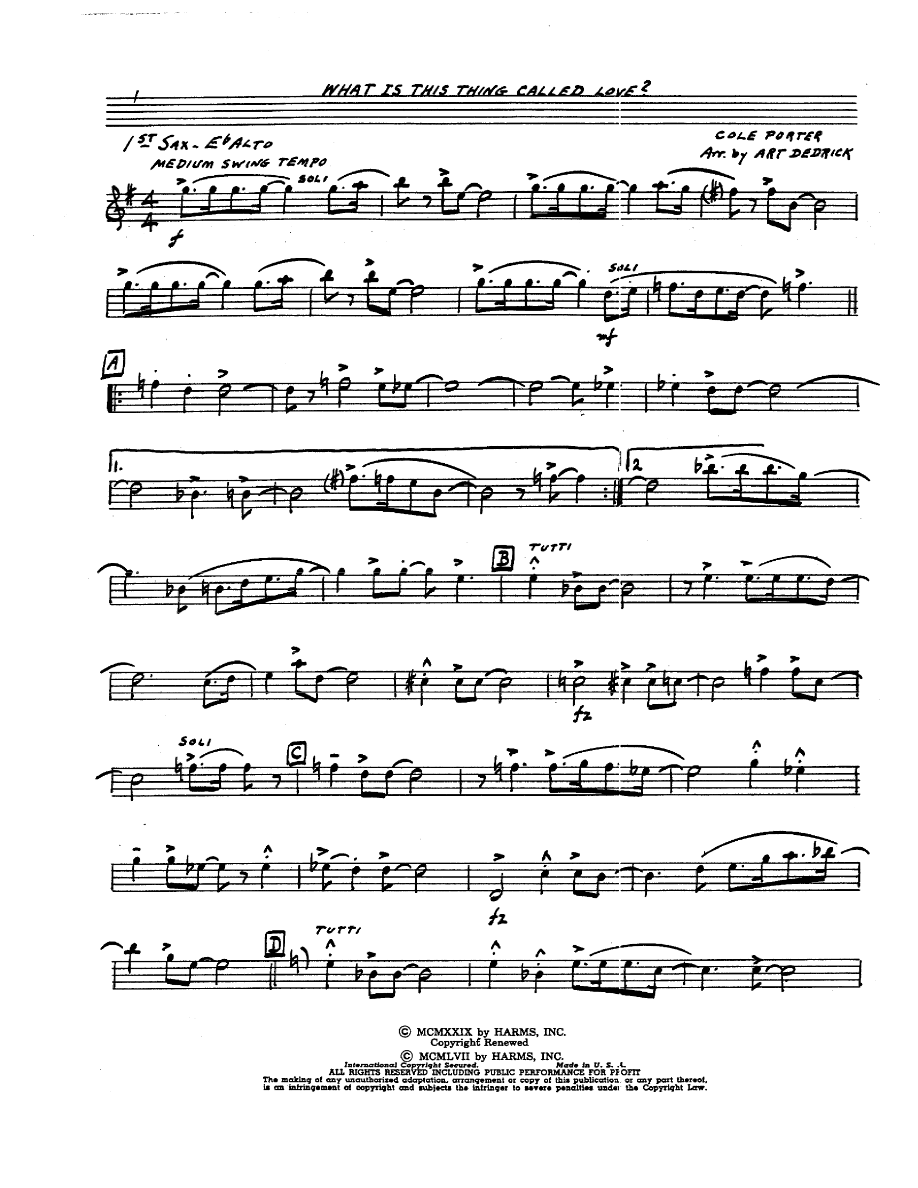
What Is This Thing Called Love (A.Dedrick)
Composed by Cole Porter
Arranged by Art Dedrick
- Ensemble: Big Band
- Style: Jazz Standard
- Pages: 28
- Instruments (17): 1st Sax - Eb Alto, 3rd Sax - Eb Alto, 2nd Sax - Bb Tenor, 4th Sax - Bb Tenor, 5th Sax - Eb Baritone, 1st Bb Trumpet, 2nd Bb Trumpet, 3rd Bb Trumpet, 4th Bb Trumpet, 1st Trombone, 2nd Trombone, 3rd Trombone, 4th Trombone, Bass Tuba, String Bass, Drums, Piano
- Difficulty: medium
- Content: Individual Parts
- Format: PDF Download (Instant)
- Price: $24.99
Cole Porter's timeless composition, "What Is This Thing Called Love," emerged from the 1929 musical *Wake Up and Dream*, quickly cementing its place in the Great American Songbook. This sophisticated standard, with its captivating AABA form and deceptively complex harmonic progression, became a cornerstone of the jazz repertoire, famously interpreted by legends like Clifford Brown, Ella Fitzgerald, and Frank Sinatra. Its enduring appeal lies in its exploration of love's perplexing nature, a theme that resonates across generations, making it an ideal vehicle for both lyrical improvisation and intricate big band arrangements. Art Dedrick's masterful treatment of this classic delivers a vibrant, medium-up swing feel that is both authentic to the era and refreshingly dynamic. Set primarily in the key of C minor, Dedrick skillfully navigates Porter's rich harmonic landscape, employing his signature clean voicings and intelligent counterpoint. The arrangement opens with a driving, full-ensemble statement of the melody, immediately establishing a bright, energetic mood. Dedrick's genius shines through in his ability to create a sense of forward motion and excitement without sacrificing clarity. Expect lush saxophone soli sections that weave intricate lines, punctuated by powerful brass interjections, building a compelling narrative throughout the piece. This arrangement is a showcase for a well-rounded big band, offering rewarding challenges and opportunities for individual expression. The melody is initially carried by the saxophones, later transitioning to the brass, creating varied textures. There are ample opportunities for featured soloists, typically a tenor saxophone and trumpet, with clearly marked chord changes that encourage creative improvisation over Porter's iconic progression. Dedrick's arrangement culminates in a powerful shout chorus that brings the entire ensemble together in a thrilling, harmonically rich climax, showcasing the band's collective power and precision. The technical demands are moderate to advanced, requiring solid ensemble blend, rhythmic accuracy, and confident soloists. Musically, this arrangement evokes a feeling of sophisticated exuberance – a classic big band sound that is both elegant and driving. It's perfectly suited for high school honor bands, college jazz ensembles, and community big bands aiming to perform a cornerstone of the jazz repertoire with authenticity and flair. The clarity of Dedrick's writing makes it an excellent teaching tool for understanding big band voicings and swing articulation, while its inherent musicality ensures a rewarding performance experience for both musicians and audience members. This arrangement thrives on a consistent, medium-up swing feel (quarter note around 160-170 bpm). Emphasize precise articulation, particularly the short, detached eighth notes characteristic of swing. Brass players should focus on clean attacks and releases, while saxophones should aim for a unified, warm blend in soli sections. The dynamic contrasts are crucial; ensure clear distinctions between *forte* ensemble passages and *mezzo piano* accompaniment figures to build tension and release. Soloists should be encouraged to explore the harmonic richness of Porter's changes, and rhythm section players should maintain a steady, driving pulse without overpowering the melodic lines. Pay close attention to the ensemble hits in the shout chorus, ensuring maximum impact through unified attacks and releases across all sections. Q: What instruments are included in this arrangement? A: This arrangement is scored for a standard 17-piece big band: Alto Saxophone 1 & 2, Tenor Saxophone 1 & 2, Baritone Saxophone, Trumpet 1-4, Trombone 1-4, Piano, Bass, Guitar, and Drums. Q: What is the difficulty level of "What Is This Thing Called Love (A.Dedrick)"? A: This arrangement is rated as medium-advanced. It requires solid ensemble playing, good rhythmic precision, and capable soloists, making it suitable for advanced high school, college, or community jazz ensembles. Q: What musical style and historical context does this arrangement represent? A: This is a classic jazz standard arrangement in a medium-up swing style, reflecting the big band era's interpretation of Cole Porter's iconic 1929 composition. It embodies the sophisticated, driving sound of traditional jazz orchestras. Q: What makes Art Dedrick's arrangement of this piece unique? A: Dedrick's signature style is evident in his clean, accessible voicings, intelligent counterpoint, and effective use of dynamic contrasts. He balances ensemble power with opportunities for lyrical solo improvisation, creating a vibrant and engaging chart. Q: What is the approximate performance duration and recommended tempo for this piece? A: The approximate performance duration is 3-4 minutes, depending on the length of improvised solos. The recommended tempo is a medium-up swing, typically around 160-170 beats per minute.
Questions and answers
- What is included in the What Is This Thing Called Love (A.Dedrick) PDF?
- The verified current file contains individual parts across 28 pages.
- How many instruments or parts are listed for What Is This Thing Called Love (A.Dedrick)?
- The verified instrumentation list contains 17 entries for this Big Band arrangement.
- Who is credited for What Is This Thing Called Love (A.Dedrick)?
- Composer: Cole Porter. Arranger: Art Dedrick.
- What difficulty is listed for What Is This Thing Called Love (A.Dedrick)?
- The verified difficulty level is medium.
- What style is listed for What Is This Thing Called Love (A.Dedrick)?
- The catalog lists the style as Jazz Standard.
- Can I preview What Is This Thing Called Love (A.Dedrick) before buying?
- Yes. The product page provides a preview generated from the current PDF file.
- How is What Is This Thing Called Love (A.Dedrick) delivered?
- After successful payment, the digital PDF is made available for download. The displayed price is $24.99.
Musicians Also Search For
What Is This Thing Called Love Art Dedrick PDF • What Is This Thing Called Love Art Dedrick sheet music • What Is This Thing Called Love arranged by Art Dedrick • Art Dedrick big band charts • Art Dedrick jazz arrangements PDF • What Is This Thing Called Love Cole Porter sheet music • What Is This Thing Called Love Cole Porter big band arrangements • Cole Porter big band charts • What Is This Thing Called Love big band arrangements • What Is This Thing Called Love big band PDF download • What Is This Thing Called Love jazz sheet music • big band sheet music download • What Is This Thing Called Love individual parts download • What Is This Thing Called Love sheet music PDF • What Is This Thing Called Love Jazz Standard charts • Jazz Standard big band arrangements • buy What Is This Thing Called Love sheet music • download What Is This Thing Called Love PDF • What Is This Thing Called Love jazz charts • best Art Dedrick big band arrangements • Cole Porter arranged by Art Dedrick • What Is This Thing Called Love printable sheet music • big band repertoire PDF