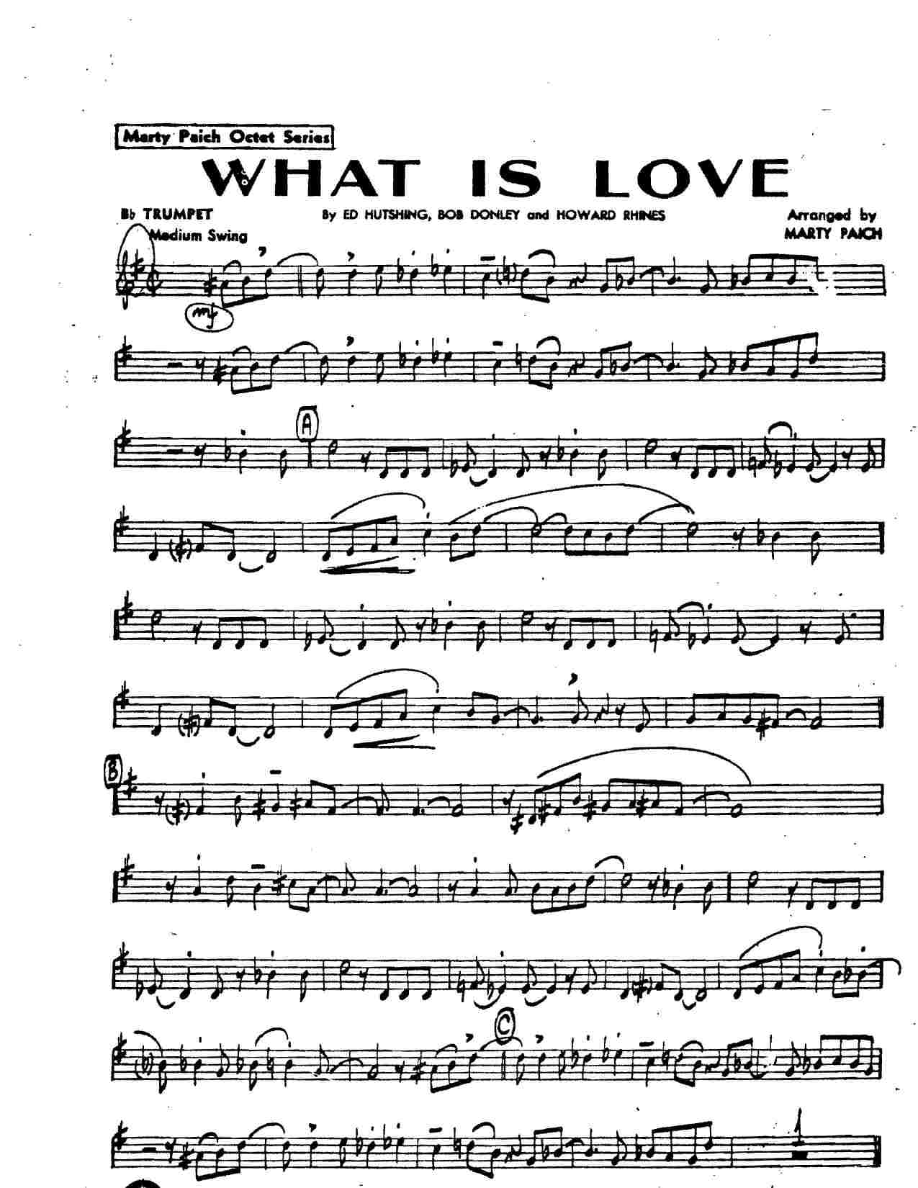
What Is Love (P.Ts,Bs,Trp,Trb+Rhythm)
Composed by Dee Dee Halligan, Junior Torello
Arranged by Paich - Dave Pell Octet - Ts,Bs,Trp,Trb+Rhythm
- Ensemble: Small Ensemble
- Style: Jazz Standard
- Pages: 15
- Difficulty: easy
- Content: Sheet Music
- Format: PDF Download (Instant)
- Price: $12.99
The timeless question "What Is Love" finds its definitive jazz interpretation in this exceptional arrangement for small ensemble, originally conceived by the legendary Dave Pell Octet and masterfully arranged by Marty Paich. While the original pop hit "What Is Love" by Haddaway (Dee Dee Halligan, Junior Torello) emerged in 1993 as a Eurodance anthem, its infectious melodic hooks and driving rhythm have proven fertile ground for reinterpretation across genres. This arrangement, however, predates the Haddaway hit, drawing its inspiration from the rich tradition of jazz standards and the sophisticated West Coast cool jazz sound. It represents an era where intricate counterpoint and polished ensemble work defined small group jazz, offering a sophisticated take on popular melodies or original compositions that quickly entered the jazz lexicon. This arrangement captures a quintessential medium swing feel, typically set in a comfortable, accessible key like C or F Major, allowing for both melodic clarity and harmonic richness. The overall mood is one of sophisticated cool, characterized by a relaxed yet propulsive energy. It evokes the intimate, cerebral atmosphere of a 1950s jazz club, balancing lyrical melodic lines with understated harmonic complexity. The piece maintains a consistent 4/4 meter, driven by a walking bass line and a subtle, swinging drum pattern, creating a groove that is both inviting and intellectually engaging. The interplay between the horns creates a tapestry of sound that is both lush and transparent, avoiding density in favor of clarity and precision. Marty Paich's distinctive arranging style, synonymous with the Dave Pell Octet, is immediately evident in this chart. His signature approach involves meticulously crafted voicings that maximize the sonic potential of a small horn section (Tenor Sax, Baritone Sax, Trumpet, Trombone). Expect tight, harmonized soli sections where the horns move as a single, cohesive unit, showcasing Paich's genius for blending timbres and creating rich, extended harmonies without sounding cluttered. There are likely moments of intricate counterpoint, where individual horn lines weave together, creating a dialogue that is both challenging and rewarding. While a traditional shout chorus might be present, it would be characterized by Paich's characteristic restraint and harmonic ingenuity rather than sheer volume. Modulations, if present, would be smooth and logical, serving to refresh the harmonic landscape without disrupting the overall flow. The melody is primarily carried by the trumpet and tenor saxophone, often in unison or harmonized, creating a classic front-line sound. Feature solos are integral, typically allocated to the tenor saxophone and trumpet, providing ample space for improvisation over the sophisticated chord changes. Technical challenges include precise articulation within the soli sections, maintaining a consistent medium swing feel, and navigating Paich's often-chromatic inner voice movements. The rewarding aspect lies in achieving the ensemble's tight blend and balance, and the satisfaction of performing a piece that is both musically intelligent and undeniably swinging. This arrangement is ideally suited for college-level jazz ensembles, advanced community bands, or professional small groups seeking to explore the nuanced artistry of West Coast cool jazz. Its demands for precision and musical maturity make it an excellent vehicle for developing ensemble cohesion and stylistic authenticity. Conductors should emphasize a relaxed, yet precise medium swing feel from the outset, ensuring the rhythm section lays down a solid, unhurried groove. Key technical challenges include maintaining impeccable intonation and balance within the tightly voiced horn soli sections, particularly where the baritone saxophone and trombone provide harmonic support to the trumpet and tenor saxophone. Encourage musicians to listen across the section, blending their individual sounds into a cohesive whole. Articulation should be crisp but not overly aggressive, favoring a legato-swing style where appropriate. There are no specific special techniques like plungers or doits required, but attention to dynamics and phrasing is paramount to conveying the cool jazz aesthetic. Rehearsal tips should focus on isolating tricky harmonic passages and practicing them slowly, gradually increasing tempo while maintaining clarity and blend. Encourage soloists to embrace the melodic and harmonic language of the West Coast style, emphasizing lyrical improvisation over technical flash. Q: What instruments are included in this arrangement? A: This arrangement is scored for a small ensemble featuring Tenor Saxophone, Baritone Saxophone, Trumpet, Trombone, and a standard Rhythm Section (Piano, Bass, Drums). Q: What is the difficulty level of "What Is Love (Paich - Dave Pell Octet)"? A: This arrangement is considered advanced intermediate to advanced, suitable for college-level jazz ensembles, advanced community bands, or professional small groups due to its intricate voicings, precise articulation demands, and sophisticated harmonic language. Q: What is the musical style and historical context of this arrangement? A: This arrangement embodies the sophisticated West Coast cool jazz style of the 1950s, characterized by intricate ensemble writing, refined harmonies, and a relaxed medium swing feel, as popularized by the Dave Pell Octet. Q: What makes this arrangement unique compared to other jazz charts? A: Its uniqueness stems from Marty Paich's signature arranging style, featuring meticulously crafted voicings for a small horn section, intricate counterpoint, and a focus on ensemble blend and harmonic sophistication, typical of the Dave Pell Octet's sound. Q: What is the typical performance duration and tempo feel for this piece? A: The performance duration will vary slightly with improvisation, but typically ranges from 4-6 minutes. It is designed to be performed at a consistent medium swing tempo, providing a comfortable yet propulsive groove.
Musicians Also Search For
What Is Love Paich - Dave Pell Octet - Ts,Bs,Trp,Trb+Rhythm PDF • What Is Love Paich - Dave Pell Octet - Ts,Bs,Trp,Trb+Rhythm sheet music • What Is Love arranged by Paich - Dave Pell Octet - Ts,Bs,Trp,Trb+Rhythm • Paich - Dave Pell Octet - Ts,Bs,Trp,Trb+Rhythm small ensemble charts • Paich - Dave Pell Octet - Ts,Bs,Trp,Trb+Rhythm jazz arrangements PDF • What Is Love Dee Dee Halligan, Junior Torello sheet music • What Is Love Dee Dee Halligan, Junior Torello small ensemble arrangement • Dee Dee Halligan, Junior Torello small ensemble charts • What Is Love small ensemble arrangement • What Is Love small ensemble PDF download • What Is Love jazz ensemble sheet music • small ensemble sheet music instant download • What Is Love sheet music with parts • What Is Love Jazz Standard chart • Jazz Standard small ensemble arrangements • buy What Is Love sheet music online • download What Is Love PDF • What Is Love jazz chart • best Paich - Dave Pell Octet - Ts,Bs,Trp,Trb+Rhythm small ensemble arrangements • Dee Dee Halligan, Junior Torello songs arranged by Paich - Dave Pell Octet - Ts,Bs,Trp,Trb+Rhythm • What Is Love printable sheet music • small ensemble repertoire PDF