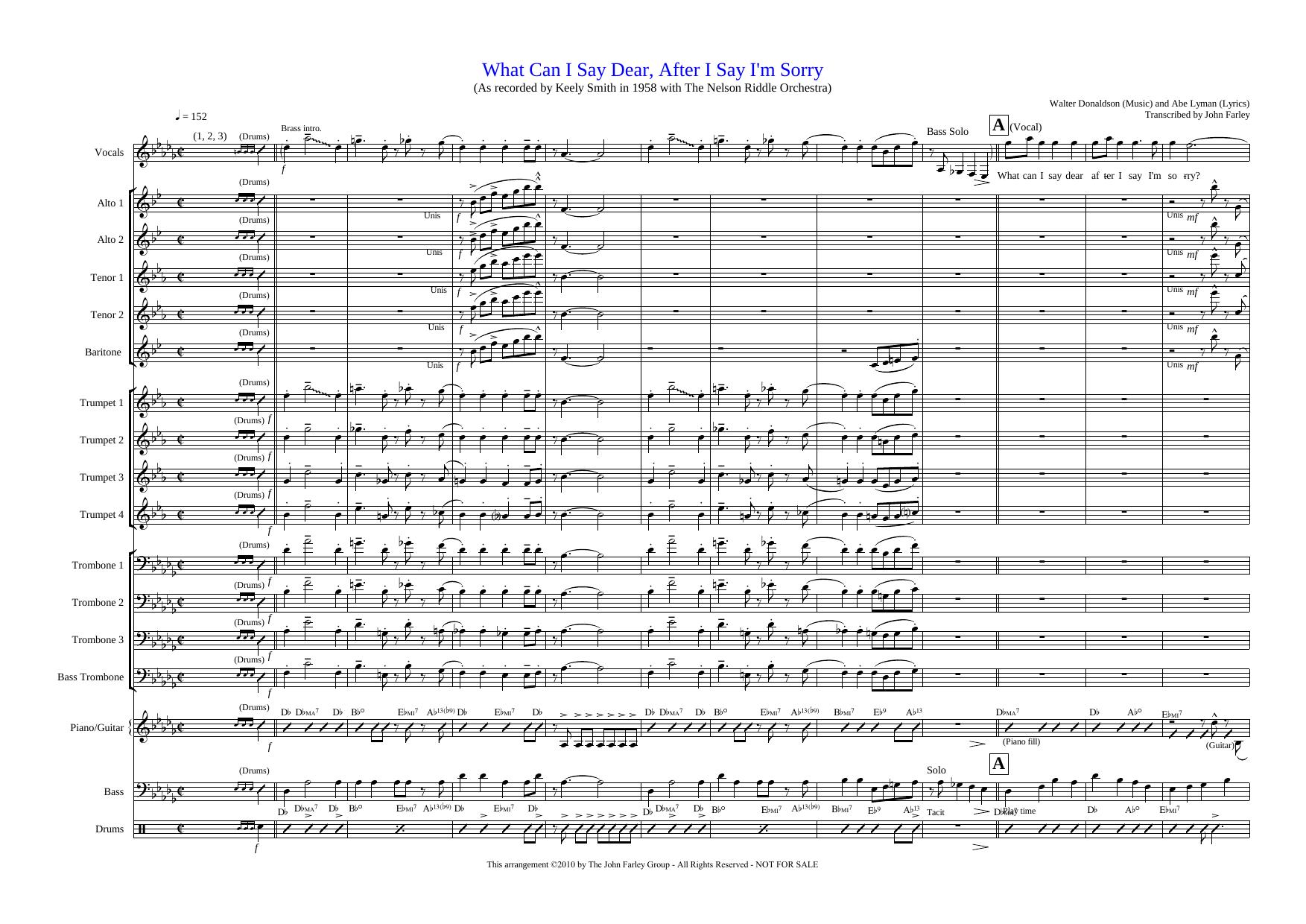
What Can I Say Dear,After I Say I'm Sorry (J.Farley)
Composed by Walter Donaldson
Arranged by John Farley
- Ensemble: Big Band
- Pages: 32
- Instruments (19): Vocals, Alto Saxophone 1, Clarinet in Bb, Alto Saxophone 2, Tenor Saxophone 1, Tenor Saxophone 2, Baritone Saxophone, Trumpet 1, Trumpet 2, Trumpet 3, Trumpet 4, Trombone 1, Trombone 2, Trombone 3, Bass Trombone, Piano, Guitar, Bass, Drums
- Difficulty: medium
- Content: Individual Parts
- Format: PDF Download (Instant)
- Price: $24.99
Walter Donaldson and Abe Lyman penned "What Can I Say, Dear, After I Say I’m Sorry" in 1926, cementing its place as a quintessential Tin Pan Alley standard of the Roaring Twenties. While initially popularized during the late-vocal jazz and early swing eras by iconic interpreters like Annette Hanshaw and later revisited by traditional jazz revivalists, the tune possesses a malleable harmonic framework that lends itself brilliantly to sophisticated big band treatment. Its enduring appeal lies in its deceptively simple AABA song form, which bridges the gap between sentimental pop-cabaret lyricism and buoyant, dance-hall swing. John Farley’s masterwork for 18-piece big band breathes new life into this 1920s classic by recasting it in a polished, medium-tempo swing pocket reminiscent of the late 1930s Kansas City style. Operating in a comfortable, brass-friendly key, the arrangement opens with a sultry, rubato vocal intro before locking into a driving, four-to-the-bar rhythm section pulse. The mood shifts effortlessly from nostalgic and intimate to exuberant and swinging, evoking the smoky atmosphere of a classic metropolitan supper club while maintaining the high-energy momentum required to captivate a modern audience. Farley’s characteristic arranging style shines through in the clever interplay between the reed and brass sections, utilizing rich, extended chord voicings and subtle chromatic counterpoint. A standout feature of this chart is a tightly knit, harmonized saxophone soli that tracks the primary melody with intricate bebop-adjacent passing tones, followed immediately by a soaring brass shout chorus that builds dynamically without sacrificing clarity. The vocal chart is tailor-made for a compelling frontman or songstress, offering ample room for expressive rubato phrasing in the head before opening up into the swinging ensemble sections. Advanced high school ensembles, collegiate jazz orchestras, and professional community big bands will find this 32-page score to be an ideal showcase. While the rhythm section requires a steady, sophisticated touch to maintain the buoyant swing feel, the horn parts are well-idiomed and lie comfortably within standard ranges. Featured solo opportunities for alto saxophone or trumpet provide a wonderful vehicle for developing improvisers to stretch out over standard changes, making it a rewarding, crowd-pleasing addition to any standard jazz repertoire concert. Executing John Farley’s arrangement of "What Can I Say, Dear, After I Say I’m Sorry" requires careful attention to articulation, balance, and stylistic cohesion. The target tempo is a comfortable medium swing (around 120–126 BPM), where the underlying triplet feel must remain relaxed yet driving. Rhythm section players should avoid heavy, downbeat-heavy hammering; the drummer should ride on a shimmering high-hat on beats two and four with a feathered bass drum, while the bassist walks a connected, quarter-note line with emphasis on the upper chord tones. Horn players must balance short, clipped short-articulations on unstressed notes with full-voiced, legato lines during the sax soli to ensure the phrasing breathes naturally. Conductors should pay close attention to dynamic contrast between the intimate vocal-led intro and the full-ensemble shouts; ensure the brass never covers the vocalist during the A sections. Subtle plunger mutes or cup mutes in the trumpet section will enhance the authentic retro texture during the background figures. Q: What instruments and parts are included in this 18-instrument big band arrangement? A: The instrumentation comprises a full big band complement: Vocal, 2 Alto Saxophones, 2 Tenor Saxophones, Baritone Saxophone, 4 Trumpets, 4 Trombones, Piano, Guitar, Bass, and Drums, spanning a comprehensive 32-page conductor and parts set. Q: What is the difficulty level of this arrangement? A: This arrangement is rated as medium-advanced, making it exceptionally well-suited for advanced high school, collegiate, and professional community big bands looking for a polished, historically grounded chart. Q: What musical style and historical era does this arrangement inhabit? A: It is styled as a classic medium-swing big band chart that reinterprets Walter Donaldson and Abe Lyman's 1926 Tin Pan Alley standard through the sophisticated harmonic and textural lens of the late 1930s swing era. Q: What makes John Farley’s treatment of this standard unique? A: Farley uniquely balances a vocal-centric cabaret aesthetic with intricate horn voicings, featuring a harmonized saxophone soli and a dynamically driving shout chorus that elevates a simple 1920s pop tune into a sophisticated modern big band feature. Q: What is the performance duration and recommended tempo for this piece? A: The arrangement plays out in approximately 3 to 4 minutes at a recommended medium-swing tempo of 120–126 beats per minute.
Questions and answers
- What is included in the What Can I Say Dear,After I Say I'm Sorry (J.Farley) PDF?
- The verified current file contains a conductor score and individual parts across 32 pages.
- How many instruments or parts are listed for What Can I Say Dear,After I Say I'm Sorry (J.Farley)?
- The verified instrumentation list contains 19 entries for this Big Band arrangement.
- Who is credited for What Can I Say Dear,After I Say I'm Sorry (J.Farley)?
- Composer: Walter Donaldson. Arranger: John Farley.
- What difficulty is listed for What Can I Say Dear,After I Say I'm Sorry (J.Farley)?
- The verified difficulty level is medium.
- Can I preview What Can I Say Dear,After I Say I'm Sorry (J.Farley) before buying?
- Yes. The product page provides a preview generated from the current PDF file.
- How is What Can I Say Dear,After I Say I'm Sorry (J.Farley) delivered?
- After successful payment, the digital PDF is made available for download. The displayed price is $24.99.
Musicians Also Search For
What Can I Say Dear,After I Say I'm Sorry John Farley PDF • What Can I Say Dear,After I Say I'm Sorry John Farley sheet music • What Can I Say Dear,After I Say I'm Sorry arranged by John Farley • John Farley big band charts • John Farley jazz arrangements PDF • What Can I Say Dear,After I Say I'm Sorry Walter Donaldson sheet music • What Can I Say Dear,After I Say I'm Sorry Walter Donaldson big band arrangements • Walter Donaldson big band charts • What Can I Say Dear,After I Say I'm Sorry big band arrangements • What Can I Say Dear,After I Say I'm Sorry big band PDF download • What Can I Say Dear,After I Say I'm Sorry jazz sheet music • big band sheet music download • What Can I Say Dear,After I Say I'm Sorry conductor score PDF • What Can I Say Dear,After I Say I'm Sorry individual parts download • What Can I Say Dear,After I Say I'm Sorry sheet music PDF • buy What Can I Say Dear,After I Say I'm Sorry sheet music • download What Can I Say Dear,After I Say I'm Sorry PDF • What Can I Say Dear,After I Say I'm Sorry jazz charts • best John Farley big band arrangements • Walter Donaldson arranged by John Farley • What Can I Say Dear,After I Say I'm Sorry printable sheet music • big band repertoire PDF