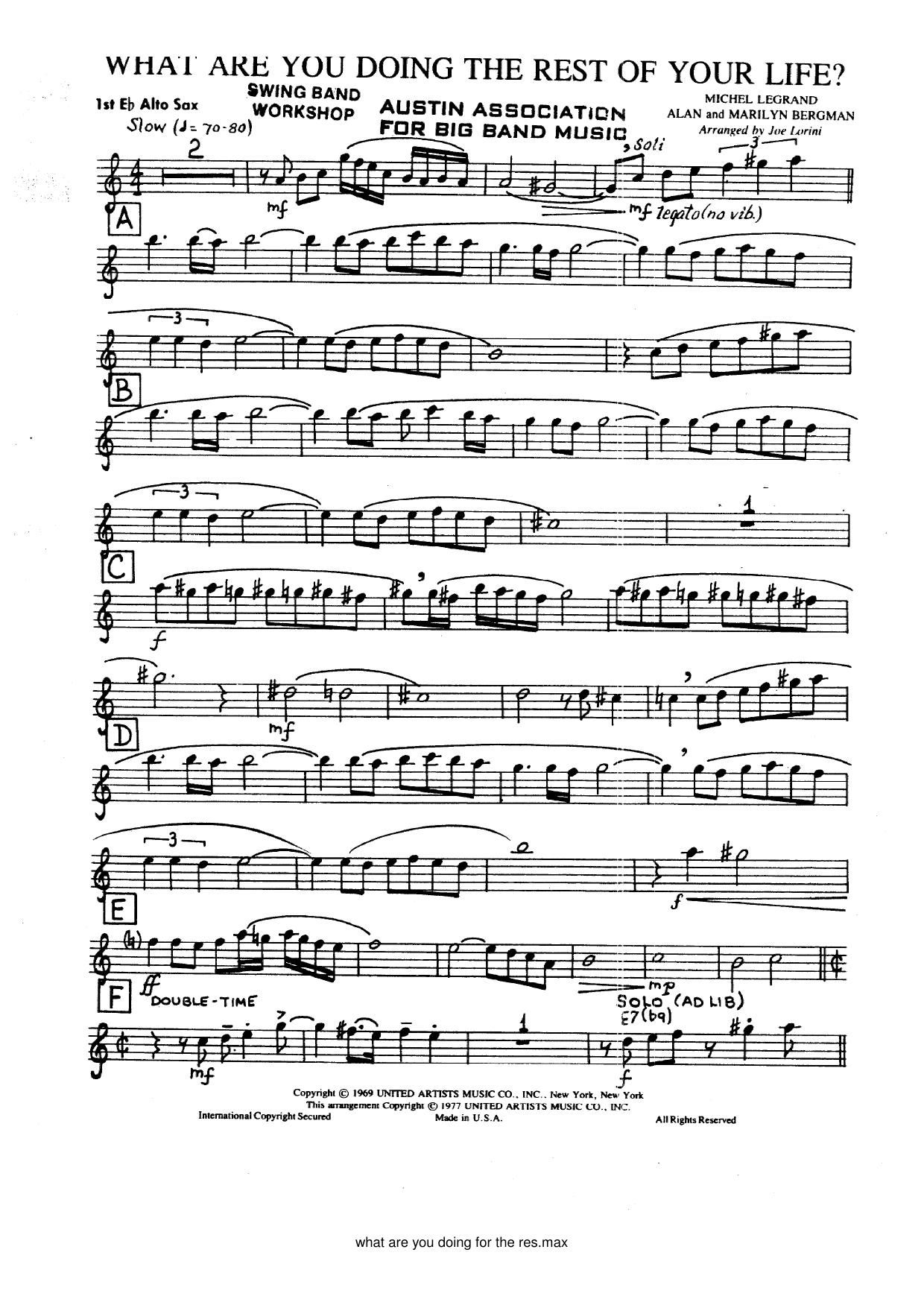
What Are You Doing For The Rest (J.Lorini)
Composed by Michel Legrand
Arranged by J.Lorini
- Ensemble: Big Band
- Style: Jazz Standard
- Pages: 35
- Instruments (17): 1st Eb Alto Sax, 2nd Eb Alto Sax, 1st Bb Tenor Sax, 2nd Bb Tenor Sax, Eb Baritone Sax, 1st Trumpet, 2nd Trumpet, 3rd Trumpet, 4th Trumpet, 1st Trombone, 2nd Trombone, 3rd Trombone, 4th Trombone, Guitar, Piano, Bass, Drums
- Difficulty: medium
- Content: Individual Parts
- Format: PDF Download (Instant)
- Price: $24.99
Michel Legrand’s timeless masterwork, originally composed for the 1969 film *The Happy Ending* and later enshrined as an elite jazz standard by vocalists and instrumentalists alike, receives a breathtaking reimagining in this 17-instrument big band charting by J. Lorini. Representative of the sophisticated, cinematic wing of the jazz standard repertoire, the composition is celebrated for its sweeping, melancholic harmonic architecture and cyclical, yearning melody. Lorini preserves the inherent dramatic tension of Legrand's writing while reframing it through a lush, contemporary big band lens that balances intimate chamber-jazz textures with powerful, room-filling ensemble climaxes. Unfolding as a deeply expressive ballad with a flowing, rubato-inflected pulse, the arrangement navigates rich tonal centers with sophisticated extended harmonies and evocative chromatic movement. The emotional landscape shifts seamlessly from quiet, reflective vulnerability to towering, passionate outbursts. Lorini utilizes the full color palette of the modern jazz orchestra, juxtaposing warm, low-register saxophone solids against shimmering upper-structure brass voicings. The arrangement avoids predictable formulas, instead treating the iconic melody with harmonic depth and textural variation that constantly recontextualizes the core motif, evoking a profound sense of nostalgia, longing, and romantic aspiration. Lorini’s distinctive approach relies heavily on masterclass-level counterpoint and subtle inner-voice motion, ensuring that even during static harmonic pads, the accompaniment remains alive and conversational. Rather than relying on a standard, high-octane shout chorus, the arrangement builds toward a magnificent, swelling climax that showcases the brass section's capability for controlled, soaring dynamics before gracefully receding into a hushed, contemplative coda. The melody is shared primarily between the lead woodwinds and a featured soloist, allowing ample space for expressive interpretation, rubato phrasing, and nuanced dynamic control. Advanced high school ensembles, collegiate jazz orchestras, and professional big bands will find this charting an exceptional vehicle for developing mature ensemble listening, intonation, and stylistic cohesion. Because the chart relies heavily on rubato pacing, delicate balance, and emotional restraint rather than sheer velocity, it offers a refreshing artistic challenge that rewards mature musicianship. It stands out as a magnificent concert centerpiece or festival ballad selection, offering audiences a profoundly moving journey through one of the twentieth century's most sublime melodic creations. This arrangement demands exceptional breath support, pristine intonation, and mature stylistic maturity, functioning more like a wind ensemble work nested within a jazz idiom. The conductor should approach the tempo flexibly, utilizing subtle push-and-pull rubato during rubato transition segments while establishing a rock-solid, unhurried pulse during metronomic ballad sections. Key technical challenges include maintaining a warm, centered tone in extreme registers—particularly for the saxophone section during high-register counter-melodies and the brass during soft dynamic plateaus. Ensure that players avoid heavy vibrato, opting instead for a clean, modern jazz tone that can bloom dynamically without distorting pitch. Rehearsal should begin with section-only work focused on balance and blend, specifically isolating the inner-voice harmony parts in the saxophones and trombones to ensure the complex chord extensions voice cleanly. Emphasize that dynamic swells must be executed collectively; require the lead players to model the precise shape of each crescendo and decrescendo to achieve Lorini’s intended cinematic sweep. Q: What instruments and parts are included in this 35-page big band arrangement? A: The charting is scored for a standard 17-instrument big band lineup, comprising 2 alto saxophones, 2 tenor saxophones, 1 baritone saxophone, standard brass configurations, and a full rhythm section. Q: What is the designated difficulty level for this arrangement? A: This piece is best suited for advanced high school, collegiate, and professional big bands capable of mature listening, nuanced dynamic control, and sophisticated ballad interpretation. Q: What is the musical style and historical background of the source material? A: The piece is a sophisticated jazz ballad based on Michel Legrand’s Academy Award-nominated theme from the 1969 film *The Happy Ending*, representing the pinnacle of cinematic jazz songwriting. Q: What makes J. Lorini’s arrangement unique compared to standard stock charts? A: Lorini utilizes advanced counterpoint, rich extended harmonies, and cinematic orchestration that transitions from intimate textures to a soaring, emotive climax without relying on a traditional upbeat shout chorus. Q: What is the recommended performance duration and tempo feel? A: The arrangement is paced as an expressive, expansive concert ballad featuring a flexible, rubato-influenced tempo feel that typically spans between 4 and 6 minutes depending on the soloist's cadenza choices.
Questions and answers
- What is included in the What Are You Doing For The Rest (J.Lorini) PDF?
- The verified current file contains individual parts across 35 pages.
- How many instruments or parts are listed for What Are You Doing For The Rest (J.Lorini)?
- The verified instrumentation list contains 17 entries for this Big Band arrangement.
- Who is credited for What Are You Doing For The Rest (J.Lorini)?
- Composer: Michel Legrand. Arranger: J.Lorini.
- What difficulty is listed for What Are You Doing For The Rest (J.Lorini)?
- The verified difficulty level is medium.
- What style is listed for What Are You Doing For The Rest (J.Lorini)?
- The catalog lists the style as Jazz Standard.
- Can I preview What Are You Doing For The Rest (J.Lorini) before buying?
- Yes. The product page provides a preview generated from the current PDF file.
- How is What Are You Doing For The Rest (J.Lorini) delivered?
- After successful payment, the digital PDF is made available for download. The displayed price is $24.99.
Musicians Also Search For
What Are You Doing For The Rest J.Lorini PDF • What Are You Doing For The Rest J.Lorini sheet music • What Are You Doing For The Rest arranged by J.Lorini • J.Lorini big band charts • J.Lorini jazz arrangements PDF • What Are You Doing For The Rest Michel Legrand sheet music • What Are You Doing For The Rest Michel Legrand big band arrangements • Michel Legrand big band charts • What Are You Doing For The Rest big band arrangements • What Are You Doing For The Rest big band PDF download • What Are You Doing For The Rest jazz sheet music • big band sheet music download • What Are You Doing For The Rest individual parts download • What Are You Doing For The Rest sheet music PDF • What Are You Doing For The Rest Jazz Standard charts • Jazz Standard big band arrangements • buy What Are You Doing For The Rest sheet music • download What Are You Doing For The Rest PDF • What Are You Doing For The Rest jazz charts • best J.Lorini big band arrangements • Michel Legrand arranged by J.Lorini • What Are You Doing For The Rest printable sheet music • big band repertoire PDF