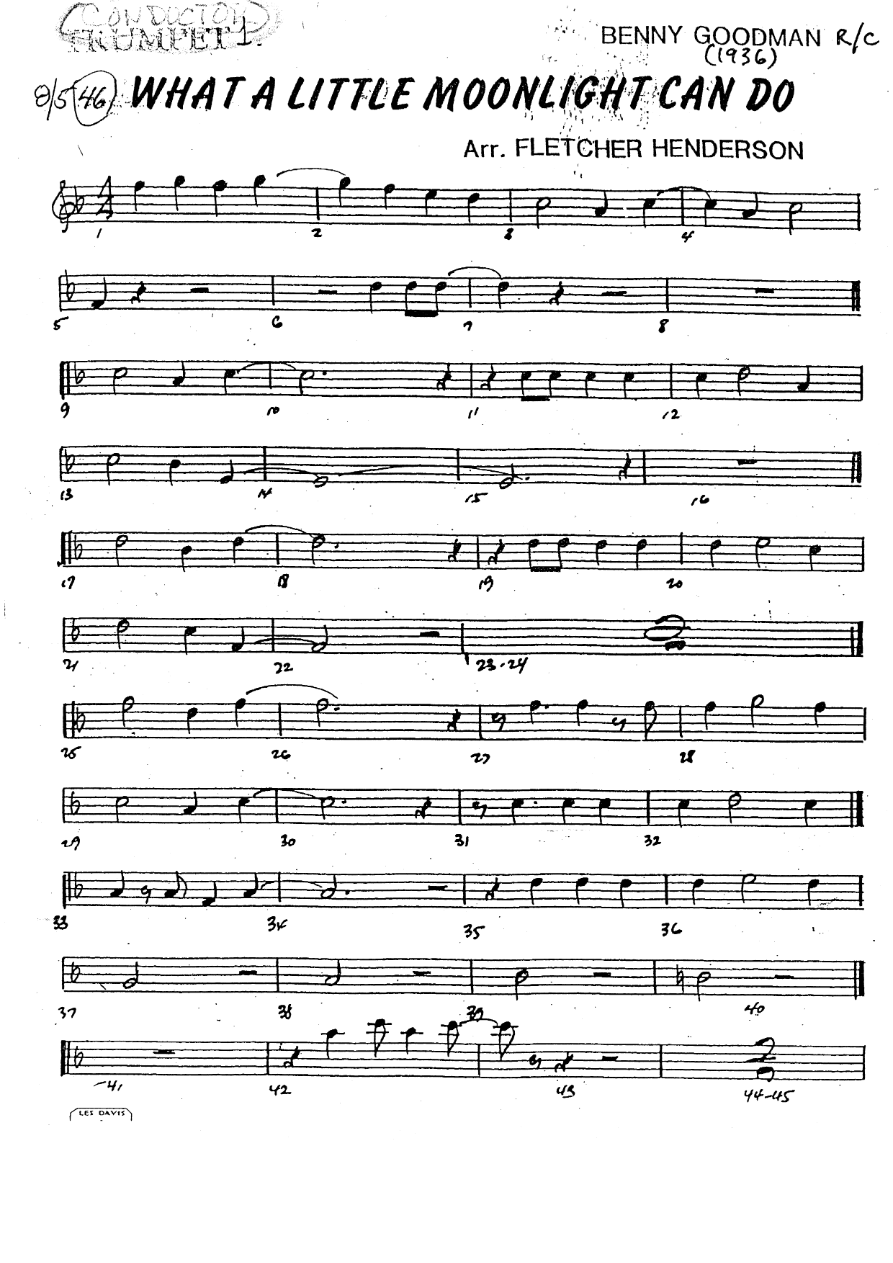
What A little Moonlight Can Do (F.Henderson)
Composed by Harry Woods
Arranged by Benny Goodman
- Ensemble: Big Band
- Style: Jazz Standard
- Pages: 51
- Instruments (17): Trumpet 1, Clarinet, Alto Saxophone 1, Alto Saxophone 2, Tenor Saxophone 3, Tenor Saxophone 4, Trumpet 2, Trumpet 3, Trumpet 4, Trombone 1, Trombone 2, Trombone 3, Trombone 4, Piano, Guitar, Bass, Drum Set
- Difficulty: advanced
- Content: Individual Parts
- Format: PDF Download (Instant)
- Price: $24.99
Penned by Harry Woods in 1934, "What A Little Moonlight Can Do" quickly ascended to jazz standard status, indelibly linked to the early career of Billie Holiday. Her iconic 1935 recording with Teddy Wilson's orchestra, featuring Roy Eldridge on trumpet, introduced the world to her unique vocal phrasing and established the song as a quintessential piece of the Swing Era. It embodies the effervescent spirit of the mid-1930s, a period marked by sophisticated melodies, danceable rhythms, and the burgeoning popularity of big band jazz. The tune's lyrical content, a romantic ode to the transformative power of moonlight, perfectly complements its bright, optimistic musicality, making it a timeless staple in the jazz repertoire. This particular big band arrangement, crafted by the legendary "King of Swing" Benny Goodman, presents "What A Little Moonlight Can Do" as a vibrant, medium-up swing chart in the key of F major. Goodman's signature touch is immediately apparent in the crisp ensemble writing and the infectious rhythmic drive. The arrangement maintains a bright, uplifting mood throughout, characterized by its clear melodic statements and a propulsive, yet relaxed, swing feel. It evokes the classic sound of the Goodman Orchestra, prioritizing precision, clarity, and an undeniable sense of joy. The energy is consistently high but never frantic, inviting both dancers and listeners into its captivating groove. Goodman's arranging style for this piece showcases his mastery of ensemble voicing and dynamic contrast. The melody is initially carried by the alto saxophone, later transitioning to a full saxophone section soli that exemplifies Goodman's tight, harmonically rich reed writing. Brass interjections are sharp and articulate, providing rhythmic punctuation without overpowering the melodic lines. There's a designated solo section for alto saxophone, offering an opportunity for a featured player to shine with improvisation over the standard chord changes. The arrangement builds through a series of call-and-response figures and layered textures, culminating in a classic shout chorus that brings the entire ensemble together for a powerful, swinging finale. Performing this arrangement is a rewarding experience for intermediate to advanced big bands. The technical challenges lie primarily in achieving the precise articulation and blend characteristic of the Goodman sound, particularly within the saxophone soli sections and the brass figures. Maintaining a consistent, driving medium-up swing feel is paramount. The chart is suitable for high school bands with strong section leaders, college ensembles, and community big bands seeking to capture the authentic spirit of the Swing Era. Its clear structure and engaging musicality make it an excellent choice for concerts, dances, and educational performances, providing a tangible link to one of jazz's most influential periods and arrangers. This arrangement should be approached with a focus on precision and rhythmic vitality, aiming for a consistent medium-up swing feel around quarter note = 180-190 bpm. Articulation is key: brass should play with crisp, short notes where indicated, while the saxophone section soli requires a unified, legato-swing approach to maintain its smooth flow. Pay close attention to dynamic contrasts, particularly the subtle swells and diminuendos that shape the phrases. The alto saxophone solo should be encouraged to embrace the melodic and rhythmic vocabulary of the Swing Era. Rehearsal time should be dedicated to balancing the ensemble during the shout chorus, ensuring all sections contribute to a powerful, cohesive sound without overblowing. No special mutes or extended techniques are required beyond standard jazz articulation. Q: What instruments are included in this arrangement? A: This big band arrangement is scored for 17 instruments: Alto Saxophone 1, Alto Saxophone 2, Tenor Saxophone 1, Tenor Saxophone 2, Baritone Saxophone, Trumpet 1, Trumpet 2, Trumpet 3, Trumpet 4, Trombone 1, Trombone 2, Trombone 3, Trombone 4, Piano, Bass, Drums, and Guitar. Q: What is the difficulty level of this arrangement? A: This arrangement is considered intermediate to advanced. It requires solid rhythmic precision, good ensemble blend, and an understanding of swing articulation, making it suitable for experienced high school, college, and community big bands. Q: What is the musical style and historical context of this piece? A: This is a classic jazz standard in the medium-up swing style, originally composed by Harry Woods in 1934 and famously recorded by Billie Holiday in 1935. This arrangement by Benny Goodman captures the authentic sound of the Swing Era. Q: What makes Benny Goodman's arrangement of "What A Little Moonlight Can Do" unique? A: Goodman's arrangement is characterized by its crisp ensemble writing, tight saxophone soli sections, clear melodic statements, and a driving medium-up swing feel, all hallmarks of his iconic big band sound. It features a designated alto saxophone solo. Q: What is the approximate performance duration and tempo for this arrangement? A: The approximate performance duration is 3-4 minutes, depending on the length of the alto saxophone solo. The recommended tempo is a medium-up swing, around quarter note = 180-190 bpm.
Musicians Also Search For
What A little Moonlight Can Do Benny Goodman PDF • What A little Moonlight Can Do Benny Goodman sheet music • What A little Moonlight Can Do arranged by Benny Goodman • Benny Goodman big band charts • Benny Goodman jazz arrangements PDF • What A little Moonlight Can Do Harry Woods sheet music • What A little Moonlight Can Do Harry Woods big band arrangement • Harry Woods big band charts • What A little Moonlight Can Do big band arrangement • What A little Moonlight Can Do big band PDF download • What A little Moonlight Can Do jazz ensemble sheet music • big band sheet music instant download • What A little Moonlight Can Do conductor score PDF • What A little Moonlight Can Do individual parts download • What A little Moonlight Can Do sheet music with parts • What A little Moonlight Can Do Jazz Standard chart • Jazz Standard big band arrangements • buy What A little Moonlight Can Do sheet music online • download What A little Moonlight Can Do PDF • What A little Moonlight Can Do jazz chart • best Benny Goodman big band arrangements • Harry Woods songs arranged by Benny Goodman • What A little Moonlight Can Do printable sheet music • big band repertoire PDF