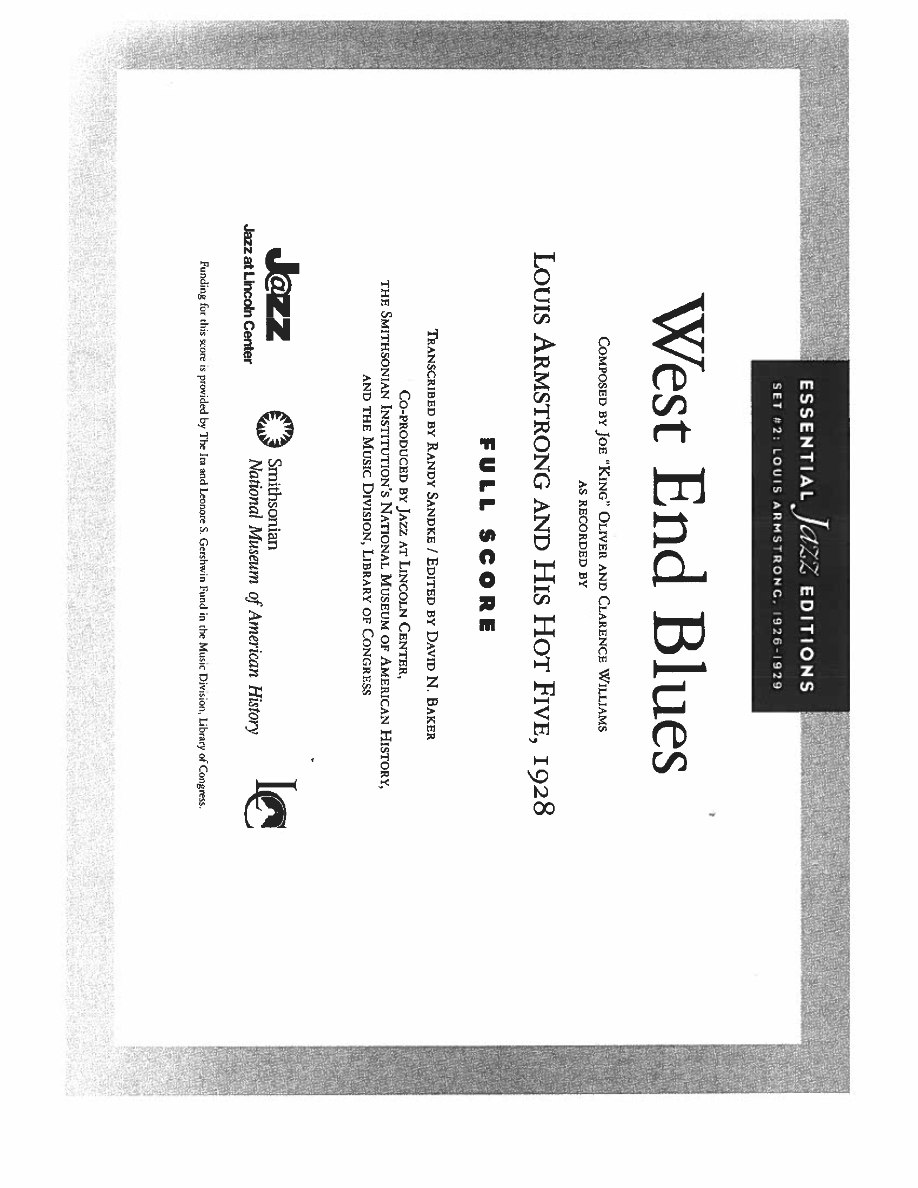
West End Blues (R.Sandke)
Composed by Joe "King" Oliver, Clarence Williams
Arranged by R.Sandke
- Ensemble: Dixieland Band
- Style: Dixieland
- Pages: 17
- Instruments (6): Bb Clarinet, Bb Trumpet, Trombone, Banjo, Drums, Piano
- Difficulty: easy
- Content: Individual Parts
- Format: PDF Download (Instant)
- Price: $18.99
Joe "King" Oliver's "West End Blues," co-composed with Clarence Williams, stands as an indelible cornerstone of early jazz, a pivotal recording that forever altered the landscape of American music. First recorded in 1928 by Louis Armstrong and His Hot Five, this seminal work transcended its Dixieland roots to become an immediate jazz standard, celebrated for its profound emotional depth and Armstrong's groundbreaking virtuosity. The piece captures the effervescent spirit and sophisticated improvisation characteristic of the late 1920s New Orleans and Chicago jazz scenes, marking a transition from collective improvisation to the emergence of the jazz soloist. Its original recording, particularly Armstrong's iconic opening cadenza, remains a masterclass in melodic invention and expressive phrasing, influencing generations of musicians. R. Sandke's arrangement of "West End Blues" respectfully reimagines this classic for the modern Dixieland ensemble while preserving its historical integrity and profound musical character. Sandke, renowned for his authentic yet innovative interpretations of traditional jazz, approaches this piece with a deep understanding of its stylistic nuances. The arrangement is set in the original key of E-flat major, maintaining the bright, open quality that defines the piece. It typically unfolds at a medium-slow tempo, emphasizing a relaxed, blues-inflected swing feel that allows for maximum expressive freedom. Sandke's treatment features carefully crafted voicings that evoke the rich, warm sonorities of early jazz, often employing close harmony and counterpoint within the ensemble sections. The mood is at once nostalgic, poignant, and celebratory, capturing the soulful lament and joyous exuberance inherent in the blues tradition. Performance of this arrangement offers a rewarding journey into the heart of early jazz. The iconic opening cadenza, traditionally associated with the trumpet, is meticulously transcribed, allowing the lead trumpet to channel Armstrong's original brilliance. Following this, the melody is often carried by the full ensemble in a lush, harmonized statement, or passed between the clarinet and trumpet, maintaining the call-and-response tradition. Featured solo opportunities are provided for the traditional Dixieland front line instruments—trumpet, clarinet, and trombone—allowing each player to showcase their improvisational skills within the blues framework. Technical challenges include maintaining a consistent, relaxed swing feel at a slower tempo, precise articulation, and achieving a cohesive ensemble blend that captures the warmth of the era. The arrangement's clarity and authentic feel make it particularly suitable for college and community Dixieland bands, as well as professional ensembles seeking an authoritative and engaging rendition of this timeless classic. This arrangement of "West End Blues" thrives on a relaxed, medium-slow swing feel, typically around quarter note = 80-90 BPM. The key to its authenticity lies in maintaining a consistent, unhurried pulse, allowing the blues inflections to breathe. The opening trumpet cadenza requires expressive phrasing and a lyrical approach, focusing on tone and dynamic shaping rather than speed. Encourage the rhythm section to provide a light, supportive foundation, emphasizing the two-beat feel in earlier sections and transitioning smoothly to a four-beat swing as the piece develops. For the ensemble sections, particularly the harmonized melody statements, focus on blend and balance, ensuring the lead voice is prominent but supported by warm, well-tuned harmonies. Soloists should be encouraged to draw inspiration from the blues idiom, utilizing bends, scoops, and expressive vibrato. Rehearsal time should be dedicated to understanding the historical context and emotional arc of the piece to fully convey its soulful character. Q: What instruments are included in the "West End Blues (R.Sandke)" arrangement? A: This Dixieland band arrangement typically includes parts for Trumpet, Clarinet, Trombone, Piano, Bass, and Drums, providing the classic instrumentation for this style. Q: What is the difficulty level of this arrangement? A: This arrangement is generally considered intermediate to advanced, suitable for college, community, and professional Dixieland ensembles due to its nuanced stylistic demands and solo opportunities. Q: What musical style and historical period does this arrangement represent? A: It represents the Dixieland jazz style, specifically capturing the essence of the late 1920s, a pivotal era in jazz history marked by the emergence of the jazz soloist. Q: What makes R. Sandke's arrangement of "West End Blues" unique? A: R. Sandke's arrangement is unique for its authentic yet fresh approach, combining meticulous transcription of the original's iconic elements with thoughtful voicings and solo opportunities that honor the historical context while being accessible to contemporary ensembles. Q: What is the typical performance duration and tempo for this piece? A: The typical performance duration for this arrangement is approximately 3 to 4 minutes, played at a medium-slow, relaxed swing tempo, usually around quarter note = 80-90 BPM.
Questions and answers
- What is included in the West End Blues (R.Sandke) PDF?
- The verified current file contains a conductor score and individual parts across 17 pages.
- How many instruments or parts are listed for West End Blues (R.Sandke)?
- The verified instrumentation list contains 6 entries for this Dixieland Band arrangement.
- Who is credited for West End Blues (R.Sandke)?
- Composer: Joe "King" Oliver, Clarence Williams. Arranger: R.Sandke.
- What difficulty is listed for West End Blues (R.Sandke)?
- The verified difficulty level is easy.
- What style is listed for West End Blues (R.Sandke)?
- The catalog lists the style as Dixieland.
- Can I preview West End Blues (R.Sandke) before buying?
- Yes. The product page provides a preview generated from the current PDF file.
- How is West End Blues (R.Sandke) delivered?
- After successful payment, the digital PDF is made available for download. The displayed price is $18.99.
Musicians Also Search For
West End Blues R.Sandke PDF • West End Blues R.Sandke sheet music • West End Blues arranged by R.Sandke • R.Sandke dixieland band charts • R.Sandke jazz arrangements PDF • West End Blues Joe "King" Oliver, Clarence Williams sheet music • West End Blues Joe "King" Oliver, Clarence Williams dixieland band arrangements • Joe "King" Oliver, Clarence Williams dixieland band charts • West End Blues dixieland band arrangements • West End Blues dixieland band PDF download • West End Blues jazz sheet music • dixieland band sheet music download • West End Blues conductor score PDF • West End Blues individual parts download • West End Blues sheet music PDF • West End Blues Dixieland charts • Dixieland dixieland band arrangements • buy West End Blues sheet music • download West End Blues PDF • West End Blues jazz charts • best R.Sandke dixieland band arrangements • Joe "King" Oliver, Clarence Williams arranged by R.Sandke • West End Blues printable sheet music • dixieland band repertoire PDF