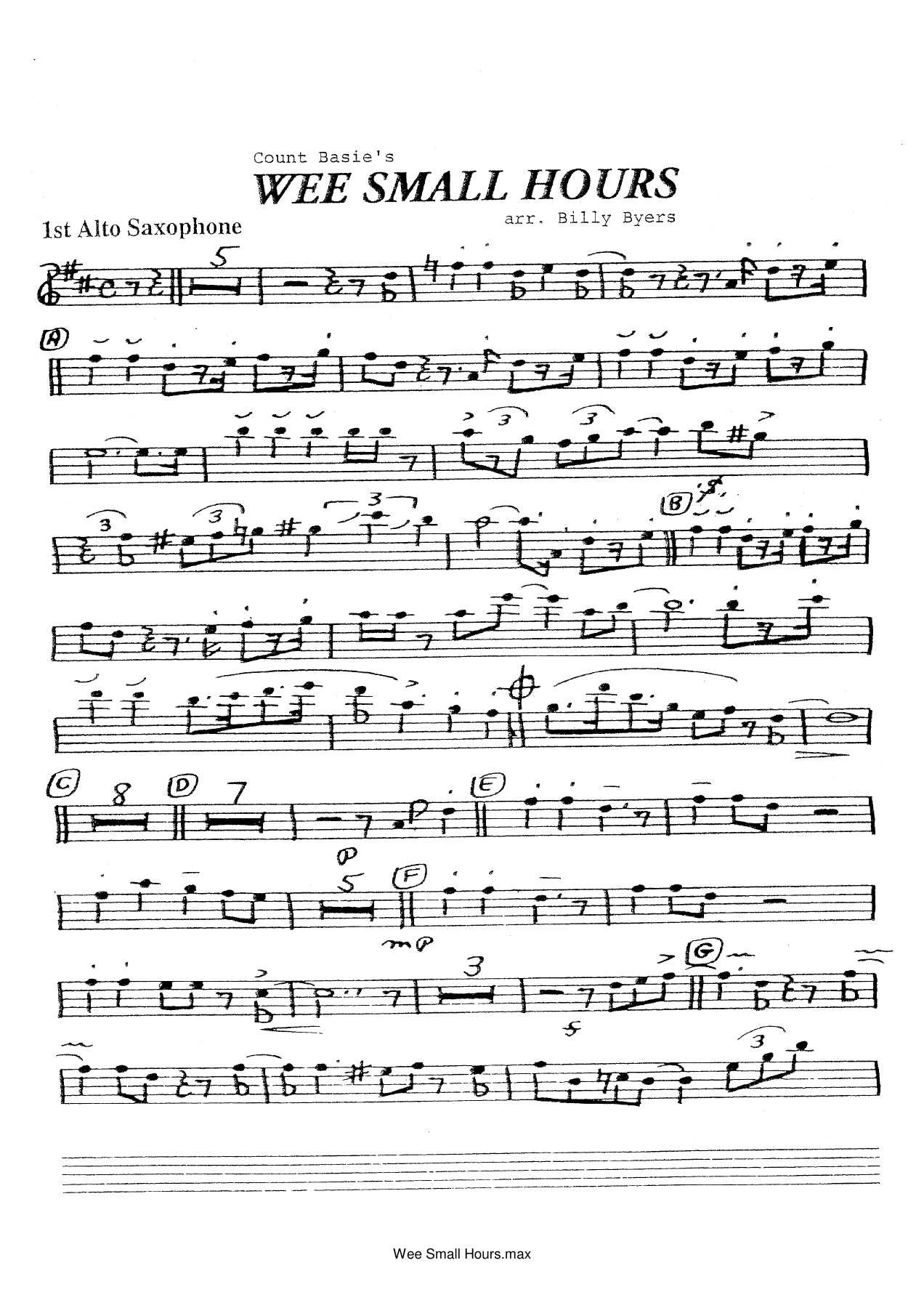
Wee Small Hours (B.Byers) sheet music preview

Wee Small Hours (B.Byers)

Composed by David Mann

Arranged by Billy Byers

  • Ensemble: Big Band
  • Style: Jazz Standard
  • Pages: 33
  • Instruments (17): 1st Alto Saxophone, 2nd Alto Saxophone, 1st Tenor Saxophone, 2nd Tenor Saxophone, Baritone Saxophone, 1st Trumpet, 2nd Trumpet, 3rd Trumpet, 4th Trumpet, 1st Trombone, 2nd Trombone, 3rd Trombone, 4th Trombone, Drums, Bass, Piano, Guitar
  • Difficulty: medium
  • Content: Individual Parts
  • Format: PDF Download (Instant)
  • Price: $24.99

"In the Wee Small Hours of the Morning," composed by David Mann with lyrics by Bob Hilliard, is a quintessential jazz standard that emerged in 1955. It gained immediate and enduring fame as the title track of Frank Sinatra's landmark album, *In the Wee Small Hours*, released by Capitol Records. This album is widely recognized as one of the first "concept albums" in popular music, meticulously crafted to evoke a specific mood of introspection, melancholy, lost love, and late-night solitude. The song itself encapsulates the quiet despair of sleepless nights, reflecting on a lost love, a theme that resonated deeply with audiences and cemented its place in the Great American Songbook. Its enduring popularity is evidenced by over 500 recorded versions, making it a cornerstone of vocal jazz and traditional pop repertoire. Musically, the piece is a tender, medium-slow ballad, typically performed with a gentle, understated swing feel. While Frank Sinatra's iconic recording often features a sparse rhythm section and lush strings to enhance its melancholic atmosphere, the core harmonic progression and lyrical sentiment lend themselves beautifully to diverse interpretations. The mood is profoundly reflective and poignant, often set in a minor key or with strong minor inflections, evoking a sense of quiet yearning and wistful remembrance. The melody, while seemingly simple, possesses an elegant contour that allows for expressive phrasing, making it a favorite for vocalists and instrumentalists alike who seek to convey deep emotion. Billy Byers' arrangement of "Wee Small Hours" for big band is a masterful translation of this intimate standard into a powerful ensemble setting, famously recorded by the Count Basie Orchestra on their album *Frankly Basie: Count Basie Plays the Hits of Frank Sinatra*. Byers, known for his ability to write arrangements that swing with incredible power and sophistication, imbues the piece with classic Basie characteristics. His signature approach often features warm ensemble voicings, strategic use of space allowing the rhythm section to shine, and meticulously crafted soli sections that build tension and release. This arrangement begins with a soft, swinging melody, often carried by a featured instrument or section, before developing into more complex textures. The arrangement features the melody passed between sections, showcasing the full dynamic range of the big band. A standout characteristic is the contrast between the initial subdued presentation and a powerful, "in-your-face" shout chorus, a hallmark of Basie-style arrangements, which then gracefully returns to the quiet, reflective melody for a gentle conclusion. Solos are strategically placed, often for tenor saxophone, trumpet, and piano, providing opportunities for individual expression within the ensemble framework. This arrangement is ideally suited for college, community, and professional big bands capable of executing nuanced dynamics and precise ensemble playing, offering a rewarding challenge in balancing emotional depth with big band power. This arrangement of "Wee Small Hours" by Billy Byers thrives on dynamic contrast and a cohesive ensemble sound. Maintain a consistent medium-slow swing tempo, focusing on a relaxed, unhurried feel rather than a strict metronomic pulse. The initial melodic statements should be played with warmth and sensitivity, allowing the lead voice (often a saxophone or trumpet) to shape phrases expressively. Pay close attention to blend and balance within sections, particularly in the brass, to achieve Byers' characteristic rich voicings. The rhythm section should lay down a solid, understated groove, providing a foundation without overpowering the delicate melodic lines. A key technical challenge lies in the transition to and execution of the shout chorus; ensure precise attacks and releases, and build intensity gradually to maximize its impact. Following the powerful shout, the return to the quiet melody requires immediate dynamic control and a seamless shift in mood. Solos, typically for tenor saxophone, trumpet, and piano, should be approached with melodic invention and an understanding of the song's melancholic character. Conductors should guide the band through the piece's emotional arc, emphasizing the interplay between the tender and the powerful moments to capture the full essence of this classic Billy Byers chart. **Q: What instruments and parts are included in this arrangement?** A: This big band arrangement is scored for 17 instruments, including Alto Saxophone 1 & 2, Tenor Saxophone 1 & 2, Baritone Saxophone, Trumpet 1-4, Trombone 1-4, Piano, Bass, Drums, and Guitar. **Q: What is the difficulty level of this arrangement?** A: This arrangement is considered medium to medium-difficult, suitable for advanced high school, college, community, and professional jazz ensembles due to its nuanced dynamics, ensemble precision requirements, and improvisational opportunities. **Q: What is the musical style and historical context of "Wee Small Hours"?** A: "Wee Small Hours" is a jazz standard from 1955, renowned for its melancholic, reflective ballad style. It was famously introduced by Frank Sinatra as the title track of his seminal concept album, *In the Wee Small Hours*, capturing themes of lost love and late-night introspection. **Q: What makes Billy Byers' arrangement of this standard unique?** A: Billy Byers' treatment, as recorded by the Count Basie Orchestra, is distinctive for its classic Basie sound, featuring a soft, swinging melodic presentation, sophisticated ensemble voicings, and a contrasting, powerful "in-your-face" shout chorus that demonstrates his mastery of big band dynamics and texture. **Q: What is the typical performance duration and tempo of this arrangement?** A: This arrangement is a medium-slow swing ballad. While exact duration can vary with interpretation and solo length, it typically runs approximately 3 to 4 minutes.

Questions and answers

What is included in the Wee Small Hours (B.Byers) PDF?
The verified current file contains individual parts across 33 pages.
How many instruments or parts are listed for Wee Small Hours (B.Byers)?
The verified instrumentation list contains 17 entries for this Big Band arrangement.
Who is credited for Wee Small Hours (B.Byers)?
Composer: David Mann. Arranger: Billy Byers.
What difficulty is listed for Wee Small Hours (B.Byers)?
The verified difficulty level is medium.
What style is listed for Wee Small Hours (B.Byers)?
The catalog lists the style as Jazz Standard.
Can I preview Wee Small Hours (B.Byers) before buying?
Yes. The product page provides a preview generated from the current PDF file.
How is Wee Small Hours (B.Byers) delivered?
After successful payment, the digital PDF is made available for download. The displayed price is $24.99.

Musicians Also Search For

Wee Small Hours Billy Byers PDFWee Small Hours Billy Byers sheet musicWee Small Hours arranged by Billy ByersBilly Byers big band chartsBilly Byers jazz arrangements PDFWee Small Hours David Mann sheet musicWee Small Hours David Mann big band arrangementsDavid Mann big band chartsWee Small Hours big band arrangementsWee Small Hours big band PDF downloadWee Small Hours jazz sheet musicbig band sheet music downloadWee Small Hours individual parts downloadWee Small Hours sheet music PDFWee Small Hours Jazz Standard chartsJazz Standard big band arrangementsbuy Wee Small Hours sheet musicdownload Wee Small Hours PDFWee Small Hours jazz chartsbest Billy Byers big band arrangementsDavid Mann arranged by Billy ByersWee Small Hours printable sheet musicbig band repertoire PDF

All arrangements by Billy Byers All David Mann sheet music