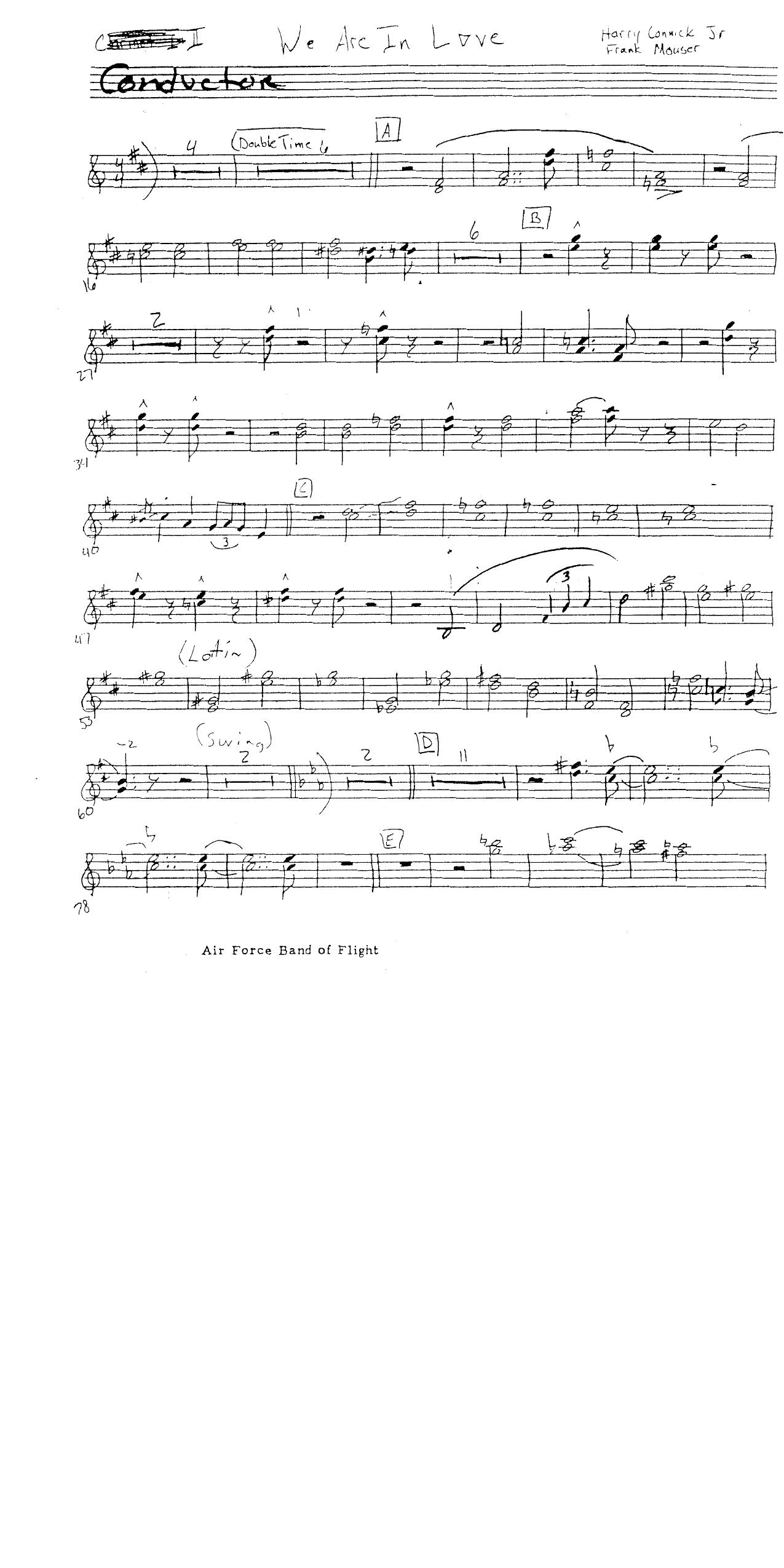
We Are In Love (H.Connick, Jr)
Composed by Harry Connick Jr.
Arranged by Harry Connick Jr
- Ensemble: Big Band
- Pages: 44
- Instruments (24): Vocal, Alto Saxophone 1, Alto Saxophone 2, Tenor Saxophone 1, Tenor Saxophone 2, Baritone Saxophone, Trumpet 1, Trumpet 2, Trumpet 3, Trumpet 4, Trombone 1, Trombone 2, Trombone 3, Trombone 4, Keyboard, Electric Bass, Flute 1/2, Oboe 1/2, Clarinet 1/2, Clarinet 3/4, Bassoon, Horn, Tuba, Percussion
- Difficulty: medium
- Content: Individual Parts
- Format: PDF Download (Instant)
- Price: $24.99
Originating from Harry Connick Jr.’s multi-platinum, Grammy-winning 1990 studio album of the same name, "We Are In Love" captures the quintessential revival of traditional big band swing and romantic vocal jazz that defined Connick’s early career. Coinciding with his meteoric rise following the cultural phenomenon of the *When Harry Met Sally...* soundtrack, this composition embodies the sophisticated elegance of the mid-century American popular songbook while filtering it through a fresh, late-20th-century lens. It stands out as a high-water mark for contemporary big band writing, merging classic Nelson Riddle-esque string and brass aesthetics with the punchy, driving rhythm section sensibilities of New Orleans jazz. Built around a lilting, medium-tempo swing feel in 4/4 time, the musical character of the piece balances lush, cinematic romance with an infectious, buoyant groove. The atmosphere shifts gracefully between tender, introspective ballad-like fragility and joyful, full-ensemble exuberance. The harmonic language relies heavily on extended and altered extensions—major sevenths, ninths, and sharp-elevenths—which lend the melody a sophisticated, bittersweet emotional depth. It evokes late-night supper club intimacy paired with the grandeur of a classic Hollywood soundstage, creating a warm, nostalgic mood that resonates immediately with both performers and audiences. Connick’s signature arranging style shines through in the clever interplay between the rhythm section and the horn tier. Rather than relying on static block-chord harmonization, the chart utilizes intricate counterpoint, sparse and tasteful voicings, and sweeping dynamic swells that allow the melody to breathe. The woodwind section—featuring multi-doubling across alto, tenor, and baritone saxophones—provides a velvety texture underneath bright, crisp brass statements. Soli sections are meticulously crafted to highlight clean phrasing and subtle stylistic nuances, capturing the classic 1950s swinging elegance without sounding like a mere imitation. Melodic duties are shared fluidly across the ensemble, transitioning from intimate horn soli segments to rich tutti passages that drive the narrative forward. While tailored to leave room for a central featured solo, the arrangement's true brilliance lies in its demanding ensemble cohesion. The technical challenges center on dynamic control, precise swing eighth-note articulation at a moderate tempo, and maintaining a relaxed, behind-the-beat pocket. It is deeply rewarding for musicians because every section plays an active, melodic role in painting the overall sonic picture rather than simply holding down background pads. Advanced high school, collegiate, and professional big bands will find this chart an ideal vehicle for developing stylistic maturity and tonal blending. Because the difficulty stems less from breakneck speed and more from the refined stylistic interpretation required to execute Connick’s specific brand of swing, it offers an exceptional educational and performance opportunity for ensembles looking to master traditional jazz phrasing and nuanced ballad-to-swing dynamics. Success with this arrangement hinges on achieving an authentic, relaxed medium-swing feel without letting the tempo drag or push. The ideal metronome marking sits comfortably around a steady medium tempo, where every eighth note must be swung with a natural, triplet-based feel rather than a rigid, dotted-eighth-sixteenth subdivision. The primary technical challenge lies in dynamic subtlety. The brass and saxophones must balance rich, lush voicings against a transparent rhythm section; over-blowing will instantly destroy the intimate supper-club aesthetic. Ensure that all muted brass passages maintain a warm core tone without pinching the sound. Rehearsal should begin by isolating the sax soli and brass background figures independently to lock in articulation, specifically focusing on the treatment of accented notes and breath releases. Pay close attention to the dynamic hairpins written into the ensemble climaxes, ensuring that crescendos peak precisely where indicated to preserve the cinematic arc of the arrangement. Q: What instruments and parts are included in this arrangement? A: This 44-page big band chart includes parts for an 8-instrument core ensemble featuring Alto Saxophone, Tenor Saxophone, Baritone Saxophone, Trumpet, Trombone, and a complete rhythm section framework. Q: What is the difficulty level of this chart? A: It is best suited for advanced high school, collegiate, and professional big bands, with technical demands centered on stylistic nuance, swing articulation, and dynamic control rather than extreme velocity. Q: What is the musical style and historical context of "We Are In Love"? A: Written and popularized by Harry Connick Jr. on his hit 1990 album, the piece is a modern traditional jazz standard that blends 1950s big band romance with New Orleans-inflected swing. Q: What makes this specific arrangement unique? A: It features Connick's signature sophisticated harmonic voicings, intricate sax-and-brass counterpoint, and a cinematic approach that balances intimate ballad textures with buoyant, medium-swing grooves. Q: What is the recommended performance tempo and duration? A: The piece is styled as a medium-tempo swing tune (around 4/4 time) designed to run approximately 3 to 4 minutes depending on the length of improvised solo sections.
Questions and answers
- What is included in the We Are In Love (H.Connick, Jr) PDF?
- The verified current file contains individual parts across 44 pages.
- How many instruments or parts are listed for We Are In Love (H.Connick, Jr)?
- The verified instrumentation list contains 24 entries for this Big Band arrangement.
- Who is credited for We Are In Love (H.Connick, Jr)?
- Composer: Harry Connick Jr.. Arranger: Harry Connick Jr.
- What difficulty is listed for We Are In Love (H.Connick, Jr)?
- The verified difficulty level is medium.
- Can I preview We Are In Love (H.Connick, Jr) before buying?
- Yes. The product page provides a preview generated from the current PDF file.
- How is We Are In Love (H.Connick, Jr) delivered?
- After successful payment, the digital PDF is made available for download. The displayed price is $24.99.
Musicians Also Search For
We Are In Love Harry Connick Jr PDF • We Are In Love Harry Connick Jr sheet music • We Are In Love arranged by Harry Connick Jr • Harry Connick Jr big band charts • Harry Connick Jr jazz arrangements PDF • We Are In Love Harry Connick Jr. sheet music • We Are In Love Harry Connick Jr. big band arrangements • Harry Connick Jr. big band charts • We Are In Love big band arrangements • We Are In Love big band PDF download • We Are In Love jazz sheet music • big band sheet music download • We Are In Love individual parts download • We Are In Love sheet music PDF • buy We Are In Love sheet music • download We Are In Love PDF • We Are In Love jazz charts • best Harry Connick Jr big band arrangements • Harry Connick Jr. arranged by Harry Connick Jr • We Are In Love printable sheet music • big band repertoire PDF