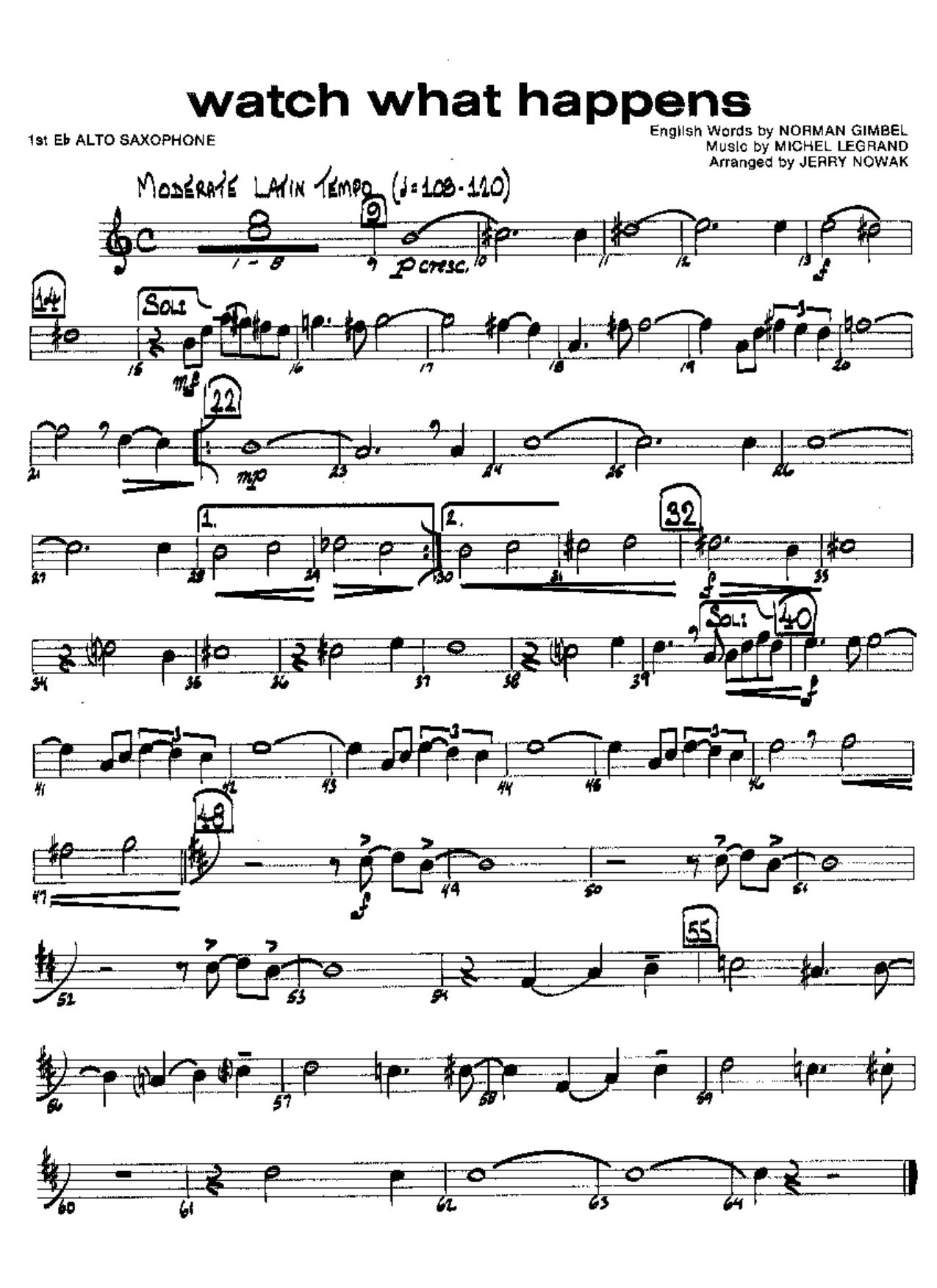
Watch What Happens (J.Nowak)
Composed by Michel Legrand
Arranged by Jerry Nowak
- Ensemble: Big Band
- Pages: 23
- Instruments (15): 1st Eb Alto Saxophone, 2nd Eb Alto Saxophone, 1st Bb Tenor Saxophone, 2nd Bb Tenor Saxophone (Optional), Eb Baritone Saxophone (Optional), 1st Bb Trumpet, 2nd Bb Trumpet, 3rd Bb Trumpet (Optional), 1st Trombone, 2nd Trombone (Optional), 3rd Trombone (Optional), Piano, Guitar (Optional), Bass (Optional), Drums
- Difficulty: medium
- Content: Individual Parts
- Format: PDF Download (Instant)
- Price: $24.99
Michel Legrand’s timeless masterwork "Watch What Happens," originally introduced in the critically acclaimed 1964 French musical film *The Umbrellas of Cherbourg* (*Les Parapluies de Cherbourg*) and later popularized in the American jazz canon by artists like Wes Montgomery, Tony Bennett, and Astrud Gilberto, stands as a crowning achievement of 1960s cinematic jazz-pop composition. Characterized by its sophisticated harmonic movement, bittersweet melodic contour, and irresistible rhythmic undercurrent, this quintessential standard bridges the gap between European art song and American jazz improvisation. Its enduring appeal lies in the brilliant interplay between melancholy and optimism, making it a staple vehicle for jazz interpreters seeking to explore nuanced phrasing and rich modal colorations. Veteran jazz educator and arranger Jerry Nowak brings his signature clarity and swinging sensibility to this big band adaptation, framing Legrand’s intricate melodies within a polished, mid-century swinging medium groove. Set in an engaging key that flatters both brass and woodwind sections, the arrangement balances lush, cinematic chord clusters with punchy, driving ensemble backgrounds. Nowak avoids overly dense, modernistic reharmonizations in favor of authentic-sounding 1960s studio-stage writing, utilizing warm flugelhorn and muted trumpet textures alongside rich saxophone solis. The energy builds organically from a lyrical, introspective head statement into a vibrant, swinging shout chorus that showcases the full dynamic range of a standard 15-piece jazz ensemble. Throughout the charts, the melodic narrative shifts gracefully between sections, giving the woodwinds ample opportunity to shine on the intricate verse before the brass steps in to drive the rhythmic momentum. Featured solo space allows an alto saxophone or trumpet soloist to stretch out over standard changes, supported by crisp, tasteful background figures that never crowd the improviser. Technically accessible yet musically sophisticated, the arrangement demands clean articulation, precise dynamic control, and an understanding of light, buoyant swing phrasing. The rhythmic interplay between the drummer's ride cymbal and the section's backbeats provides the essential forward propulsion that makes playing this chart an absolute joy for both performers and audiences alike. Advancing high school jazz ensembles, college groups, and community big bands will find this arrangement to be an ideal repertoire choice. It offers enough technical and stylistic meat to challenge developing players—particularly in maintaining balance during thick chordal passages and executing clean swing eighth-note subdivisions—without presenting insurmountable technical roadblocks. Directors will appreciate how naturally the chart rehearses, rewarding careful attention to articulation markings and dynamic shading with a professional, studio-ready big band sound. Success with this arrangement hinges on establishing a relaxed, infectious medium-swing groove right from the downbeat. The tempo should remain steady and unhurried, allowing the subtle harmonic shifts in Legrand's progression to breathe. Conductors should pay close attention to the balance between the rhythm section and the horn lines; the piano and guitar should comp with light, sparse voicings to preserve the transparent texture of the mid-60s style. Horn players must execute eighth notes with an authentic jazz articulation—detailing a slightly weighted downbeat and an articulated, lifted upbeat, avoiding stiff or over-accentuated triplet feels. Key technical challenges involve navigating the sudden dynamic shifts between the intimate solo backgrounds and the roaring ensemble shout choruses. Ensure that the lead trumpet maintains a warm, centered tone without forcing the upper register, and demand that the saxophone section blends homogeneously during the unison and harmonized soli passages. Subtle use of cup or straight mutes in the brass section will enhance the nostalgic, cinematic color palette called for in the arrangement's quieter moments. Q: What instruments and parts are included in this arrangement? A: This 15-instrument big band arrangement includes parts for Alto Saxophone 1, Alto Saxophone 2, Tenor Saxophone 1, Tenor Saxophone 2, Baritone Saxophone, plus standard brass and rhythm section instrumentation, backed by a comprehensive 23-page conductor score. Q: What is the difficulty level of this chart? A: It is graded as medium, making it exceptionally well-suited for advanced high school jazz ensembles, college groups, and professional community big bands looking for rewarding, accessible repertoire. Q: What is the historical style and background of the music? A: The piece is rooted in the 1964 cinematic jazz tradition originating from Michel Legrand’s score for *The Umbrellas of Cherbourg*, arranged here in a classic 1960s American big band swing style. Q: What makes Jerry Nowak's arrangement unique? A: Nowak uniquely balances lush, cinematic European harmonies with crisp, driving American swing backgrounds, providing a sophisticated yet approachable vehicle that highlights both ensemble blend and individual soloists. Q: What is the performance duration and tempo feel? A: The arrangement is designed in a comfortable, driving medium-swing tempo feel, yielding a performance duration of approximately 3 to 4 minutes depending on the length allotted for improvised solos.
Questions and answers
- What is included in the Watch What Happens (J.Nowak) PDF?
- The verified current file contains a conductor score and individual parts across 23 pages.
- How many instruments or parts are listed for Watch What Happens (J.Nowak)?
- The verified instrumentation list contains 15 entries for this Big Band arrangement.
- Who is credited for Watch What Happens (J.Nowak)?
- Composer: Michel Legrand. Arranger: Jerry Nowak.
- What difficulty is listed for Watch What Happens (J.Nowak)?
- The verified difficulty level is medium.
- Can I preview Watch What Happens (J.Nowak) before buying?
- Yes. The product page provides a preview generated from the current PDF file.
- How is Watch What Happens (J.Nowak) delivered?
- After successful payment, the digital PDF is made available for download. The displayed price is $24.99.
Musicians Also Search For
Watch What Happens Jerry Nowak PDF • Watch What Happens Jerry Nowak sheet music • Watch What Happens arranged by Jerry Nowak • Jerry Nowak big band charts • Jerry Nowak jazz arrangements PDF • Watch What Happens Michel Legrand sheet music • Watch What Happens Michel Legrand big band arrangements • Michel Legrand big band charts • Watch What Happens big band arrangements • Watch What Happens big band PDF download • Watch What Happens jazz sheet music • big band sheet music download • Watch What Happens conductor score PDF • Watch What Happens individual parts download • Watch What Happens sheet music PDF • buy Watch What Happens sheet music • download Watch What Happens PDF • Watch What Happens jazz charts • best Jerry Nowak big band arrangements • Michel Legrand arranged by Jerry Nowak • Watch What Happens printable sheet music • big band repertoire PDF