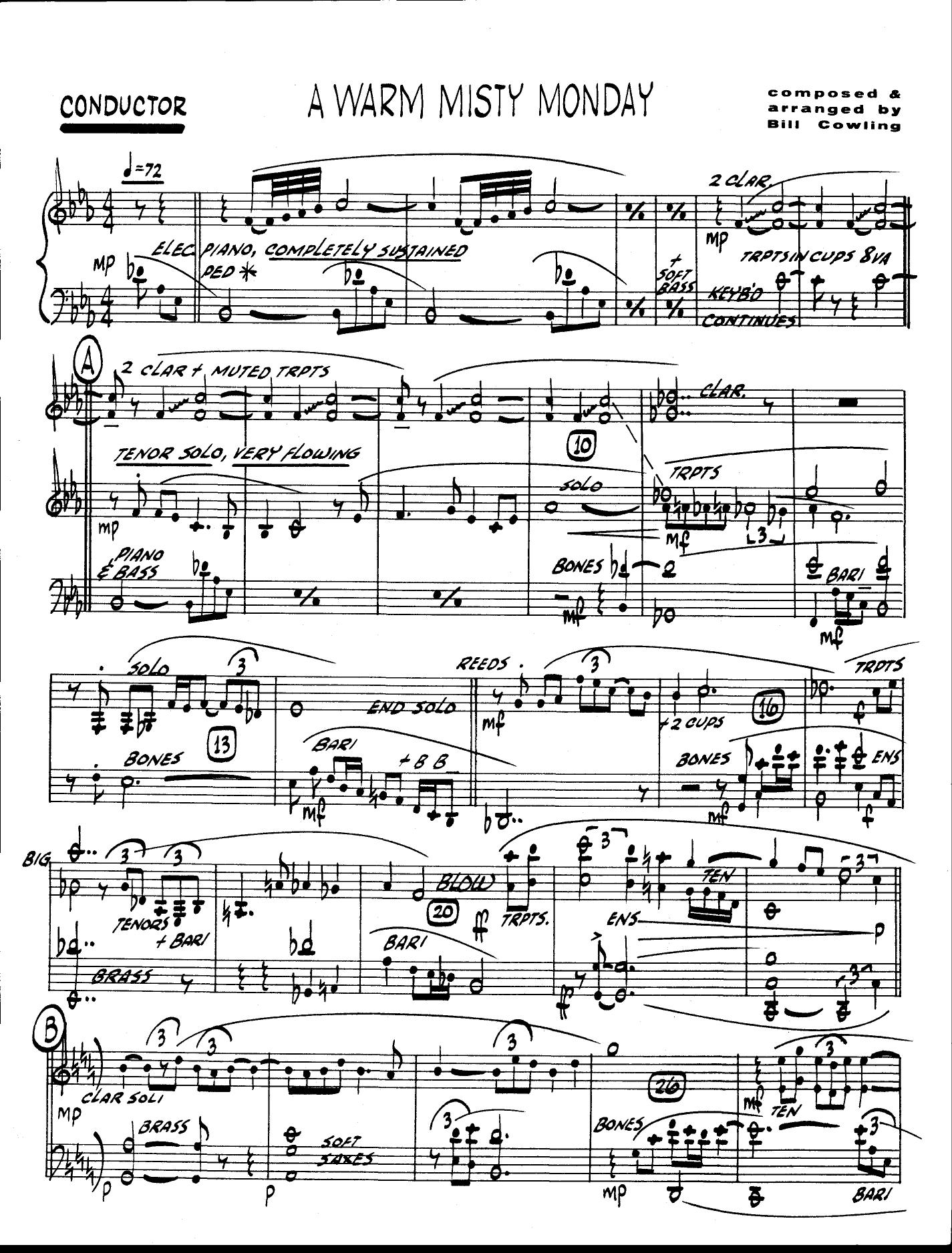
Warm Misty Monday (B.Cowling)
Composed by B. Cowling
Arranged by B.Cowling
- Ensemble: Big Band
- Style: Jazz Standard
- Pages: 25
- Instruments (22): Conductor, Clarinet I, Clarinet II, Tenor III, Tenor III Transposed for Alto, Tenor IV, Baritone V, Trumpet I, Trumpet II, Trumpet III, Trumpet IV, Trumpet V, Trombone I, Trombone II, Trombone III, Trombone IV, Bass Trombone, Bass, Drum Sketch, Percussion I, Electric Piano, Guitar
- Difficulty: medium
- Content: Individual Parts
- Format: PDF Download (Instant)
- Price: $24.99
Evoking the melancholic, rain-streaked atmosphere of an urban early-morning commute, "Warm Misty Monday," composed and arranged by B.Cowling, captures the sophisticated harmonic palette and relaxed sophistication of modern post-bop jazz. Operating comfortably in the lineage of classic mid-century modal jazz and contemporary big band literature, the work marries lush, impressionistic chord clusters with an accessible, driving medium-swing pulse. The composition establishes its distinct identity through a clever juxtaposition of dense, sustained woodwind textures and sharp, arresting brass interjections, channeling the atmospheric depth found in classic arrangements by the Thad Jones-Mel Lewis Orchestra while retaining a unique, contemporary compositional voice. At a measured medium-swing tempo (approximately 116 BPM), the piece opens with an evocative, rubato-tinged introduction led by the rhythm section, before the horns enter with the primary theme stated delicately by a rich saxophone soli featuring dual clarinets and tenor saxophones. The harmonic landscape shifts gracefully between minor modal centers and unexpected chromatic mediant relationships, creating a bittersweet emotional trajectory that feels both nostalgic and forward-looking. As the chart unfolds, the energy builds steadily through a series of conversational call-and-response passages between the brass and reeds, culminating in a soaring, harmonically sophisticated shout chorus that showcases Cowling’s signature penchant for upper-structure extensions and interlocking counterpoint. B.Cowling’s scoring approach for this 21-instrument big band setting demonstrates an intimate understanding of modern ensemble balance. Rather than relying on wall-to-wall tutti scoring, Cowling utilizes transparent, three- and four-part horn voicings that allow individual sections to breathe. The arrangement includes designated solo space over standard modal changes, offering featured players ample room for expressive improvisation. Technical challenges lie primarily in maintaining pristine intonation during the slow-moving, tightly voiced harmonic suspensions and executing the subtle dynamic nuances required to sell the chart's shifting moods. Articulations are meticulously marked throughout, demanding clean section work, controlled vibrato, and a light, forward-moving swing eighth-note feel. Advanced high school ensembles with strong section leaders, as well as collegiate and professional community big bands, will find this chart to be an exceptional programming choice. It provides a masterclass in ensemble blend, dynamic control, and stylistic maturity without relying on breakneck tempos or extreme altissimo ranges. Conductor and band directors looking to feature a sophisticated, mood-driven contemporary standard that offers both intellectual engagement for the musicians and immediate emotional resonance for the audience will discover an invaluable addition to their library. Achieving the authentic atmosphere of "Warm Misty Monday" requires meticulous attention to dynamic contrast and articulation balance from the outset. The rhythm section serves as the anchor: the drummer should maintain a subtle, feather-light ride cymbal pattern with crisp hi-hat chicks on beats two and four, avoiding heavy backbeats that would disrupt the floating, impressionistic feel. Piano and bass must lock in tightly on the undulating modal vamps, ensuring that chord extensions bloom without muddying the texture. For the horn sections, the primary technical hurdle involves maintaining pristine intonation during the dense, slow-moving harmonic clusters found in the exposition and transitional bridges. Players should practice their passages sub-tone where indicated, blending their timbres to create a cohesive organ-like wall of sound. Brass players should approach mutes (where utilized) with a focus on core tone quality over sheer volume, ensuring that cup or straight mutes complement rather than pierce the reed textures. Rehearsal should prioritize isolating the interlocking countermelodies in the middle section to ensure every inner voice speaks clearly before balancing the full ensemble crescendos leading into the shout chorus. Q: What instruments and parts are included in this arrangement? A: This 21-instrument big band arrangement features a comprehensive modern instrumentation including Clarinet I, Clarinet II, Tenor Saxophone I, Tenor Saxophone II, Baritone Saxophone I, alongside standard big band brass and rhythm section parts, totaling 25 pages of score and parts with a full conductor score. Q: What is the difficulty level of this chart? A: This arrangement is graded as advanced-intermediate to advanced, making it ideal for accomplished high school ensembles, collegiate jazz orchestras, and professional community big bands with strong section leaders. Q: What is the musical style and historical context of the piece? A: Written in the style of a modern post-bop jazz standard, the piece blends traditional medium-swing feels with contemporary modal harmonies, evoking the atmospheric sophistication of mid-century jazz composition. Q: What makes B.Cowling's arrangement unique? A: The arrangement stands out for its transparent, impressionistic voicings—utilizing dual clarinets and nuanced saxophone solis—alongside a signature shout chorus that employs upper-structure extensions and intricate counterpoint rather than standard block-chord writing. Q: What is the performance duration and tempo of the work? A: The piece is set at a relaxed medium-swing tempo of approximately 116 BPM, resulting in a total performance duration of roughly 5 to 6 minutes depending on the length of improvised solos.
Questions and answers
- What is included in the Warm Misty Monday (B.Cowling) PDF?
- The verified current file contains a conductor score and individual parts across 25 pages.
- How many instruments or parts are listed for Warm Misty Monday (B.Cowling)?
- The verified instrumentation list contains 22 entries for this Big Band arrangement.
- Who is credited for Warm Misty Monday (B.Cowling)?
- Composer: B. Cowling. Arranger: B.Cowling.
- What difficulty is listed for Warm Misty Monday (B.Cowling)?
- The verified difficulty level is medium.
- What style is listed for Warm Misty Monday (B.Cowling)?
- The catalog lists the style as Jazz Standard.
- Can I preview Warm Misty Monday (B.Cowling) before buying?
- Yes. The product page provides a preview generated from the current PDF file.
- How is Warm Misty Monday (B.Cowling) delivered?
- After successful payment, the digital PDF is made available for download. The displayed price is $24.99.
Musicians Also Search For
Warm Misty Monday B.Cowling PDF • Warm Misty Monday B.Cowling sheet music • Warm Misty Monday arranged by B.Cowling • B.Cowling big band charts • B.Cowling jazz arrangements PDF • Warm Misty Monday B. Cowling sheet music • Warm Misty Monday B. Cowling big band arrangements • B. Cowling big band charts • Warm Misty Monday big band arrangements • Warm Misty Monday big band PDF download • Warm Misty Monday jazz sheet music • big band sheet music download • Warm Misty Monday conductor score PDF • Warm Misty Monday individual parts download • Warm Misty Monday sheet music PDF • Warm Misty Monday Jazz Standard charts • Jazz Standard big band arrangements • buy Warm Misty Monday sheet music • download Warm Misty Monday PDF • Warm Misty Monday jazz charts • best B.Cowling big band arrangements • B. Cowling arranged by B.Cowling • Warm Misty Monday printable sheet music • big band repertoire PDF