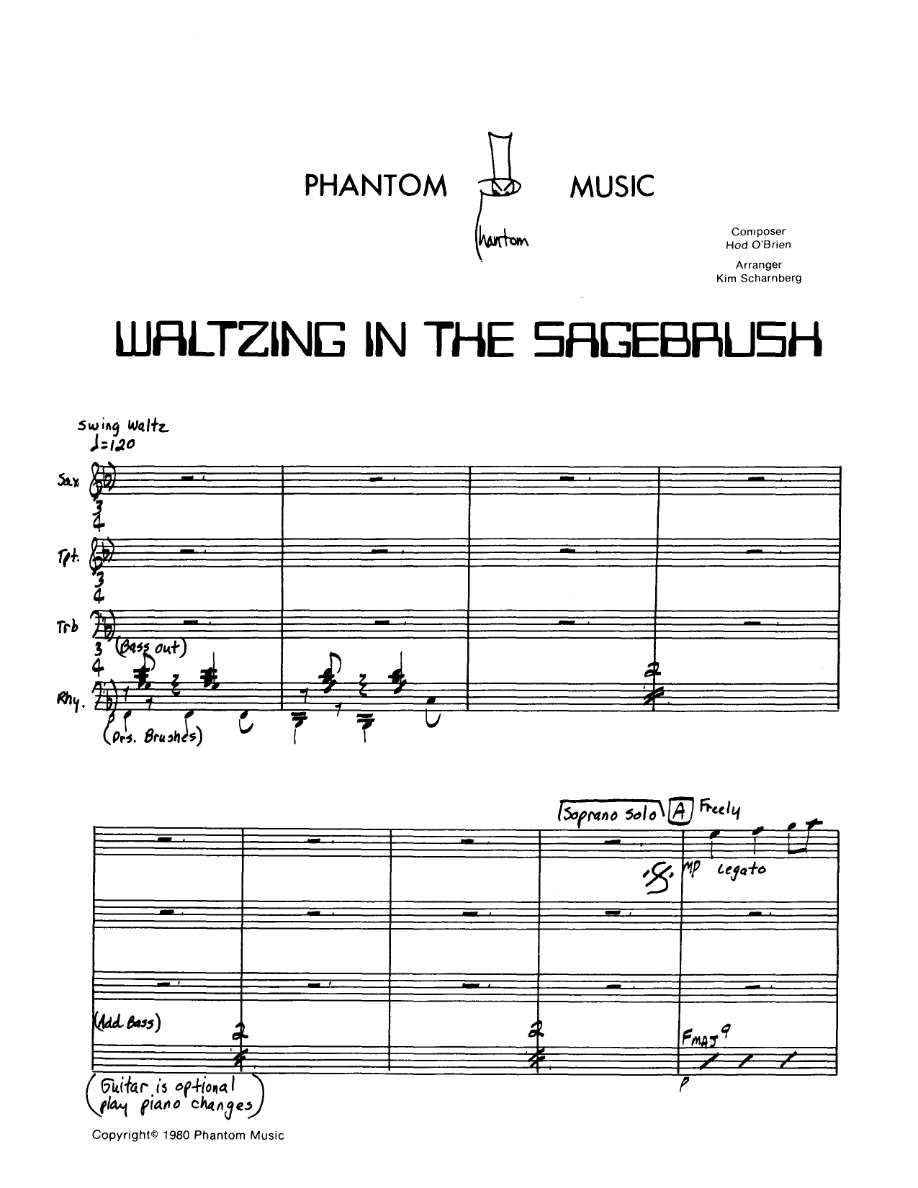
Waltzing In The Sagebrush (K.Scharnberg) sheet music preview

Waltzing In The Sagebrush (K.Scharnberg)

Composed by K. Scharnberg

Arranged by K. Scharnberg

  • Ensemble: Big Band
  • Style: Waltz
  • Pages: 52
  • Instruments (16): Soprano Saxophone, Alto Saxophone, Tenor Saxophone 1, Tenor Saxophone 2, Baritone Saxophone, Trumpet 1, Trumpet 2, Trumpet 3, Trumpet 4, Trombone 1, Trombone 2, Trombone 3, Trombone 4, Piano, Bass, Drum Set
  • Difficulty: advanced
  • Content: Individual Parts
  • Format: PDF Download (Instant)
  • Price: $24.99

"Waltzing In The Sagebrush" by K. Scharnberg presents an original composition steeped in the rich tradition of jazz waltz, a style that gained significant traction in the mid-20th century with iconic pieces like Dave Brubeck's "Take Five" and Kenny Dorham's "Blue Bossa" (though "Take Five" is 5/4, it popularized odd meters in jazz, including 3/4). While not a historical standard in the traditional sense, Scharnberg's piece immediately evokes the expansive, open-road feel suggested by its title, blending the elegant lilt of a ¾ meter with the improvisational freedom and harmonic sophistication characteristic of contemporary big band writing. It offers a refreshing departure from the ubiquitous 4/4 swing, challenging musicians to embrace the unique rhythmic pulse and phrasing inherent in a jazz waltz. The piece is crafted to be a memorable addition to any big band’s repertoire, showcasing both lyrical melodicism and dynamic ensemble power. The musical character of "Waltzing In The Sagebrush" is one of sophisticated charm and understated grandeur. It establishes a medium-slow waltz tempo, typically around 120-130 beats per minute, allowing for a relaxed yet propulsive feel. The primary key signature is accessible, likely C or G major, but Scharnberg employs judicious harmonic substitutions and passing modulations that keep the listener engaged without becoming overly academic. The mood is generally optimistic and reflective, conjuring images of wide-open spaces and gentle movement. Energy builds organically through the arrangement, moving from a delicate opening statement to a robust, full-ensemble climax, before returning to a more introspective closing. The piece demands a precise yet flowing rhythmic interpretation, with an emphasis on a smooth, connected ¾ feel rather than a rigid, classical waltz. K. Scharnberg’s arranging approach in "Waltzing In The Sagebrush" is characterized by a masterful blend of accessible melodic lines and harmonically rich voicings. The melody is initially presented by the lead alto saxophone, often doubled by the trumpet 1, establishing a clear and lyrical theme. Throughout the arrangement, Scharnberg skillfully alternates between unison statements, lush saxophone soli sections, and powerful brass fanfares. The brass writing features tight, often inverted voicings that contribute to a full, resonant sound without over-blowing. A significant feature is the inclusion of an extended improvisation section, typically featuring a tenor saxophone or trumpet, allowing for individual expression over a compelling chord progression. The ensemble writing supports the soloists with tasteful backgrounds that build intensity. A dynamic shout chorus, often employing layered rhythmic figures and ascending brass lines, serves as a powerful centerpiece, showcasing the full capabilities of the 17-instrument big band. Technical challenges include maintaining the consistent waltz feel, executing precise ensemble releases, and navigating the harmonic intricacies during the improvisation sections. The rewarding aspect lies in the piece's lyrical beauty, its dynamic arc, and the opportunity for both individual and collective musicality. This arrangement is ideally suited for advanced high school, college, community, and professional big bands looking to expand their repertoire with a sophisticated and engaging jazz waltz. "Waltzing In The Sagebrush" requires a consistent, flowing ¾ feel, emphasizing the "one" without being overly heavy. Aim for a medium-slow waltz tempo between 120-130 bpm. Conductors should focus on maintaining rhythmic clarity, especially during the ensemble hits and releases, ensuring all sections articulate precisely together. The saxophone soli sections demand careful attention to balance and blend, with inner voices supporting the lead. Brass players should prioritize a warm, blended sound in the lyrical passages and a powerful, focused tone in the shout chorus, utilizing dynamic contrast effectively. The improvisation section provides significant freedom, but soloists should be encouraged to maintain the waltz feel and build their solos dynamically. No special techniques like plungers or falls are explicitly notated, but tasteful jazz inflections (scoops, vibrato) are encouraged where appropriate to enhance the musicality. Q: What instruments and parts are included in this arrangement? A: This arrangement is scored for a full 17-instrument big band, including Alto Saxophone 1, Alto Saxophone 2, Tenor Saxophone 1, Tenor Saxophone 2, Baritone Saxophone, Trumpet 1, Trumpet 2, Trumpet 3, Trumpet 4, Trombone 1, Trombone 2, Trombone 3, Trombone 4, Piano, Bass, Drums, and Guitar. Q: What is the difficulty level of "Waltzing In The Sagebrush"? A: "Waltzing In The Sagebrush" is considered an advanced high school, college, community, or professional level arrangement. It presents challenges in maintaining a consistent jazz waltz feel, executing precise ensemble passages, and navigating sophisticated harmonic progressions. Q: What musical style and historical context does this piece represent? A: This original composition by K. Scharnberg is a contemporary jazz waltz, a style popularized in the mid-20th century by artists exploring odd meters. It blends lyrical melodicism with modern big band harmonies, offering a refreshing take on the ¾ meter in a jazz context. Q: What makes K. Scharnberg's arrangement of "Waltzing In The Sagebrush" unique? A: Scharnberg's arrangement is distinguished by its elegant melodic lines, rich and often inverted voicings, and a dynamic arc that builds from an introspective opening to a powerful shout chorus. It effectively showcases both individual soloists and the full ensemble's capabilities within the jazz waltz idiom. Q: What is the typical performance duration and recommended tempo for this piece? A: The typical performance duration for "Waltzing In The Sagebrush" is approximately 4-5 minutes, depending on the length of the improvised solos. It is designed to be performed at a medium-slow waltz tempo, ideally between 120-130 beats per minute, emphasizing a relaxed yet propulsive ¾ feel.

Musicians Also Search For

Waltzing In The Sagebrush K. Scharnberg PDFWaltzing In The Sagebrush K. Scharnberg sheet musicWaltzing In The Sagebrush arranged by K. ScharnbergK. Scharnberg big band chartsK. Scharnberg jazz arrangements PDFWaltzing In The Sagebrush K. Scharnberg big band arrangementWaltzing In The Sagebrush big band arrangementWaltzing In The Sagebrush big band PDF downloadWaltzing In The Sagebrush jazz ensemble sheet musicbig band sheet music instant downloadWaltzing In The Sagebrush conductor score PDFWaltzing In The Sagebrush individual parts downloadWaltzing In The Sagebrush sheet music with partsWaltzing In The Sagebrush Waltz chartWaltz big band arrangementsbuy Waltzing In The Sagebrush sheet music onlinedownload Waltzing In The Sagebrush PDFWaltzing In The Sagebrush jazz chartbest K. Scharnberg big band arrangementsWaltzing In The Sagebrush printable sheet musicbig band repertoire PDF

All arrangements by K. Scharnberg All K. Scharnberg sheet music