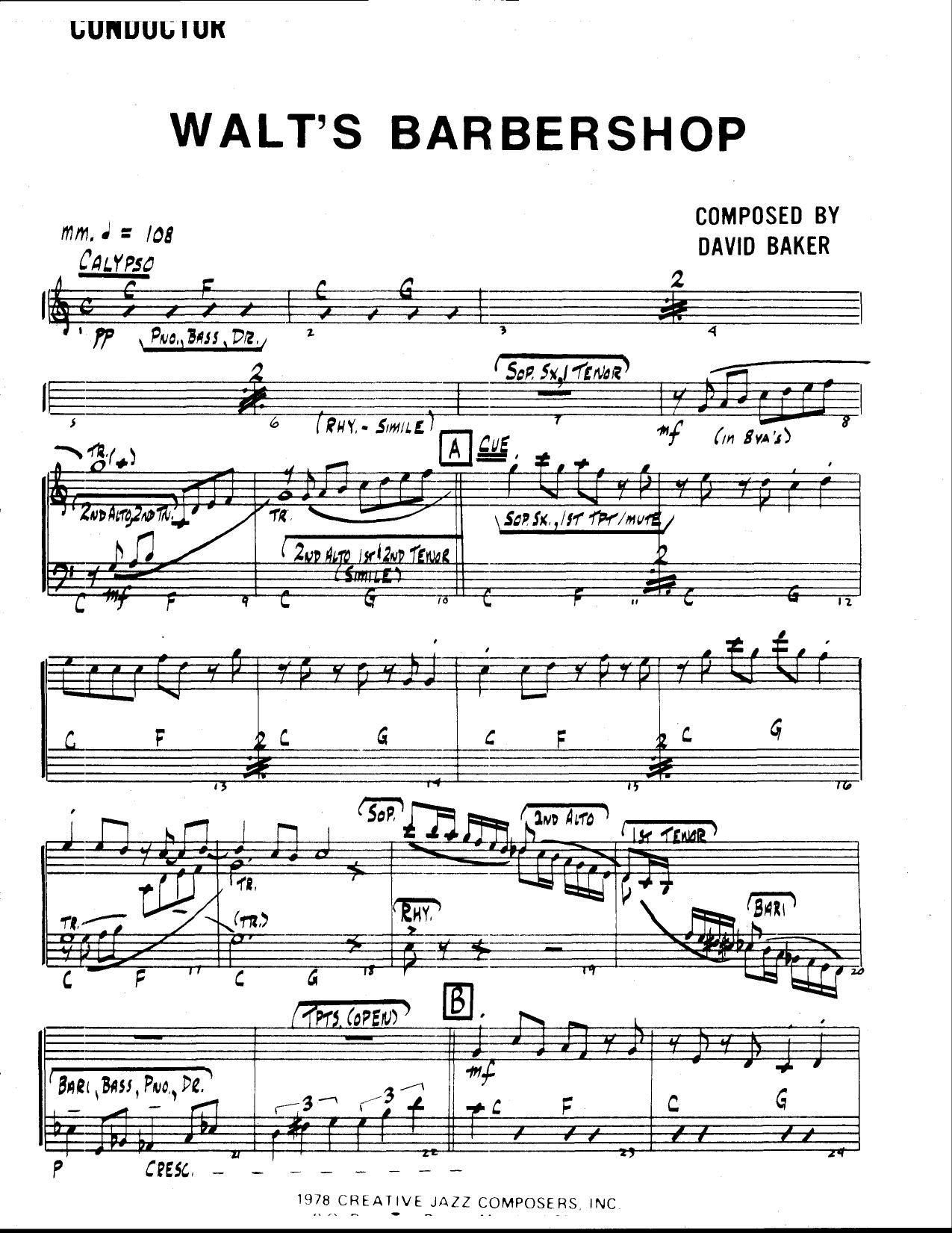
Walt's Barbershop (D.Baker) sheet music preview

Walt's Barbershop (D.Baker)

Composed by D. Baker

Arranged by D.Baker

  • Ensemble: Big Band
  • Style: Jazz Standard
  • Pages: 64
  • Instruments (19): 1st Alto Saxophone (doubling Soprano), 2nd Alto Saxophone, 1st Tenor Saxophone, 2nd Tenor Saxophone, Baritone Saxophone, 1st Trumpet, 2nd Trumpet, 3rd Trumpet, 4th Trumpet, 5th Trumpet, 1st Trombone, 2nd Trombone, 3rd Trombone, Bass Trombone, Tuba, Piano, Guitar, Bass, Drums
  • Difficulty: advanced
  • Content: Individual Parts
  • Format: PDF Download (Instant)
  • Price: $24.99

David Baker’s "Walt’s Barbershop" stands as a brilliant testament to the rich, educational, and deeply swinging compositional legacy of one of modern jazz’s most influential figures. Emerging from the vibrant post-bop and contemporary big band traditions championed by educators and composers of Baker's caliber, this chart captures the upbeat, folksy charm and intricate harmonic sophistication associated with mid-century jazz writing. Grounded in the classic blues-and-changes framework that defined much of Baker’s small-group and large-ensemble output, the composition bridges the gap between accessible, hummable melodic hooks and the sophisticated vertical structures of advanced modern jazz. Driven by an infectious, buoyant medium-swing groove, "Walt’s Barbershop" opens with a playful, conversational head that immediately establishes a lighthearted yet technically demanding mood. The arrangement is anchored by clever chromatic counterpoint and snappy rhythmic unisons between the brass and reed sections, evoking the lively cadence of a neighborhood gathering spot while challenging the ensemble's internal clock. Baker utilizes transparent orchestration during the initial statements, allowing the melody—shared deftly between the alto saxophone and trumpet sections—to cut cleanly through a crisp rhythm section accompaniment. As the chart unfolds, the harmonic landscape expands through clever modal shifts and extended chord extensions, providing a rich sonic palette that transitions seamlessly from whimsical storytelling to high-energy swing exuberance. The developmental arc of the arrangement relies heavily on Baker’s signature penchant for dynamic contrast and tightly knit sectional solis. A standout saxophone soli showcases the reed section's agility, moving through fleet-footed bebop lines that require absolute precision in articulation and breath support. Following open modal space for featured soloists—ideally suited for both tenor saxophone and trumpet improvisers—the ensemble builds inexorably toward a classic, high-octane shout chorus. This climactic section integrates tiered brass voicings and rolling drum breaks, pushing the entire big band to a thrilling dynamic peak before pulling back abruptly for a witty, understated coda that nods right back to the opening theme. Advanced high school ensembles with strong section leaders, as well as collegiate and professional big bands, will find this chart to be an exceptionally rewarding addition to their repertoire. While the piece demands crisp articulation, agile fingerwork in the woodwinds, and a mature understanding of swing subdivision, its inherent melodic charm ensures an enthusiastic reception from any audience. Conductor and band alike will appreciate how the meticulous 128-page conductor score and comprehensive 18-instrument parts lay out a masterclass in modern big band pacing, balancing structural rigor with unadulterated joy. Achieving an authentic reading of "Walt’s Barbershop" requires strict adherence to a buoyant medium-swing tempo, where the underlying eighth notes must remain bouncy and forward-moving rather than heavy or squared off. Conductors should pay close attention to the dynamic balance during the head; the rhythm section must maintain a feather-light ride cymbal pulse to allow the intricate inner-voice countermelodies in the trombones to breathe. Key technical challenges lie in the rapid unison lines of the saxophone soli and the sudden dynamic shifts leading into the shout chorus. Horn players should utilize crisp, jazz-articulated tongue placements, treating scalar passages with appropriate bebop accentuation on the upbeat-driven syncopations. While specialized effects like plungers are not mandatory, players should master natural tonal shading, subtle falls, and precise cut-offs to capture the conversational, vocal quality Baker intended. Rehearsals should begin section by section at a reduced tempo, focusing heavily on ensemble blend and intonation within the extended dominant and altered chord structures before integrating the rhythm section's comping patterns. Q: What instruments and parts are included in this publication? A: The complete 18-instrument big band instrumentation features standard parts for Alto Saxophone 1 & 2, Tenor Saxophone 1 & 2, Baritone Saxophone, 4 Trumpets, 4 Trombones, Piano, Guitar, Bass, and Drums, backed by a comprehensive 128-page conductor score. Q: What is the difficulty level of this arrangement? A: This arrangement is graded as advanced, making it ideal for advanced high school, collegiate, and professional big bands that possess strong sectional reading skills and a solid grasp of swing articulation. Q: What is the musical style and historical context of "Walt's Barbershop"? A: Written by the esteemed composer and educator David Baker, the piece is a contemporary jazz standard rooted in the post-bop and medium-swing tradition, blending blues-infused accessibility with sophisticated modern jazz harmonies. Q: What makes this specific arrangement unique within big band literature? A: It is distinguished by Baker’s signature craftsmanship, featuring witty melodic hooks, transparent scoring that highlights sectional interplay, a demanding saxophone soli, and a clever narrative arc from playful swing to a roaring shout chorus. Q: What is the performance duration and tempo feel of the piece? A: The arrangement is designed as a medium-swing chart with a lively, upbeat tempo feel, typically clocking in at around 3.5 to 5 minutes depending on the length of the open solo sections.

Questions and answers

What is included in the Walt's Barbershop (D.Baker) PDF?
The verified current file contains a conductor score and individual parts across 64 pages.
How many instruments or parts are listed for Walt's Barbershop (D.Baker)?
The verified instrumentation list contains 19 entries for this Big Band arrangement.
Who is credited for Walt's Barbershop (D.Baker)?
Composer: D. Baker. Arranger: D.Baker.
What difficulty is listed for Walt's Barbershop (D.Baker)?
The verified difficulty level is advanced.
What style is listed for Walt's Barbershop (D.Baker)?
The catalog lists the style as Jazz Standard.
Can I preview Walt's Barbershop (D.Baker) before buying?
Yes. The product page provides a preview generated from the current PDF file.
How is Walt's Barbershop (D.Baker) delivered?
After successful payment, the digital PDF is made available for download. The displayed price is $24.99.

Musicians Also Search For

Walt's Barbershop D.Baker PDFWalt's Barbershop D.Baker sheet musicWalt's Barbershop arranged by D.BakerD.Baker big band chartsD.Baker jazz arrangements PDFWalt's Barbershop D. Baker sheet musicWalt's Barbershop D. Baker big band arrangementsD. Baker big band chartsWalt's Barbershop big band arrangementsWalt's Barbershop big band PDF downloadWalt's Barbershop jazz sheet musicbig band sheet music downloadWalt's Barbershop conductor score PDFWalt's Barbershop individual parts downloadWalt's Barbershop sheet music PDFWalt's Barbershop Jazz Standard chartsJazz Standard big band arrangementsbuy Walt's Barbershop sheet musicdownload Walt's Barbershop PDFWalt's Barbershop jazz chartsbest D.Baker big band arrangementsD. Baker arranged by D.BakerWalt's Barbershop printable sheet musicbig band repertoire PDF

All arrangements by D.Baker All D. Baker sheet music