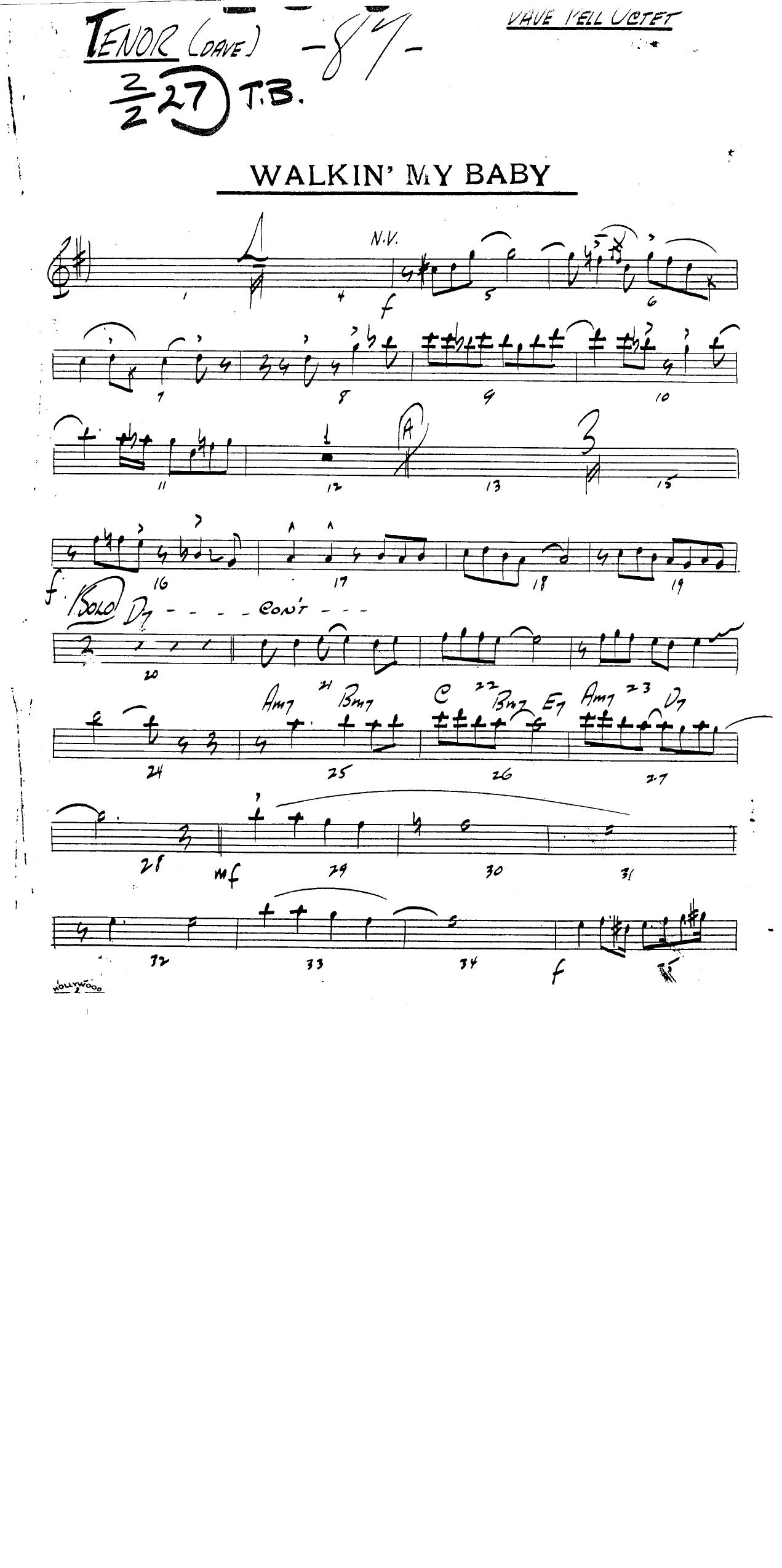
Walking My Baby Back Home (B.Ts,Bs,Trp,Trb+Rhythm)
Composed by Fred E. Ahlert
Arranged by Bill Holman - Dave Pell Octet - Ts,Bs,Trp,Trb+Rhythm
- Ensemble: Small Ensemble
- Style: Jazz Standard
- Pages: 27
- Instruments (8): Tenor Saxophone, Trumpet, Trombone, Baritone Saxophone, Piano, Guitar, Bass, Drums
- Difficulty: easy
- Content: Individual Parts
- Format: PDF Download (Instant)
- Price: $12.99
Fred E. Ahlert and Roy Turk’s timeless 1930 pop standard "Walking My Baby Back Home" achieved a definitive jazz pedigree through the West Coast cool jazz movement, most notably championed by saxophonist Dave Pell’s innovative octet. Originally popularized by artists like Nat King Cole and Johnny Ray, the tune's jaunty, optimistic narrative arc provided fertile ground for modernist jazz arrangers looking to inject sophisticated harmonic motion and witty counterpoint into classic Tin Pan Alley forms. The Dave Pell Octet, renowned for its tight, punchy, and economically brilliant writing, transformed standard vocal-era gems into swinging instrumental masterworks that bridged the gap between traditional jazz accessibility and advanced modernist arranging techniques. Driving with an infectious, buoyant medium-swing tempo, this arrangement radiates the sophisticated optimism characteristic of the 1950s West Coast scene. The harmonic landscape is immediately rich, shifting the standard's innocent diatonic framework into a colorful palette enriched by altered dominants, clever chromatic voice-leading, and subtle reharmonizations. The mood is persistently upbeat, effortless, and urbane, evoking the breezy coolness of a Los Angeles afternoon while maintaining an intense rhythmic drive. The interplay between the horns creates a buoyant momentum, balancing playful melodic statements with deeply satisfying harmonic cushions that keep both the audience and performers thoroughly engaged from the downbeat. Bill Holman’s legendary arranging genius is on full display here, utilizing the unique lightweight timbre of a four-horn front line—tenor saxophone, baritone saxophone, trumpet, and trombone—plus a full rhythm section. Holman avoids the dense, congested textures typical of larger ensembles by exploiting the transparent, linear clarity of the octet format. His writing features intricate counterpoint, angular yet swinging horizontal lines, and masterclass chord voicings that make four horns sound like a much larger section. Rather than relying on standard block chords, Holman distributes the harmonic weight inventively across the brass and reeds, frequently pairing the tenor and trumpet in bright dialogue against the anchoring baritone and trombone. Navigating this chart successfully demands precision, excellent intonation, and a light, agile swing feel, making it an ideal choice for advanced college ensembles, professional pick-up groups, and high-level community jazz bands looking to stretch beyond standard big band literature. The melody is shared seamlessly across the frontline voices, rewarding players with dynamic ensemble solis and ample space for inspired solo rotations. Technical challenges center primarily on maintaining immaculate rhythmic alignment during tight unison passages and executing Holman's brisk, linear articulations cleanly. It is a rewarding, intellectually stimulating addition to any small-ensemble concert program, offering a masterclass in West Coast counterpoint and economy of orchestration. The primary technical challenge in executing this Bill Holman chart lies in maintaining absolute rhythmic crispness and uniform articulation across the four-horn frontline. Because there are no superfluous voices, every player must match the attack, length, and dynamic shape of their neighbors, particularly during angular contrapuntal lines. Aim for a driving, buoyant medium-swing feel that avoids heavy accents on beats two and four; the groove should feel forward-leaning, relaxed, and transparent. The rhythm section must act as a seamless extension of the horns, with the piano and guitar laying down sparse, highly conversational rootless voicings that honor Holman's sophisticated harmonic alterations. Horn players should pay close attention to dynamic contrast, ensuring that background figures never step on featured soloists or primary melodic statements. Rehearsal should begin slowly, locking in the inner-voice balance of the counterpoint before ramping up to performance tempo, ensuring that every chromatic line speaks with absolute clarity and punch. Q: What instruments and parts are included in this arrangement? A: Scored for a compact eight-piece lineup consisting of tenor saxophone, baritone saxophone, trumpet, trombone, and a full rhythm section (piano, bass, drums, guitar), along with a comprehensive 27-page conductor score. Q: What is the difficulty level of this chart? A: Advanced, making it best suited for professional ensembles, top-tier college bands, and accomplished community jazz groups with strong readers and technicians. Q: What is the historical style and context of this piece? A: Written by Fred E. Ahlert and arranged by Bill Holman for the Dave Pell Octet, this chart exemplifies the sophisticated, swinging West Coast cool jazz aesthetic of the 1950s. Q: What makes this specific arrangement unique? A: Holman’s writing maximizes the transparent textures of a four-horn front line using ingenious linear counterpoint, reharmonizations, and clever voice distribution that punches well above its ensemble size. Q: What is the performance duration and tempo feel? A: The arrangement is designed for an energetic medium-swing tempo feel, typically clocking in at around 3 to 4 minutes depending on solo extensions.
Questions and answers
- What is included in the Walking My Baby Back Home (B.Ts,Bs,Trp,Trb+Rhythm) PDF?
- The verified current file contains individual parts across 27 pages.
- How many instruments or parts are listed for Walking My Baby Back Home (B.Ts,Bs,Trp,Trb+Rhythm)?
- The verified instrumentation list contains 8 entries for this Small Ensemble arrangement.
- Who is credited for Walking My Baby Back Home (B.Ts,Bs,Trp,Trb+Rhythm)?
- Composer: Fred E. Ahlert. Arranger: Bill Holman - Dave Pell Octet - Ts,Bs,Trp,Trb+Rhythm.
- What difficulty is listed for Walking My Baby Back Home (B.Ts,Bs,Trp,Trb+Rhythm)?
- The verified difficulty level is easy.
- What style is listed for Walking My Baby Back Home (B.Ts,Bs,Trp,Trb+Rhythm)?
- The catalog lists the style as Jazz Standard.
- Can I preview Walking My Baby Back Home (B.Ts,Bs,Trp,Trb+Rhythm) before buying?
- Yes. The product page provides a preview generated from the current PDF file.
- How is Walking My Baby Back Home (B.Ts,Bs,Trp,Trb+Rhythm) delivered?
- After successful payment, the digital PDF is made available for download. The displayed price is $12.99.
Musicians Also Search For
Walking My Baby Back Home Bill Holman - Dave Pell Octet - Ts,Bs,Trp,Trb+Rhythm PDF • Walking My Baby Back Home Bill Holman - Dave Pell Octet - Ts,Bs,Trp,Trb+Rhythm sheet music • Walking My Baby Back Home arranged by Bill Holman - Dave Pell Octet - Ts,Bs,Trp,Trb+Rhythm • Bill Holman - Dave Pell Octet - Ts,Bs,Trp,Trb+Rhythm small ensemble charts • Bill Holman - Dave Pell Octet - Ts,Bs,Trp,Trb+Rhythm jazz arrangements PDF • Walking My Baby Back Home Fred E. Ahlert sheet music • Walking My Baby Back Home Fred E. Ahlert small ensemble arrangements • Fred E. Ahlert small ensemble charts • Walking My Baby Back Home small ensemble arrangements • Walking My Baby Back Home small ensemble PDF download • Walking My Baby Back Home jazz sheet music • small ensemble sheet music download • Walking My Baby Back Home individual parts download • Walking My Baby Back Home sheet music PDF • Walking My Baby Back Home Jazz Standard charts • Jazz Standard small ensemble arrangements • buy Walking My Baby Back Home sheet music • download Walking My Baby Back Home PDF • Walking My Baby Back Home jazz charts • best Bill Holman - Dave Pell Octet - Ts,Bs,Trp,Trb+Rhythm small ensemble arrangements • Fred E. Ahlert arranged by Bill Holman - Dave Pell Octet - Ts,Bs,Trp,Trb+Rhythm • Walking My Baby Back Home printable sheet music • small ensemble repertoire PDF