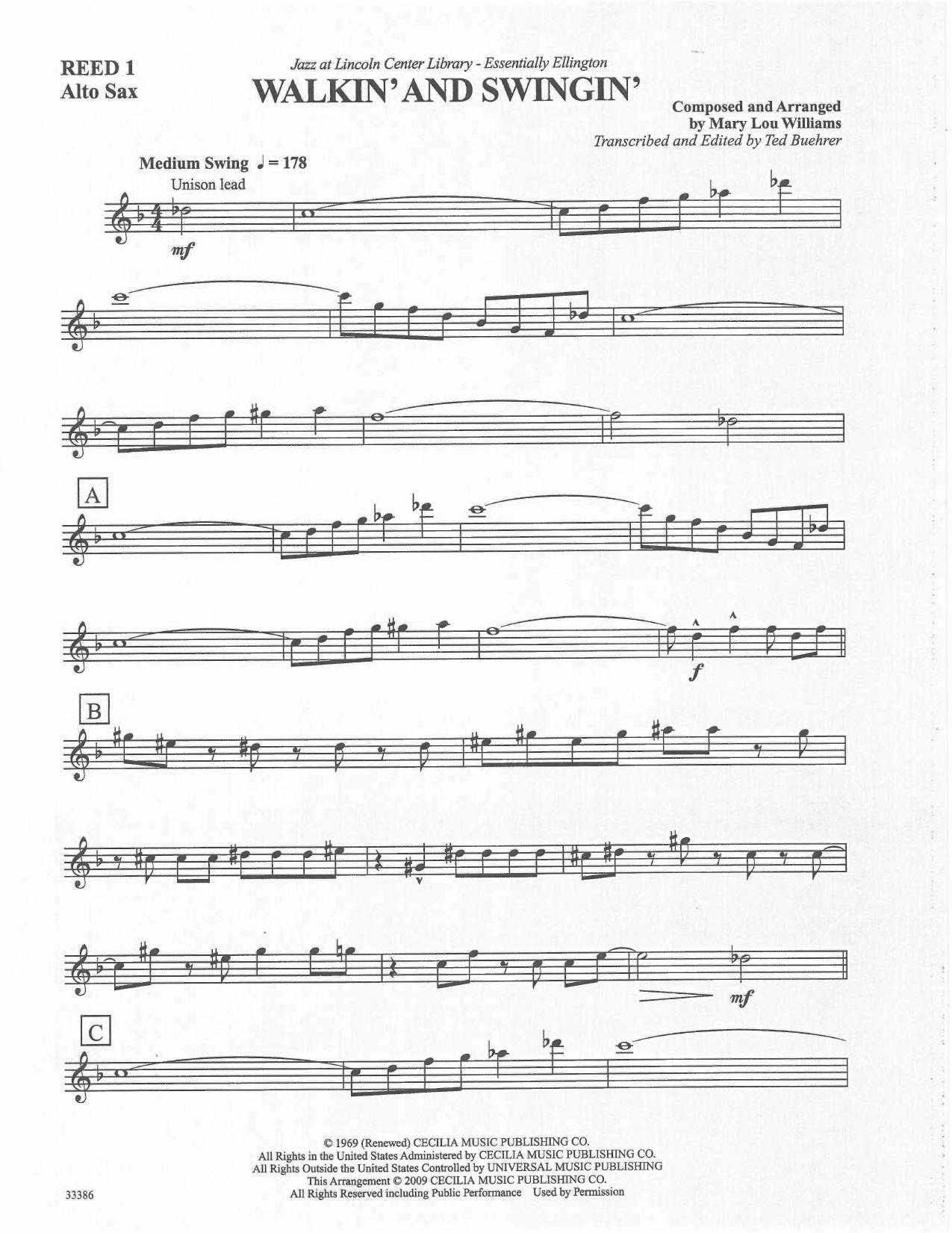
Walkin' And Swingin' (M.L.Williams) sheet music preview

Walkin' And Swingin' (M.L.Williams)

Composed by Mary Lou Williams

Arranged by M.L.Williams

  • Ensemble: Big Band
  • Pages: 48
  • Instruments (11): Reed 1 Alto Sax, Reed 2 Alto Sax, Reed 3 Tenor Sax, Trumpet 1, Trumpet 2, Trombone 1, Trombone 2, Guitar, Piano, Bass, Drums
  • Difficulty: medium
  • Content: Individual Parts
  • Format: PDF Download (Instant)
  • Price: $24.99

Mary Lou Williams stands as one of the most formidable architects of Kansas City swing and the broader jazz canon, and "Walkin' And Swingin'" encapsulates her brilliant synthesis of sophisticated harmonic innovation and driving, blues-rooted momentum. Originally recorded in 1936 by Andy Kirk and His Twelve Clouds of Joy—an orchestra shaped profoundly by Williams’s trailblazing arrangements and piano work—this composition bridges the territorial big band style of the 1930s with the forward-looking modernism that would soon birth bebop. Duke Ellington, Thelonious Monk, and countless others revered Williams for her uncanny ability to voice saxophones and brass with a distinctively modern, angular elegance. This timeless chart captures that exact historical apex, serving as a masterclass in economy of design, rhythmic vitality, and counterpoint within the standard 16-instrument big band instrumentation. Propelled by an infectious, relaxed medium-swing groove in 4/4 time, the arrangement radiates a sophisticated yet earthy energy that immediately engages both performers and audiences. The harmonic language blends buoyant swing-era diatonicism with unexpected chromatic twists and sly modal colorations, a hallmark of Williams’s compositional voice. The mood oscillates effortlessly between playful swagger and intense, tightly coiled rhythmic drive. Listeners will note how the textures shift transparently from sparse, rhythm-section-backed horn lines to thunderous, full-ensemble climaxes, creating a dynamic journey that honors the collaborative spirit of the mid-1930s Kansas City jazz scene while remaining strikingly fresh for contemporary ears. In this definitive treatment, Williams crafts a masterclass in big band architecture where the melodic weight is shared equitably across the ensemble rather than relying solely on the brass or saxophones. The arrangement features intricate horn solis that demand pristine articulation and unified phrasing, particularly from the saxophone section, which often carries the primary thematic statements with light, agile swing eighth notes. Solo opportunities are thoughtfully integrated, allowing featured improvisers to stretch out over standard swing changes supported by crisp, drop-2 and drop-4 section voicings. A tightly constructed shout chorus builds tension through clever syncopation and dynamic contrast, leading the ensemble to a satisfying, high-energy resolution without ever sacrificing the underlying groove for sheer volume. Advanced high school, collegiate, and professional jazz orchestras will find this 48-page publication an ideal vehicle for developing stylistic authenticity and ensemble cohesion. While the technical demands of individual parts are accessible to proficient players, the true challenge—and reward—lies in achieving the stylistic nuances required for authentic 1930s swing: balancing lightweight phrasing, transparent dynamic blending, and an immaculate, forward-leaning time feel. Conductor and band alike will discover that "Walkin' And Swingin'" is not merely a historical artifact, but a living, breathing blueprint for swinging with intellect, grace, and irrepressible joy. Achieving an authentic interpretation of "Walkin' And Swingin'" requires meticulous attention to the stylistic conventions of the mid-1930s Kansas City swing era. The tempo should remain a steady, unhurried medium-swing groove where the emphasis falls naturally on beats two and four. Horn players must master the articulation of unaccented eighth notes, ensuring a smooth, legato-tongued delivery rather than a choppy, staccato approach. The rhythm section is the engine of this chart; the drummer should maintain a feather-light ride cymbal pattern with a crisp hi-hat chop on two and four, while the bassist walks a steady, acoustic-style quarter-note line that anchors the harmony without heavy percussive accents. Balance is critical during the interwoven horn solis—the accompanying sections must dynamically recede to let the melodic voices cut through effortlessly. Pay close attention to dynamic markings leading into the shout chorus, utilizing controlled crescendos to build natural architectural tension rather than forcing the tone quality. Q: What instruments and parts are included in this arrangement? A: This standard 16-instrument big band publication includes parts for four trumpets, four trombones, five saxophones (typically two altos, two tenors, and one baritone), and a full rhythm section comprising piano, bass, and drums, spanning a comprehensive 48-page score and set of parts. Q: What is the difficulty level of this arrangement? A: This chart is best suited for advanced high school, collegiate, and professional jazz ensembles due to its stylistic demands, requiring strong section cohesion, precise swing articulation, and mature rhythmic phrasing rather than extreme technical pyrotechnics. Q: What is the historical style and context of "Walkin' And Swingin'"? A: Composed by pioneering jazz icon Mary Lou Williams, this piece represents the pinnacle of 1930s Kansas City swing, originally made famous by Andy Kirk and His Twelve Clouds of Joy as a bridge between territory band swing and modern jazz harmony. Q: What makes this specific arrangement unique? A: Williams's writing is celebrated for its modern, angular horn voicings, inventive counterpoint, and democratic distribution of melodic material across the ensemble, avoiding predictable big band formulas in favor of subtle harmonic twists and transparent textures. Q: What is the performance tempo and duration of the piece? A: The arrangement is set in a comfortable medium-swing tempo in 4/4 time, making it an ideal centerpiece for a festival performance or concert set with an average duration of approximately three to four minutes depending on solo rotations.

Questions and answers

What is included in the Walkin' And Swingin' (M.L.Williams) PDF?
The verified current file contains a conductor score and individual parts across 48 pages.
How many instruments or parts are listed for Walkin' And Swingin' (M.L.Williams)?
The verified instrumentation list contains 11 entries for this Big Band arrangement.
Who is credited for Walkin' And Swingin' (M.L.Williams)?
Composer: Mary Lou Williams. Arranger: M.L.Williams.
What difficulty is listed for Walkin' And Swingin' (M.L.Williams)?
The verified difficulty level is medium.
Can I preview Walkin' And Swingin' (M.L.Williams) before buying?
Yes. The product page provides a preview generated from the current PDF file.
How is Walkin' And Swingin' (M.L.Williams) delivered?
After successful payment, the digital PDF is made available for download. The displayed price is $24.99.

Musicians Also Search For

Walkin' And Swingin' M.L.Williams PDFWalkin' And Swingin' M.L.Williams sheet musicWalkin' And Swingin' arranged by M.L.WilliamsM.L.Williams big band chartsM.L.Williams jazz arrangements PDFWalkin' And Swingin' Mary Lou Williams sheet musicWalkin' And Swingin' Mary Lou Williams big band arrangementsMary Lou Williams big band chartsWalkin' And Swingin' big band arrangementsWalkin' And Swingin' big band PDF downloadWalkin' And Swingin' jazz sheet musicbig band sheet music downloadWalkin' And Swingin' conductor score PDFWalkin' And Swingin' individual parts downloadWalkin' And Swingin' sheet music PDFbuy Walkin' And Swingin' sheet musicdownload Walkin' And Swingin' PDFWalkin' And Swingin' jazz chartsbest M.L.Williams big band arrangementsMary Lou Williams arranged by M.L.WilliamsWalkin' And Swingin' printable sheet musicbig band repertoire PDF

All arrangements by M.L.Williams All Mary Lou Williams sheet music