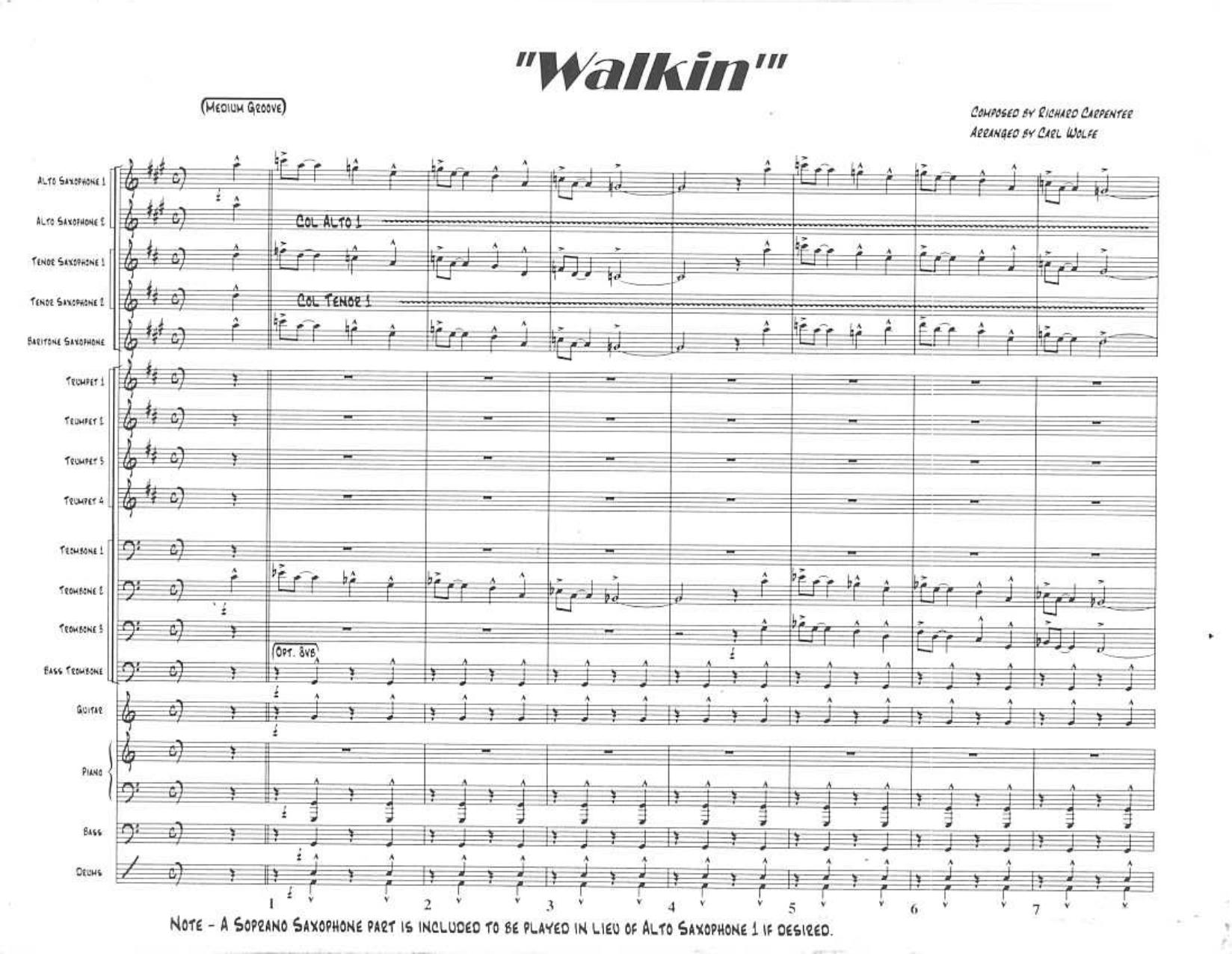
Walkin' (C.Wolfe) sheet music preview

Walkin' (C.Wolfe)

Composed by Richard Carpenter

Arranged by C.Wolfe

  • Ensemble: Big Band
  • Style: Jazz Standard
  • Pages: 88
  • Instruments (18): Soprano Saxophone, Alto Saxophone 1, Alto Saxophone 2, Tenor Saxophone 1, Tenor Saxophone 2, Baritone Saxophone, Trumpet 1, Trumpet 2, Trumpet 3, Trumpet 4, Trombone 1, Trombone 2, Trombone 3, Bass Trombone, Guitar, Piano, Bass, Drums
  • Difficulty: advanced
  • Content: Individual Parts
  • Format: PDF Download (Instant)
  • Price: $24.99

Richard Carpenter’s sophisticated melodic sensibility finds an inspired second life in this vibrant big band interpretation of "Walkin'," expertly crafted by arranger C.Wolfe. While Richard Carpenter is globally celebrated as the compositional and-arranging genius behind the legendary pop duo The Carpenters—whose lush, vocal-driven recordings defined the soft-rock landscape of the 1970s—his underlying mastery of traditional pop composition, vocal harmony, and classic American songform frequently crossed over into jazz sensibilities. "Walkin'" captures that rare intersection, translating a sophisticated, groove-oriented melodic framework into a powerhouse big band chart that honors traditional mid-century jazz styling while maintaining a fresh, contemporary harmonic gloss. Grooving at a confident, driving medium-swing tempo (around 116 BPM), the arrangement opens with a cool, subterranean bassline and snappy hi-hat punctuation before expanding into rich, contemporary horn voicings. The emotional landscape shifts gracefully from laid-back, street-corner swagger during the head statements to high-octane exhilaration during the dynamic ensemble sections. C.Wolfe employs a sophisticated harmonic palette, utilizing extended 9th and 13th chords, unexpected chromatic mediant shifts, and lush saxophone solis that evoke the golden eras of Thad Jones and Sammy Nestico while retaining a distinct, modern voice. The brass writing features warm, open-horn voicings contrasted with articulate plunger effects in the trombones, creating a rich textural depth that keeps both performers and listeners thoroughly engaged. Throughout the chart, the melodic weight is shared dynamically across the ensemble. Alto Saxophone 1 and Tenor Saxophone 1 share primary melodic duties during the initial head statements, supported by punchy, counter-melodic background figures in the brass. A standout feature of the arrangement is an extended, harmonically rich saxophone soli that builds organically into a roaring, brass-heavy shout chorus designed to test the endurance and articulation of the entire section. Solo opportunities are provided for tenor saxophone and trumpet, framed by crisp ensemble backgrounds that encourage adventurous modal exploration. The rhythm section—anchored by an insistent walking bassline and interactive piano voicings—drives the ensemble forward, demanding a drummer with a rock-solid pocket and a refined sense of swing propulsion. Advanced high school ensembles with strong section leaders, as well as collegiate and professional community big bands, will find this 88-page chart to be an immensely rewarding centerpiece for a concert or festival program. The technical demands lie primarily in maintaining clean articulation at moderate tempos, executing tight ensemble blends across wide dynamic ranges, and locking in the subtle stylistic nuances of a modern swing feel. C.Wolfe’s meticulous score and part preparation ensure that sections can rehearse efficiently, making "Walkin'" an exceptional vehicle for showcasing a band's versatility, groove, and sophisticated musicality. Conductors should approach "Walkin'" with a primary focus on time-feel consistency and section-wide articulation uniformity. The medium-swing tempo leaves nowhere to hide, demanding that the rhythm section locks in a relentless, unhurried pocket where the eighth notes are properly swung and accented on the backbeats (beats 2 and 4). Technically, the primary hurdles involve the fast-moving saxophone soli and the dynamic contrast required in the brass section. Saxophonists must prioritize clean, legato lines with light tongue accents on upbeats to preserve the forward momentum. Brass players should utilize subtle doits and falls where indicated, ensuring these stylistic ornaments enhance rather than muddy the texture. Trombone players must master their plunger technique in the secondary themes to achieve the characteristic vocal-like growl without sacrificing pitch center. During rehearsals, isolate the rhythm section first to establish the groove before layering in the saxophones and brass. Pay close attention to the dynamic swells leading into the shout chorus; ensure the band drops back immediately following the peak to allow the featured soloists room to breathe without forcing their tone. Q: What instruments and parts are included in this arrangement? A: This 88-page big band publication is scored for a standard 18-piece instrumentation: 2 Alto Saxophones, 2 Tenor Saxophones, 1 Baritone Saxophone, 4 Trumpets, 4 Trombones, Piano, Guitar, Bass, and Drums. Q: What is the difficulty level of this chart? A: This arrangement is graded as advanced, making it ideal for high school bands with strong section players, college ensembles, and professional community big bands looking for a sophisticated challenge. Q: What is the musical style and historical context of the piece? A: Written as a jazz standard in a medium-swing style, the piece recontextualizes the melodic craftsmanship of composer Richard Carpenter into a classic, horn-driven big band format. Q: What makes C.Wolfe’s arrangement unique? A: C.Wolfe blends traditional mid-century big band aesthetics—such as classic shout choruses and plunger effects—with modern extended harmonies, lush saxophone solis, and clever chromatic shifts. Q: What is the recommended performance duration and tempo? A: The arrangement is set at a medium-swing tempo of approximately 116 BPM, resulting in a performance duration of roughly 4 to 5 minutes depending on the length of the open improvised solos.

Questions and answers

What is included in the Walkin' (C.Wolfe) PDF?
The verified current file contains a conductor score and individual parts across 88 pages.
How many instruments or parts are listed for Walkin' (C.Wolfe)?
The verified instrumentation list contains 18 entries for this Big Band arrangement.
Who is credited for Walkin' (C.Wolfe)?
Composer: Richard Carpenter. Arranger: C.Wolfe.
What difficulty is listed for Walkin' (C.Wolfe)?
The verified difficulty level is advanced.
What style is listed for Walkin' (C.Wolfe)?
The catalog lists the style as Jazz Standard.
Can I preview Walkin' (C.Wolfe) before buying?
Yes. The product page provides a preview generated from the current PDF file.
How is Walkin' (C.Wolfe) delivered?
After successful payment, the digital PDF is made available for download. The displayed price is $24.99.

Musicians Also Search For

Walkin' C.Wolfe PDFWalkin' C.Wolfe sheet musicWalkin' arranged by C.WolfeC.Wolfe big band chartsC.Wolfe jazz arrangements PDFWalkin' Richard Carpenter sheet musicWalkin' Richard Carpenter big band arrangementsRichard Carpenter big band chartsWalkin' big band arrangementsWalkin' big band PDF downloadWalkin' jazz sheet musicbig band sheet music downloadWalkin' conductor score PDFWalkin' individual parts downloadWalkin' sheet music PDFWalkin' Jazz Standard chartsJazz Standard big band arrangementsbuy Walkin' sheet musicdownload Walkin' PDFWalkin' jazz chartsbest C.Wolfe big band arrangementsRichard Carpenter arranged by C.WolfeWalkin' printable sheet musicbig band repertoire PDF

All arrangements by C.Wolfe All Richard Carpenter sheet music