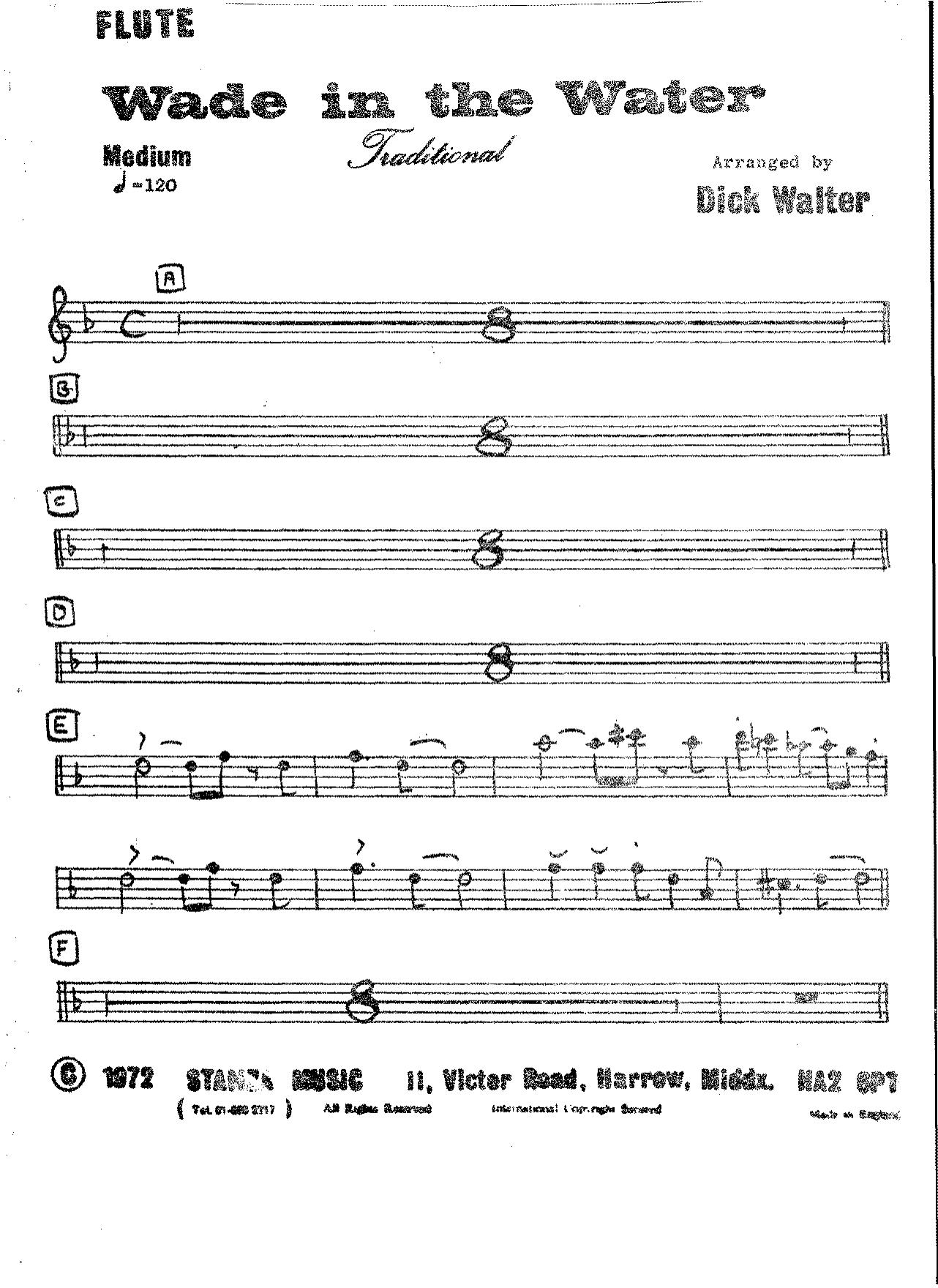
Wade In The Water (D.Walter)
Composed by Traditional
Arranged by D.Walter
- Ensemble: Big Band
- Style: Jazz Standard
- Pages: 42
- Instruments (21): Flute, Alto Saxophone 1, Alto Saxophone 2, Tenor Saxophone 1, Tenor Saxophone 2, Baritone Saxophone, Trumpet 1, Trumpet 2 (doubling Flügelhorn), Trumpet 3, Trumpet 4, Trumpet 5, French Horn, Trombone 1, Trombone 2, Trombone 3, Trombone 4, Trombone 5, Piano, Guitar, Bass Guitar, Drums
- Difficulty: medium
- Content: Individual Parts
- Format: PDF Download (Instant)
- Price: $24.99
Deeply rooted in the African American spiritual tradition, "Wade in the Water" emerged as a coded anthem of the Underground Railroad, famously believed to instruct escaping slaves to walk through water to throw tracking hounds off their scent. Over the decades, this powerful melody transitioned from sacred folk roots into a cornerstone of the jazz and rhythm-and-blues canons, immortalized by artists like Ramsey Lewis, whose funky 1966 jazz-piano rendition brought the tune widespread commercial acclaim. Its modal, minor-key framework and driving, insistent rhythm make it an ideal vehicle for jazz interpretation, inviting everything from subtle, haunting blues phrasing to explosive big band modernism. Propelled by a driving, modal-inflected funk-swing groove in 4/4 time, this striking big band adaptation by D.Walter transforms the traditional spiritual into a high-energy powerhouse. Set in a minor key that emphasizes its inherent tension and dramatic gravity, the arrangement balances dark, brooding ensemble passages with sudden bursts of brilliant modal color. The mood oscillates between tense, secretive anticipation and roaring, celebratory release, evoking the heavy atmosphere of the antebellum South re-imagined through a sophisticated contemporary jazz lens. D.Walter infuses the score with a distinctively modern harmonic palette, utilizing lush extended chords, sharp dynamic contrasts, and dense block-voicing for the saxophones that recall the textural wizardry of Sammy Nestico and Bob Mintzer, yet retain an independent edge. The arrangement features a tightly-knit brass-and-reed interlock, punctuated by an aggressive, driving bassline that anchors the rhythm section. A soaring saxophone soli anchors the middle development, leading directly into a thunderous shout chorus that reworks the traditional melody with stacked fourths and gripping chromatic ascents. Carried initially by the low reeds and rhythm section, the melody is progressively handed off to the trumpet and alto saxophone sections, building cumulative intensity across the charts. Solo space is provided for improvisers, backed by shifting, harmonically rich background figures that challenge the ensemble to maintain dynamic control and balance. Advanced high school, collegiate, and professional jazz ensembles will find this chart deeply rewarding; it demands strong rhythmic precision, impeccable section blend, and stylistic versatility to navigate its fusion of traditional spiritual weight and modern big band fire. Navigating this arrangement requires absolute precision from the rhythm section, particularly the bassist and drummer, who must lock into a relentless, driving groove that feels both heavy and forward-moving. The tempo should remain steady, avoiding any tendency to rush during the intense crescendo leading into the shout chorus. Key technical challenges include executing the sharp, syncopated ensemble figures cleanly without sacrificing the relaxed, swinging pocket required underneath. Horn players should pay close attention to articulation markings: short, clipped staccatos must contrast sharply with wide, expressive slurs and controlled falls. Brass players should utilize subtle plunger mutes or cup mutes where indicated to achieve the desired vocal, guttural quality reminiscent of early blues traditions. During rehearsal, conductors should isolate the rhythm section first to establish the foundational vamp before layering in the horn sections. Balance is paramount during the dense chordal clusters of the saxophone soli; ensure the inner voices do not bury the lead alto line. Finally, work meticulously on the dynamic drop immediately following the shout chorus to maximize the dramatic impact of the final sustained chord. Q: What instruments and parts are included in this 21-instrument big band arrangement? A: The instrumentation comprises a full standard big band layout across 42 pages, including a dedicated Flute part, two Alto Saxophones, two Tenor Saxophones, and a Baritone Saxophone; four Trumpets, four Trombones; and a full rhythm section featuring Piano, Guitar, Bass, and Drums. Q: What is the difficulty level of D.Walter’s "Wade In The Water" big band arrangement? A: This arrangement is graded as advanced-intermediate to advanced, making it best suited for accomplished high school, collegiate, and professional jazz ensembles that possess strong section cohesion and rhythm-section stamina. Q: How does this arrangement honor the historical context of the original composition? A: While utilizing a contemporary jazz and funk-swing harmonic language, the chart preserves the dark, minor-mode intensity and hauntingly spiritual character inherent to the traditional antebellum folk hymn. Q: What elements make this specific arrangement by D.Walter unique? A: It stands out through its sophisticated modal harmony, dense saxophone block-voicings, an intricate middle soli section, and a powerful shout chorus that utilizes stacked fourths and chromatic ascents. Q: What is the performance duration and tempo feel of this chart? A: The arrangement runs approximately 4 to 5 minutes at a medium-up, driving funk-swing tempo of around 120-126 beats per minute in 4/4 time.
Questions and answers
- What is included in the Wade In The Water (D.Walter) PDF?
- The verified current file contains individual parts across 42 pages.
- How many instruments or parts are listed for Wade In The Water (D.Walter)?
- The verified instrumentation list contains 21 entries for this Big Band arrangement.
- Who is credited for Wade In The Water (D.Walter)?
- Composer: Traditional. Arranger: D.Walter.
- What difficulty is listed for Wade In The Water (D.Walter)?
- The verified difficulty level is medium.
- What style is listed for Wade In The Water (D.Walter)?
- The catalog lists the style as Jazz Standard.
- Can I preview Wade In The Water (D.Walter) before buying?
- Yes. The product page provides a preview generated from the current PDF file.
- How is Wade In The Water (D.Walter) delivered?
- After successful payment, the digital PDF is made available for download. The displayed price is $24.99.
Musicians Also Search For
Wade In The Water D.Walter PDF • Wade In The Water D.Walter sheet music • Wade In The Water arranged by D.Walter • D.Walter big band charts • D.Walter jazz arrangements PDF • Wade In The Water Traditional sheet music • Wade In The Water Traditional big band arrangements • Traditional big band charts • Wade In The Water big band arrangements • Wade In The Water big band PDF download • Wade In The Water jazz sheet music • big band sheet music download • Wade In The Water individual parts download • Wade In The Water sheet music PDF • Wade In The Water Jazz Standard charts • Jazz Standard big band arrangements • buy Wade In The Water sheet music • download Wade In The Water PDF • Wade In The Water jazz charts • best D.Walter big band arrangements • Traditional arranged by D.Walter • Wade In The Water printable sheet music • big band repertoire PDF