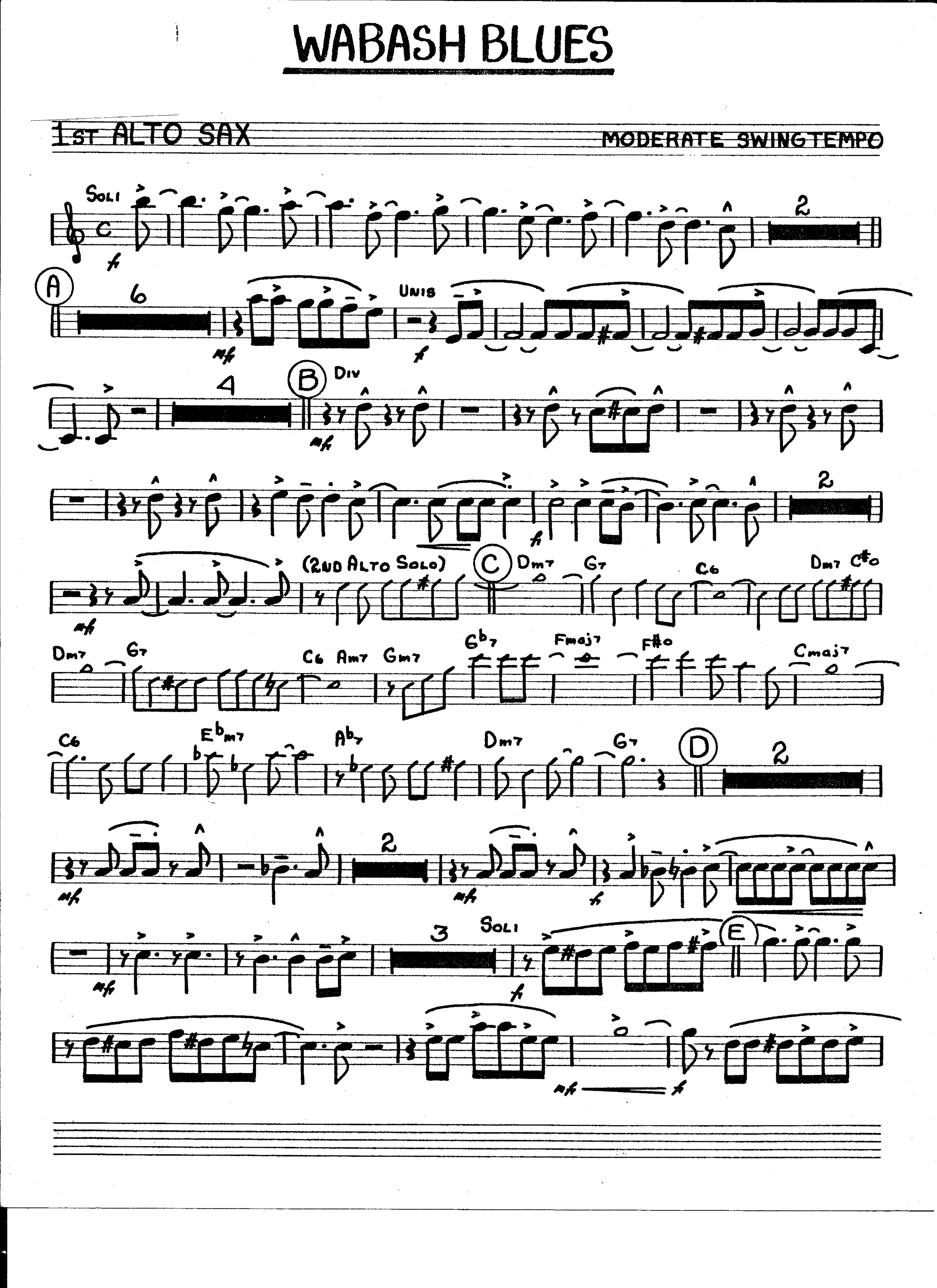
Wabash Blues (D.Gwitt) sheet music preview

Wabash Blues (D.Gwitt)

Composed by Fred Meinken

Arranged by D.Gwitt

  • Ensemble: Big Band
  • Style: Jazz Standard
  • Pages: 35
  • Instruments (17): 1st Alto Sax, 2nd Alto Sax, 1st Tenor Sax, 2nd Tenor Sax, Baritone Sax, 1st Trumpet, 2nd Trumpet, 3rd Trumpet, 4th Trumpet, 1st Trombone, 2nd Trombone, 3rd Trombone, 4th Trombone, Bass, Drums, Guitar, Piano
  • Difficulty: medium
  • Content: Individual Parts
  • Format: PDF Download (Instant)
  • Price: $24.99

Composed by Fred Meinken with lyrics by Dave Ringle, "Wabash Blues" first captured the imagination of the American public during the 1921 commercial blues and early jazz boom, quickly becoming a staple of the repertoire for early jazz orchestras and dixieland revivalists alike. Immortalized through landmark early recordings by Isham Jones and later reinterpreted across generations of traditional and swing-era ensembles, the composition bridges the gap between classic 12-bar blues forms and the structured Tin Pan Alley song structures of the 1920s. Its enduring appeal lies in its infectious, melancholy-tinged melody that lends itself naturally to cyclical improvisation and rich harmonic expansion. In this sophisticated big band adaptation, arranger D.Gwitt breathes fresh life into the historical canvas, recasting the turn-of-the-century standard in a vibrant medium-swing groove. The chart opens with a sultry, understated brass introduction before leaping into a driving 4/4 swing feel characterized by walking basslines and crisp cross-rhythms in the rhythm section. D.Gwitt employs lush, extended chord voicings in the saxes and rich fourth-interval harmonies in the brass, elevating the traditional blues changes into a sophisticated post-swing soundscape. A standout feature of the arrangement is a tightly knit, harmonized saxophone soli that reinterprets the core melody with modern chromatic passing tones, building organically toward a high-energy shout chorus that trades blows between the brass and reed sections. Balancing ensemble interplay with spotlight moments, the arrangement features flexible solo opportunities—nominally for tenor saxophone and trumpet—over standard blues changes that allow soloists to stretch out comfortably. The technical demands require tight articulation discipline, particularly in the section unisons and dynamic contrast control, ensuring the shout chorus achieves maximum impact without distorting the overall balance. D.Gwitt’s dynamic writing carefully manages textural density, shifting seamlessly from sparse, intimate trio accompaniment behind the soloists to roaring, full-ensemble climaxes that showcase the full palette of the modern big band. Advanced high school, collegiate, and professional community jazz orchestras will find this chart an ideal centerpiece for festival programs or club performances. It offers an engaging educational vehicle for teaching traditional swing articulation, section blending, and stylistic phrasing, while providing enough contemporary harmonic sophistication to satisfy seasoned professional musicians and discerning audiences alike. Conductors should approach "Wabash Blues" with a relaxed, driving medium-swing tempo (approx. quarter note = 120–126 BPM), ensuring the rhythm section maintains an insistent, forward-moving pulse rather than dragging. The primary technical challenge lies in the execution of articulated swing eighth notes; horn players must crisp up tongue placements on off-beat accents to achieve the authentic bite D.Gwitt’s writing demands. Brass players should utilize cup and harmon mutes where indicated in the score to capture the authentic early-jazz color palette, transitioning cleanly to open-bell tones during the dynamic swells of the shout chorus. Rehearsal should initially focus on sectional balance within the sax soli, ensuring the inner voices project clearly beneath the lead alto line. Pay careful attention to dynamic markings; dropping the ensemble volume to a whisper during the secondary theme statements will maximize the emotional payoff of the final brass-heavy climax. Q: What instrumentation and parts are included in this arrangement? A: This chart is scored for a standard 17-instrument big band, consisting of 5 saxophones (Alto 1-2, Tenor 1-2, Baritone), 4 trumpets, 4 trombones, and a standard 4-piece rhythm section (piano, guitar, bass, drums), spanning a comprehensive 35-page score and parts set. Q: What is the difficulty level of D.Gwitt’s "Wabash Blues"? A: This arrangement is graded as intermediate-advanced (Level 4), making it well-suited for accomplished high school, collegiate, and professional community big bands that are comfortable with standard jazz swing idioms and extended section unisons. Q: What is the historical background of the musical style? A: Based on Fred Meinken’s 1921 classic, this arrangement reimagines a foundational early jazz standard within a classic swing-era aesthetic, blending vintage blues sentiments with contemporary big band arranging techniques. Q: What makes this specific arrangement unique? A: D.Gwitt uniquely fuses nostalgic 1920s melodic themes with modern extended tertian harmonies, a tightly crafted saxophone soli, and dynamic shouting counterlines that breathe fresh life into a historic blues progression. Q: What is the performance duration and tempo recommendation? A: The arrangement runs approximately 4 to 4.5 minutes in length when performed at the recommended medium-swing tempo of roughly 120 to 126 beats per minute.

Questions and answers

What is included in the Wabash Blues (D.Gwitt) PDF?
The verified current file contains individual parts across 35 pages.
How many instruments or parts are listed for Wabash Blues (D.Gwitt)?
The verified instrumentation list contains 17 entries for this Big Band arrangement.
Who is credited for Wabash Blues (D.Gwitt)?
Composer: Fred Meinken. Arranger: D.Gwitt.
What difficulty is listed for Wabash Blues (D.Gwitt)?
The verified difficulty level is medium.
What style is listed for Wabash Blues (D.Gwitt)?
The catalog lists the style as Jazz Standard.
Can I preview Wabash Blues (D.Gwitt) before buying?
Yes. The product page provides a preview generated from the current PDF file.
How is Wabash Blues (D.Gwitt) delivered?
After successful payment, the digital PDF is made available for download. The displayed price is $24.99.

Musicians Also Search For

Wabash Blues D.Gwitt PDFWabash Blues D.Gwitt sheet musicWabash Blues arranged by D.GwittD.Gwitt big band chartsD.Gwitt jazz arrangements PDFWabash Blues Fred Meinken sheet musicWabash Blues Fred Meinken big band arrangementsFred Meinken big band chartsWabash Blues big band arrangementsWabash Blues big band PDF downloadWabash Blues jazz sheet musicbig band sheet music downloadWabash Blues individual parts downloadWabash Blues sheet music PDFWabash Blues Jazz Standard chartsJazz Standard big band arrangementsbuy Wabash Blues sheet musicdownload Wabash Blues PDFWabash Blues jazz chartsbest D.Gwitt big band arrangementsFred Meinken arranged by D.GwittWabash Blues printable sheet musicbig band repertoire PDF

All arrangements by D.Gwitt All Fred Meinken sheet music