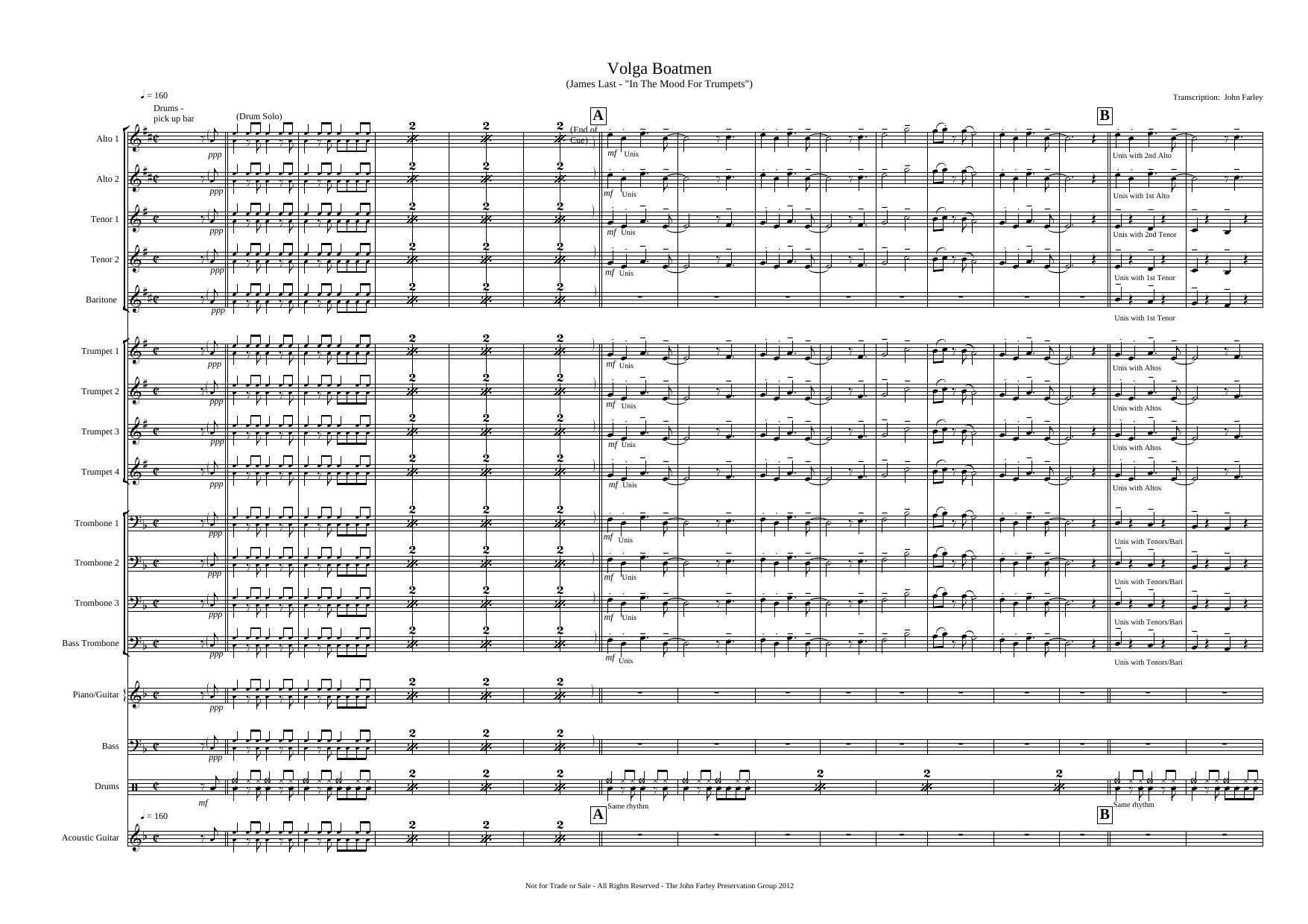
Volga Boatmen (J.Last) sheet music preview

Volga Boatmen (J.Last)

Composed by Traditional

Arranged by James Last

  • Ensemble: Big Band
  • Pages: 60
  • Instruments (19): Alto Saxophone 1, Alto Saxophone 2, Tenor Saxophone 1, Tenor Saxophone 2, Baritone Saxophone, Flute, Trumpet 1, Trumpet 2, Trumpet 3, Trumpet 4, Trombone 1, Trombone 2, Trombone 3, Bass Trombone, Piano, Guitar, Acoustic Guitar, Bass, Drums
  • Difficulty: advanced
  • Content: Individual Parts
  • Format: PDF Download (Instant)
  • Price: $24.99

The haunting Russian traditional melody "The Song of the Volga Boatmen" underwent a remarkable transformation when filtered through the lush, crowd-pleasing orchestration style of legendary German bandleader and arranger James Last. Originally a bleak, heavy work song sung by barge haulers on the Volga River, the theme gained international prominence in the 20th century through classical adaptations, orchestral suites, and eventually jazz interpretations. James Last took this deeply solemn, minor-mode folk motif and re-imagined it through a high-energy, brass-heavy big band lens that bridges mid-century European easy listening and punchy contemporary swing. By injecting a driving rhythm section groove and expansive harmonies into the stark Russian framework, Last turned a centuries-old lament into an exhilarating showcase for modern instrumental ensembles. Dynamic momentum defines the musical character of this 60-page arrangement, shifting effortlessly from brooding, low-register tension to explosive, celebratory peaks. Anchored in a minor key that emphasizes its dramatic Russian roots, the piece opens with an atmospheric, suspended intro before settling into a robust, driving groove with a heavy backbeat. The mood transitions dynamically from dark and mysterious to triumphant and exuberant, evoking the sheer physical power of the original haulers combined with the sophisticated sheen of a world-class touring big band. Rich, stacked chord voicings in the brass and interlocking woodwind countermelodies create a thick, wall-of-sound texture that is unmistakably characteristic of Last’s grand orchestration style, steering clear of sparse modernism in favor of rich, cinematic fullness. James Last approaches the traditional material with a signature blend of populist accessibility and clever compositional sophistication, utilizing soaring brass counterlines, sweeping modulations, and a pulsating rhythm section groove. Rather than playing the melody straight, the arrangement utilizes clever metric shifts and rhythmic displacement to keep the listener engaged, weaving the iconic theme through unexpected harmonic coloring. The 9-instrument core ensemble functions with remarkable textural density, demanding tight section playing where the alto sax, tenor sax, trumpet, and trombone must lock in seamlessly with the driving piano and rhythm framework. Solos are seamlessly integrated into the structural arc, providing moments of improvisational freedom that contrast sharply with the meticulously scored ensemble shout choruses. Performing this demanding 9-instrument version requires exceptional blend, intonation, and rhythmic precision, making it an ideal choice for ambitious college ensembles, advanced community big bands, and professional groups seeking a unique crowd-pleaser. The technical challenges lie primarily in maintaining a steady, driving momentum through the frequent dynamic swells and navigating the dense harmonic shifts without sacrificing intonation. The woodwinds and brass share the spotlight, passing the iconic melodic weight back and forth while the rhythm section maintains an unyielding pocket. Delivering this chart successfully yields immense musical rewards, offering audiences a thrilling, unexpected fusion of traditional Slavic folklore and high-octane big band jazz vitality. Navigating this arrangement successfully requires careful attention to balance and stylistic duality, as the chart demands both the weight of a classical tone poem and the crisp articulation of a jazz big band. - **Tempo and Feel:** Establish a rock-solid, driving medium tempo from the outset. Avoid rushing the syncopated figures; the groove must feel heavy and purposeful, especially during the transition from the brooding minor-mode intro into the main rhythmic sections. - **Technical Challenges:** The primary hurdle involves executing the dense, 9-instrument harmonic voicings with immaculate intonation. Trumpets and trombones should carefully balance their chordal stakes so that no single voice overpowers the rich inner intervals. - **Articulation:** Use crisp, defined tongue strokes on off-beat figures to give the rhythm section maximum punch. Ensure that legato lines in the saxophones maintain a warm, vocal quality reminiscent of a choir of human voices. - **Rehearsal Strategy:** Isolate the rhythm section first to lock in the foundational groove before layering in the horns. Pay close attention to dynamic contrast; the quiet transitional passages must whisper so the subsequent shout choruses can truly erupt. Q: What instruments and parts are included in this 60-page publication? A: This arrangement is scored for a 9-instrument ensemble configuration, featuring core parts for Alto Saxophone, Tenor Saxophone, Trumpet, Trombone, Piano, and accompanying rhythm section instrumentation spanning 60 total pages of detailed score and parts. Q: What is the difficulty level of this James Last arrangement? A: This piece is best suited for advanced high school, collegiate, and professional or advanced community big bands due to its dense harmonies, demanding range requirements, and need for tight sectional interlock. Q: What is the musical style and historical background of this piece? A: It is a jazz-orchestral interpretation of a traditional Russian Volga boatmen work song, re-conceived by arranger James Last to blend folk melancholy with high-energy big band swing and rich, cinematic harmonies. Q: What makes this specific arrangement by James Last unique? A: It stands out through Last's signature "wall-of-sound" orchestration, featuring sweeping modulations, lush brass voicings, and a driving rhythmic pulse that transforms a solemn folk melody into an exuberant jazz showcase. Q: What is the approximate performance duration and tempo framework? A: While performance time varies slightly based on chosen interpretive rubatos and solo sections, the piece typically runs between 3.5 to 5 minutes at a steady, driving medium tempo.

Questions and answers

What is included in the Volga Boatmen (J.Last) PDF?
The verified current file contains a conductor score and individual parts across 60 pages.
How many instruments or parts are listed for Volga Boatmen (J.Last)?
The verified instrumentation list contains 19 entries for this Big Band arrangement.
Who is credited for Volga Boatmen (J.Last)?
Composer: Traditional. Arranger: James Last.
What difficulty is listed for Volga Boatmen (J.Last)?
The verified difficulty level is advanced.
Can I preview Volga Boatmen (J.Last) before buying?
Yes. The product page provides a preview generated from the current PDF file.
How is Volga Boatmen (J.Last) delivered?
After successful payment, the digital PDF is made available for download. The displayed price is $24.99.

Musicians Also Search For

Volga Boatmen James Last PDFVolga Boatmen James Last sheet musicVolga Boatmen arranged by James LastJames Last big band chartsJames Last jazz arrangements PDFVolga Boatmen Traditional sheet musicVolga Boatmen Traditional big band arrangementsTraditional big band chartsVolga Boatmen big band arrangementsVolga Boatmen big band PDF downloadVolga Boatmen jazz sheet musicbig band sheet music downloadVolga Boatmen conductor score PDFVolga Boatmen individual parts downloadVolga Boatmen sheet music PDFbuy Volga Boatmen sheet musicdownload Volga Boatmen PDFVolga Boatmen jazz chartsbest James Last big band arrangementsTraditional arranged by James LastVolga Boatmen printable sheet musicbig band repertoire PDF

All arrangements by James Last All Traditional sheet music