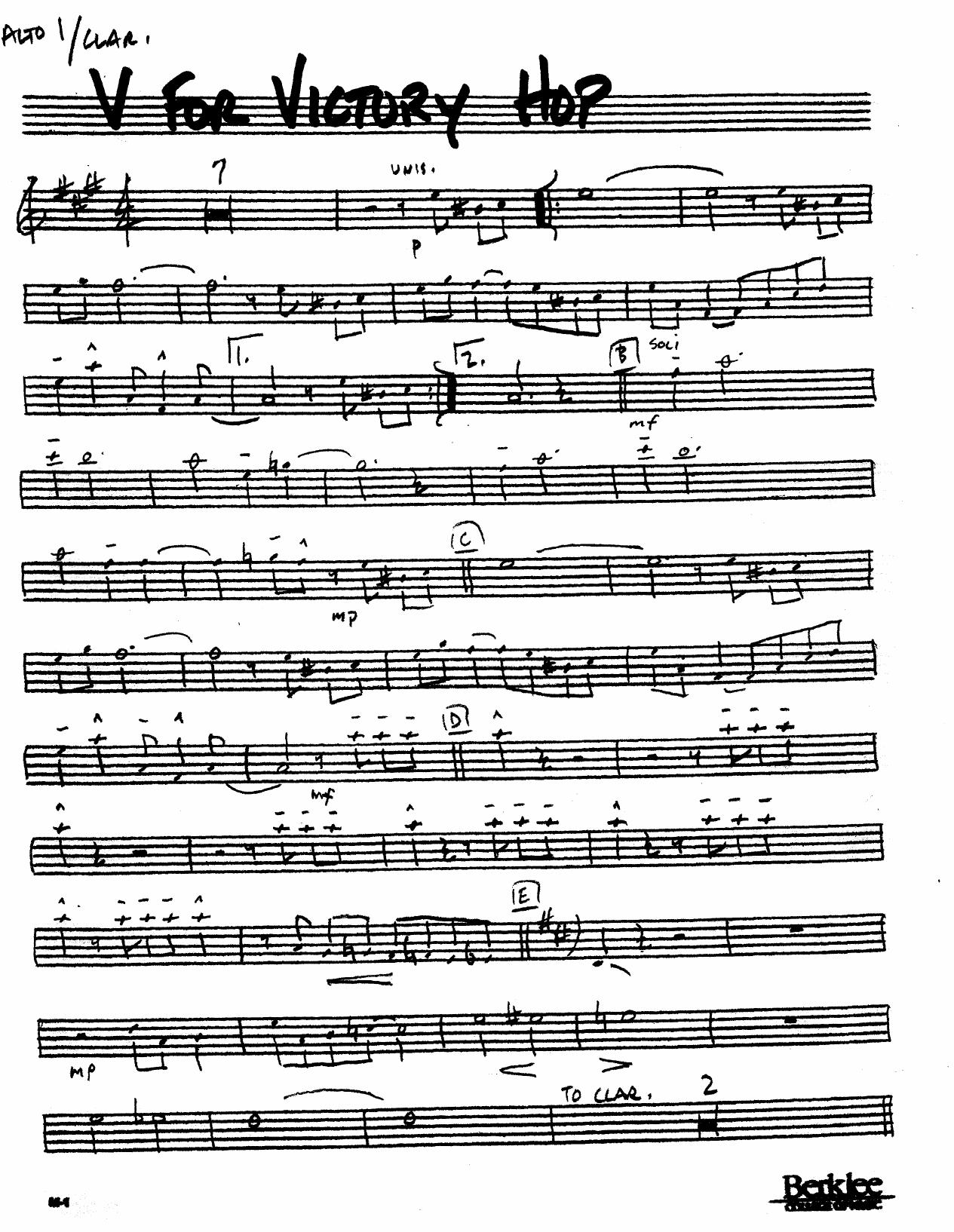
V For Victory Hop (J.Gray)
Composed by Jerry Gray
Arranged by Glen Miller
- Ensemble: Big Band
- Pages: 37
- Instruments (17): Alto Saxophone 1, Alto Saxophone 2, Tenor Saxophone 1, Tenor Saxophone 2, Baritone Saxophone, Trumpet 1, Trumpet 2, Trumpet 3, Trumpet 4, Trombone 1, Trombone 2, Trombone 3, Trombone 4, Piano, Guitar, Bass, Drums
- Difficulty: medium
- Content: Individual Parts
- Format: PDF Download (Instant)
- Price: $24.99
Jerry Gray penned "V For Victory Hop" during the height of the World War II era, capturing the indomitable spirit and high-octane energy of the mid-1940s swing movement. As one of the premier arrangers for the legendary Glenn Miller Army Air Force Band, Gray specialized in crafting driving, rhythmically precise charts that translated the civilian dance craze into a disciplined, military-grade powerhouse sound. This composition directly references the famous Morse code "V" for victory rhythm (three short notes followed by one long note, matching Beethoven’s Fifth Symphony motif), weaving that patriotic syncopation into the very fabric of a blistering swing chart. It stands today as a quintessential artifact of wartime morale-boosting entertainment, offering modern big bands a direct window into the precision-engineered styling that defined the Greatest Generation's contribution to jazz history. Propelled by an aggressive, medium-up swing tempo in 4/4 time, the arrangement radiates an urgent, unyielding energy. The harmonic language relies heavily on punchy triad-plus-sixth voicings, stacked brass triads, and tight block-chord textures that demand absolute rhythmic unity. The mood shifts dynamically from a brisk, driving swagger to exhilarating, full-ensemble climaxes that evoke the bustling optimism and collective resolve of a 1940s USO show. Listeners will immediately note the bright, brass-heavy fanfare figures and the relentless walking bassline foundation that keep the propulsion engine running hot from the first downbeat to the final explosive chord. Glenn Miller’s signature arranging footprint is unmistakable throughout the score, characterized by closely voiced clarinet-and-sax combinations carrying the primary thematic weight, underpinned by harmonized muted brasses. Gray avoids overly complex modern extensions, opting instead for crystal-clear diatonic and chromatic voice-leading that maximizes punch and projection. The arrangement features brilliantly integrated ensemble solis where the reduced instrumentation—tailored for an 8-instrument lineup—mimics the thick, multi-layered punch of a full seventeen-piece orchestra. A compact yet fiery shout chorus serves as the structural peak, leveraging dynamic contrast to build explosive tension before resolving into a crisp, definitive ending. Executing this 37-page score requires immense attention to articulation, particularly regarding short, detached staccato notes and precisely timed swing eighth-note phrasing. The melody is shared fluidly between the alto and tenor saxophones, supported by punchy trumpet and trombone interjections that act as dynamic punctuation marks. Featured solo sections provide ample space for horns to stretch out within a traditional swing vocabulary, while the piano part acts as both a rhythmic anchor and a harmonic colorist. Advanced high school, collegiate, and professional community big bands will find this chart exceptionally rewarding; its leaner eight-instrument configuration demands absolute chamber-like independence from every player while delivering the massive sonic impact of a full Miller-style broadcast. Conductors tackling "V For Victory Hop" must prioritize ultra-crisp articulation and uniform swing eighth-note interpretation across all eight instruments. The target tempo should remain brisk and unwavering, keeping the rhythmic drive strictly locked in with the drummer's ride cymbal. Brass players should utilize cup or straight mutes where indicated to achieve that authentic 1940s broadcast timbre, paying careful attention to clean cut-offs on all accented figures. Saxophones need to lock their intonation during tight soli passages, ensuring that the lead alto voice blends seamlessly with the tenor. Rehearsal should initially focus on sectional isolation of the syncopated "V-for-Victory" motif rhythm, ensuring every player executes the dotted-value accents with identical weight before integrating the rhythm section. Balance is crucial: because this is an 8-instrument adaptation of a full big band chart, inner voices must project without overpowering the primary melodic line carried by the saxes. Q: What specific instruments and parts are included in this 37-page arrangement? A: This chart is scored for an 8-instrument ensemble comprising Alto Saxophone, Tenor Saxophone, Trumpet, Trombone, Piano, and rhythm section support, optimized for a compact big band or jazz combo setup. Q: What is the difficulty level of this arrangement? A: This piece is best suited for advanced high school, collegiate, and professional community ensembles due to its demanding swing articulation, fast tempo, and requirement for tight chamber-style independence. Q: What is the historical style and background of "V For Victory Hop"? A: Composed by Jerry Gray and arranged in the signature style of Glenn Miller, this piece represents the high-energy wartime swing era of the mid-1940s, explicitly incorporating the famous Morse code "V-for-victory" rhythm into its thematic material. Q: What makes this particular arrangement unique? A: It brilliantly condenses the massive, dense orchestrations of the famous Glenn Miller Army Air Force Band into a lean 8-instrument format without sacrificing the punchy shout choruses, block voicings, and driving momentum of the original recording. Q: What is the performance duration and recommended tempo feel? A: The arrangement is performed at a brisk, high-energy medium-up swing tempo in 4/4 time, typically lasting around 3 minutes, making it an ideal high-impact opener or closer for a concert set.
Questions and answers
- What is included in the V For Victory Hop (J.Gray) PDF?
- The verified current file contains individual parts across 37 pages.
- How many instruments or parts are listed for V For Victory Hop (J.Gray)?
- The verified instrumentation list contains 17 entries for this Big Band arrangement.
- Who is credited for V For Victory Hop (J.Gray)?
- Composer: Jerry Gray. Arranger: Glen Miller.
- What difficulty is listed for V For Victory Hop (J.Gray)?
- The verified difficulty level is medium.
- Can I preview V For Victory Hop (J.Gray) before buying?
- Yes. The product page provides a preview generated from the current PDF file.
- How is V For Victory Hop (J.Gray) delivered?
- After successful payment, the digital PDF is made available for download. The displayed price is $24.99.
Musicians Also Search For
V For Victory Hop Glen Miller PDF • V For Victory Hop Glen Miller sheet music • V For Victory Hop arranged by Glen Miller • Glen Miller big band charts • Glen Miller jazz arrangements PDF • V For Victory Hop Jerry Gray sheet music • V For Victory Hop Jerry Gray big band arrangements • Jerry Gray big band charts • V For Victory Hop big band arrangements • V For Victory Hop big band PDF download • V For Victory Hop jazz sheet music • big band sheet music download • V For Victory Hop individual parts download • V For Victory Hop sheet music PDF • buy V For Victory Hop sheet music • download V For Victory Hop PDF • V For Victory Hop jazz charts • best Glen Miller big band arrangements • Jerry Gray arranged by Glen Miller • V For Victory Hop printable sheet music • big band repertoire PDF