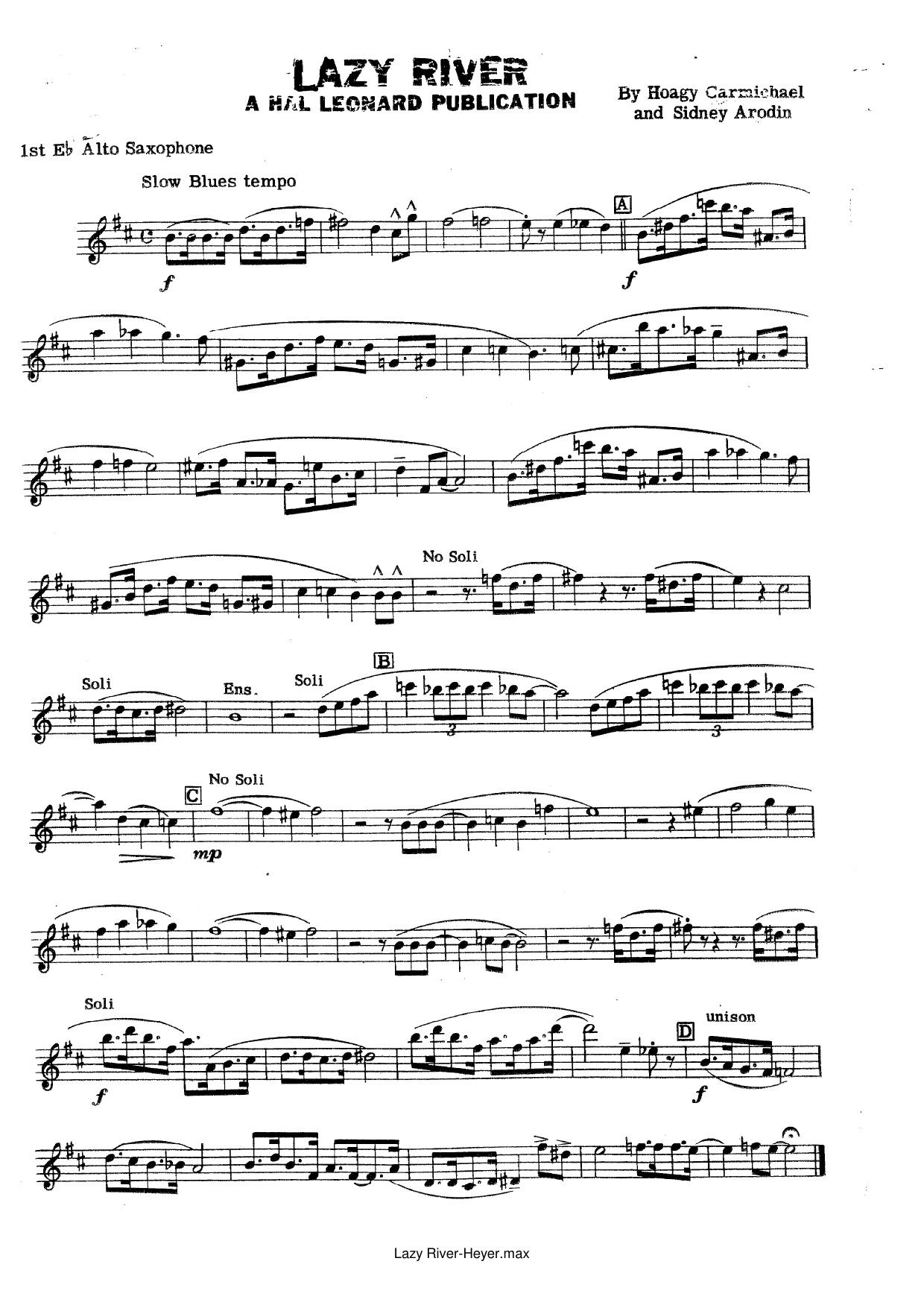
Up A Lazy River (F.Heyer) sheet music preview

Up A Lazy River (F.Heyer)

Composed by Hoagy Carmichael

Arranged by F.Heyer

  • Ensemble: Big Band
  • Style: Jazz Standard
  • Pages: 19
  • Instruments (17): 1st Eb Alto Saxophone, 2nd Alto Saxophone II, 1st Bb Tenor Saxophone, 2nd Bb Tenor Saxophone, Eb Baritone Saxophone, 1st Trumpet, 2nd Trumpet, 2nd Trumpet II, 4th Trumpet, 1st Trombone, 2nd Trombone, 3rd Trombone, Trombone IV, Drums, String Bass, Guitar, Piano
  • Difficulty: easy
  • Content: Individual Parts
  • Format: PDF Download (Instant)
  • Price: $24.99

Hoagy Carmichael and Sidney Arodin’s timeless 1930 composition "Up A Lazy River" occupies a cherished space in the early jazz and swing canon, popularized over the decades by icons ranging from the Mills Brothers and Louis Armstrong to Bobby Darin. Representing the quintessential transition from late-1920s parlor novelty to buoyant swing-era staple, the tune relies on a deceptively simple harmonic framework that invites effortless phrasing and inventive reharmonization. Its enduring appeal lies in its relaxed, pastoral imagery paired with an infectious, forward-driving rhythm that has made it a favorite vehicle for traditionalists and modernists alike across nearly a century of recorded jazz history. Masterfully adapted for the classic 17-piece big band instrumentation, this arrangement by F.Heyer breathes fresh life into the standard through a vibrant medium-swing feel. The chart opens with a warm, inviting ensemble introduction before establishing a buoyant 4/4 groove anchored by a crisp ride cymbal and walking bassline. The overall mood shifts seamlessly from nostalgic warmth to exuberant high-energy swing, evoking the sultry atmosphere of a Mississippi riverboat ride paired with the crisp precision of mid-century studio jazz writing. Heyer balances relaxed, laid-back melodic statements with sharp, punctuated brass stabs that keep the momentum fresh and engaging for both performers and listeners. Heyer’s distinctive arranging approach shines through clever sectional writing, contrasting lush, full-ensemble saxophone solis with punchy, blues-infused brass interludes. The reeds carry the primary thematic weight through the early choruses, utilizing tight, beautiful voicings that highlight the rich scalar movement of Carmichael’s melody. Mid-way through the chart, the arrangement opens up for dynamic solo rotations—traditionally featuring trumpet and tenor saxophone—before building steadily toward a textbook high-register shout chorus. This climactic section utilizes dynamic terracing and crisp rhythmic unisons to drive the band to an exciting peak before resolving into a playful, cascading outro. Advanced high school, collegiate, and community jazz ensembles will find this arrangement an ideal vehicle for developing stylistic maturity, section balance, and swing articulation. While the technical demands of the individual parts remain accessible to competent players, the true challenge lies in achieving an authentic, relaxed jazz feel without rushing the tempo. The 19-page manuscript provides ample breathing room across all 17 parts, making it a robust, rewarding centerpiece for festival programs, spring concerts, or formal club settings where stylistic nuance and ensemble cohesion take center stage. Achieving the authentic, laid-back feel of this arrangement requires strict adherence to a steady, unhurried medium-swing tempo. Conductors should caution the rhythm section against dragging while maintaining the relaxed "back-of-the-beat" phrasing characteristic of 1930s and 40s swing. Horn players must pay close attention to articulation markings: short, crisp staccatos should be played with tongue-led precision, while longer notes demand a warm, supported vibrato. Brass players should utilize cup or bucket mutes where indicated to achieve the authentic textural warmth reminiscent of classic territory bands, ensuring smooth transitions when opening up for the shout chorus. Rehearsals should initially focus on sectional balance within the sax soli, ensuring the inner voices project clearly beneath the lead alto. Rhythm section players need to lock in tightly, with the drummer utilizing light hi-hat chokes on beats two and four to maintain a driving yet unobtrusive pulse throughout the form. Q: What instruments and parts are included in this 17-instrument big band arrangement? A: The arrangement is scored for a standard 17-piece big band instrumentation, comprising 5 saxophones (Alto 1, Alto 2, Tenor 1, Tenor 2, Baritone), 4 trumpets, 4 trombones, and a standard 4-piece rhythm section consisting of piano, guitar, bass, and drums. Q: What is the overall difficulty level of F.Heyer's arrangement? A: This chart is graded at a medium difficulty level, making it well-suited for advanced high school, collegiate, and community jazz bands looking to refine their swing feel and ensemble blending. Q: What is the historical background and musical style of "Up A Lazy River"? A: Originally composed in 1930 by Hoagy Carmichael and Sidney Arodin, the piece is a foundational jazz standard that bridges early jazz and swing-era idioms, here cast in a vibrant, swinging big band style. Q: What makes this specific arrangement by F.Heyer unique? A: Heyer's treatment stands out through its clever integration of lush saxophone solis, dynamic brass interplay, and a carefully structured shout chorus that modernizes the classic melody without sacrificing its nostalgic charm. Q: What is the suggested performance tempo and duration for this chart? A: The arrangement is designed to be performed at a comfortable medium-swing tempo (approximately 116-124 BPM) and typically runs for about 3.5 to 4 minutes depending on solo extensions.

Questions and answers

What is included in the Up A Lazy River (F.Heyer) PDF?
The verified current file contains individual parts across 19 pages.
How many instruments or parts are listed for Up A Lazy River (F.Heyer)?
The verified instrumentation list contains 17 entries for this Big Band arrangement.
Who is credited for Up A Lazy River (F.Heyer)?
Composer: Hoagy Carmichael. Arranger: F.Heyer.
What difficulty is listed for Up A Lazy River (F.Heyer)?
The verified difficulty level is easy.
What style is listed for Up A Lazy River (F.Heyer)?
The catalog lists the style as Jazz Standard.
Can I preview Up A Lazy River (F.Heyer) before buying?
Yes. The product page provides a preview generated from the current PDF file.
How is Up A Lazy River (F.Heyer) delivered?
After successful payment, the digital PDF is made available for download. The displayed price is $24.99.

Musicians Also Search For

Up A Lazy River F.Heyer PDFUp A Lazy River F.Heyer sheet musicUp A Lazy River arranged by F.HeyerF.Heyer big band chartsF.Heyer jazz arrangements PDFUp A Lazy River Hoagy Carmichael sheet musicUp A Lazy River Hoagy Carmichael big band arrangementsHoagy Carmichael big band chartsUp A Lazy River big band arrangementsUp A Lazy River big band PDF downloadUp A Lazy River jazz sheet musicbig band sheet music downloadUp A Lazy River individual parts downloadUp A Lazy River sheet music PDFUp A Lazy River Jazz Standard chartsJazz Standard big band arrangementsbuy Up A Lazy River sheet musicdownload Up A Lazy River PDFUp A Lazy River jazz chartsbest F.Heyer big band arrangementsHoagy Carmichael arranged by F.HeyerUp A Lazy River printable sheet musicbig band repertoire PDF

All arrangements by F.Heyer All Hoagy Carmichael sheet music