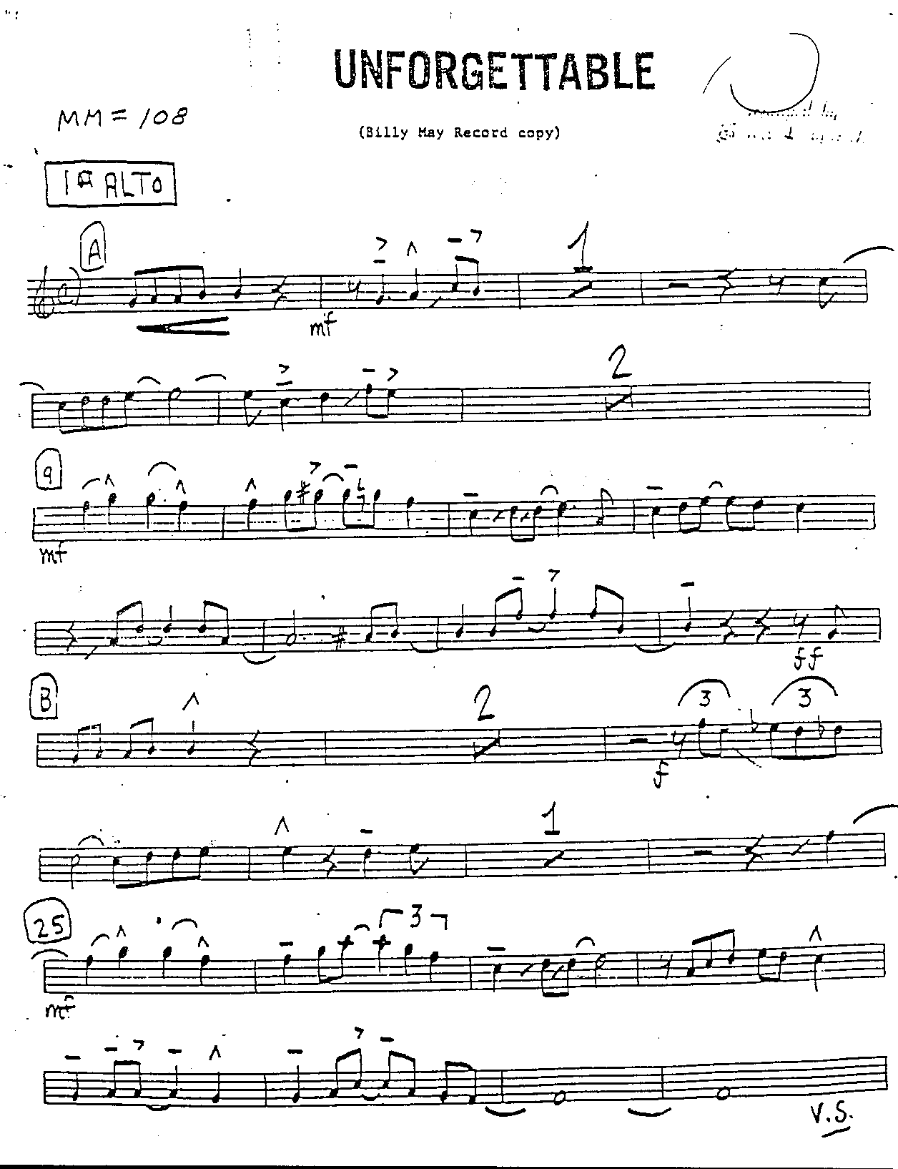
Unforgettable (B.May)
Composed by Irving Gordon
Arranged by B.May
- Ensemble: Big Band
- Style: Jazz Standard
- Pages: 33
- Instruments (17): 1st Alto Saxophone, 2nd Alto Saxophone, Baritone Saxophone, 1st Tenor Saxophone, 2nd Tenor Saxophone, 1st Trumpet, 2nd Trumpet, 3rd Trumpet, 4th Trumpet, 1st Trombone, 2nd Trombone, 3rd Trombone, 4th Trombone, Drums, Piano, Bass, Guitar
- Difficulty: medium
- Content: Individual Parts
- Format: PDF Download (Instant)
- Price: $24.99
"Unforgettable," penned by the gifted songwriter Irving Gordon, first graced the musical landscape in 1951. While the song's original working title was "Uncomparable," the publishing company wisely suggested the change to "Unforgettable." It was Nat King Cole's iconic 1951 recording, featuring a lush arrangement by Nelson Riddle, that catapulted the ballad into enduring fame and solidified its status as a quintessential jazz standard. Cole's smooth, warm baritone and the elegant orchestration created a captivating listening experience, making it a staple in the vocal jazz repertoire and a timeless classic of the mid-20th century. Decades later, in 1991, the song experienced a resurgence when Natalie Cole created a "virtual duet" with her late father, earning three Grammy Awards and introducing the piece to a new generation. This big band arrangement by B.May reimagines the classic ballad, presenting it in a sophisticated, medium-swing tempo that honors its romantic origins while infusing it with fresh, contemporary jazz sensibilities. The arrangement is set in the key of F major, a comfortable register that allows the melody to soar gracefully. The overall mood is one of tender elegance and heartfelt warmth, evoking the timeless sentiment of the original. B.May's signature style, often characterized by meticulous voicings and dynamic contrasts, shines through, ensuring that the emotional core of the piece remains intact while offering new interpretive possibilities for the ensemble. B.May's distinctive approach to "Unforgettable" incorporates rich, extended harmonies that add depth and color to Gordon's melodic masterpiece. Expect carefully crafted soli sections that allow the saxophone and brass sections to showcase their collective artistry, often featuring the arranger's characteristic "swooping" saxophone lines and punchy brass figures, reminiscent of the classic big band era. The melody is primarily carried by the lead alto saxophone, offering a beautiful feature for a strong soloist, with supporting lines woven throughout the ensemble. While there isn't an extended improvised solo section, the arrangement provides ample opportunity for expressive playing and nuanced phrasing from all sections. The technical challenges lie in achieving precise ensemble blend, navigating the subtle dynamic shifts, and executing the intricate voicings with clarity and balance. The reward for the band is a truly moving performance that captures the essence of this beloved standard. This arrangement is ideally suited for college, community, and professional big bands seeking a sophisticated and emotionally resonant addition to their repertoire. Its detailed scoring and harmonic richness provide an excellent vehicle for developing ensemble cohesion and musical expression. High school bands with strong lead players and a dedicated rhythm section will also find this arrangement challenging yet highly rewarding, offering valuable experience in performing a classic jazz ballad with a refined touch. The 17-instrument scoring ensures a full and vibrant sound, making it a standout piece for any concert or performance. Conductors should emphasize a relaxed, medium-swing feel from the outset, allowing the rhythm section to establish a gentle, pulsing foundation. The key technical challenges include achieving precise intonation within the lush, extended voicings, particularly in the saxophone soli sections, and maintaining balance between the brass and woodwinds. Encourage brass players to use a warm, controlled tone, avoiding harshness, especially in sustained chords. The lead alto saxophone, carrying the primary melodic statements, should focus on lyrical phrasing and expressive vibrato. Dynamic contrast is crucial; guide the band through the subtle crescendos and decrescendos to enhance the emotional arc of the piece. Rehearsal time should be dedicated to sectional work on the intricate harmonic passages and ensuring seamless transitions between melodic statements and ensemble figures. No special mutes or extended techniques are explicitly required, allowing the focus to remain on musicality and blend. **Q: What instruments and parts are included in this arrangement?** A: This big band arrangement is scored for 17 instruments, including Alto Saxophone 1, Alto Saxophone 2, Tenor Saxophone 1, Tenor Saxophone 2, Baritone Saxophone, Trumpet 1-4, Trombone 1-4, Piano, Bass, Drums, and Guitar. **Q: What is the difficulty level of "Unforgettable (B.May)"?** A: This arrangement is considered medium-difficult, making it appropriate for college, community, and professional big bands. Advanced high school ensembles with strong individual players and a cohesive rhythm section will also find it rewarding. **Q: What musical style and historical context does this arrangement represent?** A: This arrangement is a jazz standard, specifically a ballad, rooted in the mid-20th century. It honors the timeless romanticism of Irving Gordon's original composition, famously recorded by Nat King Cole in 1951. **Q: What makes B.May's arrangement of "Unforgettable" unique?** A: B.May's distinctive treatment features rich, extended harmonies, sophisticated voicings, and meticulously crafted soli sections that showcase the ensemble. The arrangement maintains the tender mood of the original while adding contemporary jazz colors and dynamic interest. **Q: What is the typical performance duration and tempo for this piece?** A: "Unforgettable (B.May)" is designed as a medium-swing ballad. The exact duration will vary slightly based on interpretation, but it typically falls within the 3:30 to 4:30 minute range.
Questions and answers
- What is included in the Unforgettable (B.May) PDF?
- The verified current file contains individual parts across 33 pages.
- How many instruments or parts are listed for Unforgettable (B.May)?
- The verified instrumentation list contains 17 entries for this Big Band arrangement.
- Who is credited for Unforgettable (B.May)?
- Composer: Irving Gordon. Arranger: B.May.
- What difficulty is listed for Unforgettable (B.May)?
- The verified difficulty level is medium.
- What style is listed for Unforgettable (B.May)?
- The catalog lists the style as Jazz Standard.
- Can I preview Unforgettable (B.May) before buying?
- Yes. The product page provides a preview generated from the current PDF file.
- How is Unforgettable (B.May) delivered?
- After successful payment, the digital PDF is made available for download. The displayed price is $24.99.
Musicians Also Search For
Unforgettable B.May PDF • Unforgettable B.May sheet music • Unforgettable arranged by B.May • B.May big band charts • B.May jazz arrangements PDF • Unforgettable Irving Gordon sheet music • Unforgettable Irving Gordon big band arrangements • Irving Gordon big band charts • Unforgettable big band arrangements • Unforgettable big band PDF download • Unforgettable jazz sheet music • big band sheet music download • Unforgettable individual parts download • Unforgettable sheet music PDF • Unforgettable Jazz Standard charts • Jazz Standard big band arrangements • buy Unforgettable sheet music • download Unforgettable PDF • Unforgettable jazz charts • best B.May big band arrangements • Irving Gordon arranged by B.May • Unforgettable printable sheet music • big band repertoire PDF