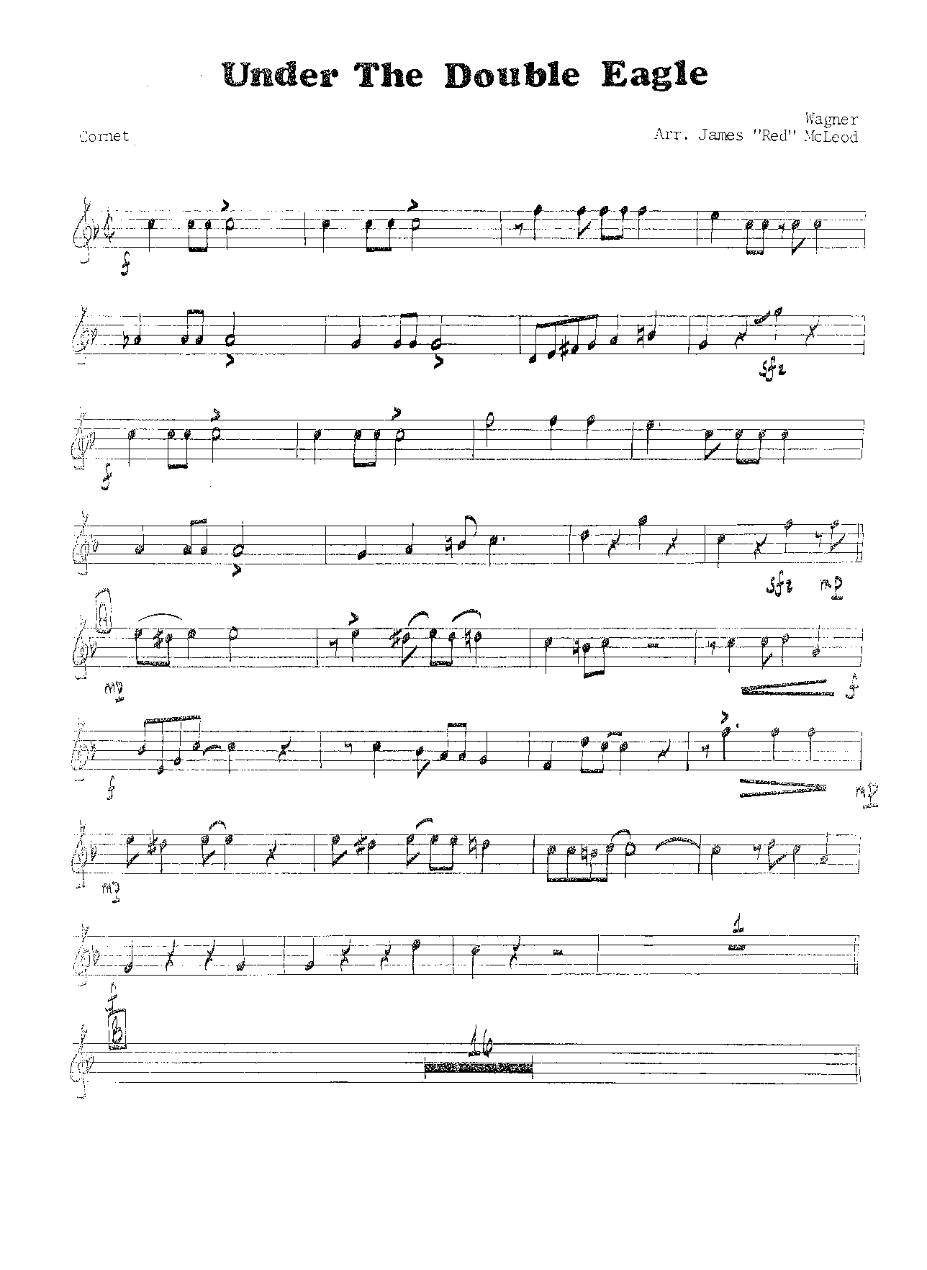
Under The Double Eagle (J.R.McLeod) sheet music preview

Under The Double Eagle (J.R.McLeod)

Composed by Josef Franz Wagner

Arranged by J.R.McLeod

  • Ensemble: Dixieland Band
  • Style: March
  • Pages: 25
  • Difficulty: easy
  • Content: Sheet Music
  • Format: PDF Download (Instant)
  • Price: $18.99

"Under The Double Eagle," originally composed by Josef Franz Wagner in 1893, is a classic military march that has transcended its origins to become a widely recognized and beloved tune across various genres. Wagner, often hailed as "The Austrian March King," created this piece, formally known as "Unter dem Doppeladler," Op. 159, as a tribute to the double-headed eagle on the coat of arms of the Austro-Hungarian Empire, symbolizing imperial power and heritage. Its popularity surged quickly, with John Philip Sousa's band recording it multiple times in the early 1900s, helping to introduce it to American audiences and embed it in the concert band repertoire. Over the decades, it has evolved from a military staple into a country music classic, a Western swing standard, and even a polka favorite, demonstrating its remarkable adaptability and enduring appeal. Its inclusion in circus routines and even Monty Python's Flying Circus further highlights its widespread cultural recognition. This Dixieland arrangement by J.R. McLeod captures the spirited essence of the original march while infusing it with the vibrant, improvisational energy characteristic of early jazz. The musical character is an up-tempo, joyous romp, typically set in a bright 4/4 meter, evoking a celebratory and slightly nostalgic mood. The arrangement maintains the march's inherent brisk tempo, translating it into a driving, two-beat Dixieland feel that encourages toe-tapping and spontaneous movement. Expect a bright and clear key, likely E-flat major as in the original, with the trio section potentially modulating to A-flat major, providing a refreshing harmonic shift. The overall energy is infectious, designed to uplift and entertain, making it a perfect selection for any occasion where a dose of classic, feel-good jazz is desired. J.R. McLeod's distinctive approach to "Under The Double Eagle" is rooted in authentic Dixieland tradition, emphasizing collective improvisation and a clear, melodic presentation. McLeod, known for his accessible yet spirited arrangements for Dixieland ensembles, typically focuses on providing solid foundational charts that allow for individual expression within the ensemble framework. In this arrangement, the melody is predominantly carried by the trumpet and clarinet, often in a contrapuntal interplay, while the trombone provides a robust harmonic and rhythmic foundation with its signature "tailgate" smears and counter-melodies. The arrangement features classic Dixieland elements such as clearly defined ensemble choruses, often with a "shout chorus" feel that builds excitement, and opportunities for featured solos from the frontline instruments. The technical challenges lie in maintaining the brisk tempo with precision, executing tight ensemble figures, and navigating the characteristic Dixieland improvisational style, which rewards musicians with a deep understanding of the genre's nuances. The rewarding aspect is the sheer joy of performing a piece that is both historically significant and inherently fun, bringing a smile to both performers and audiences. This arrangement is ideally suited for college and community Dixieland bands, as well as experienced high school ensembles looking to delve into authentic traditional jazz repertoire. Its clear structure and well-voiced parts make it approachable for groups with varying levels of experience, while still offering enough complexity and room for individual flair to satisfy more advanced players. The 25 pages of score and parts suggest a comprehensive and detailed arrangement, ensuring that all instruments have engaging and purposeful roles. It serves as an excellent vehicle for developing ensemble cohesion, rhythmic precision, and an understanding of the collective improvisation that defines the Dixieland sound. To capture the authentic Dixieland spirit of J.R. McLeod's "Under The Double Eagle," a brisk, driving two-beat feel is paramount, typically around a tempo of quarter note = 180-200 BPM. The primary technical challenge lies in maintaining this energetic tempo with rhythmic precision and clarity, especially during the ensemble passages. Conductors should emphasize a light, buoyant articulation from the frontline horns (trumpet, clarinet, trombone) to avoid a heavy, plodding sound. Encouraging a strong, yet flexible, rhythmic foundation from the rhythm section (piano, banjo/guitar, tuba/bass, drums) is crucial; the tuba or bass should provide a walking bass line that propels the ensemble forward, while the banjo or guitar offers crisp, rhythmic strumming. Special techniques include subtle trombone smears and glissandi, and the clarinet's agile arpeggiated figures. Rehearsal should focus on balancing the polyphonic texture, ensuring that individual melodic lines are heard without overpowering the collective sound. Pay particular attention to the hand-offs of melodic phrases between instruments and the build-up of intensity in the shout choruses. Q: What instruments/parts are included in this arrangement? A: This Dixieland arrangement typically includes parts for Clarinet, Trumpet, Trombone, Piano, Banjo/Guitar, Tuba/String Bass, and Drums, providing a full traditional Dixieland ensemble. The total of 25 pages suggests comprehensive scoring for all standard instruments in this configuration. Q: What is the difficulty level of this arrangement? A: This arrangement is considered intermediate, making it suitable for experienced high school, college, and community Dixieland bands. It offers engaging parts for all musicians while providing opportunities for developing rhythmic precision and ensemble interplay. Q: What is the style and historical context of "Under The Double Eagle"? A: "Under The Double Eagle" is a classic march composed by Josef Franz Wagner in 1893, known for its lively and patriotic character. This arrangement transforms it into a vibrant, up-tempo Dixieland jazz piece, reflecting the early 20th-century jazz tradition. Q: What makes this J.R. McLeod arrangement unique? A: J.R. McLeod's arrangement uniquely blends the original march's melodic structure with authentic Dixieland stylings, featuring collective improvisation, clear ensemble choruses, and opportunities for featured solos. It captures the joyous and spirited essence of traditional jazz while honoring the source material. Q: What is the typical performance duration or tempo for this piece? A: Given its up-tempo Dixieland style, this arrangement is designed for a brisk performance, typically around 2-3 minutes in duration, depending on the number of solo choruses taken. The tempo should be a driving two-beat feel, ideally between quarter note = 180-200 BPM.

Musicians Also Search For

Under The Double Eagle J.R.McLeod PDFUnder The Double Eagle J.R.McLeod sheet musicUnder The Double Eagle arranged by J.R.McLeodJ.R.McLeod dixieland band chartsJ.R.McLeod jazz arrangements PDFUnder The Double Eagle Josef Franz Wagner sheet musicUnder The Double Eagle Josef Franz Wagner dixieland band arrangementJosef Franz Wagner dixieland band chartsUnder The Double Eagle dixieland band arrangementUnder The Double Eagle dixieland band PDF downloadUnder The Double Eagle jazz ensemble sheet musicdixieland band sheet music instant downloadUnder The Double Eagle sheet music with partsUnder The Double Eagle March chartMarch dixieland band arrangementsbuy Under The Double Eagle sheet music onlinedownload Under The Double Eagle PDFUnder The Double Eagle jazz chartbest J.R.McLeod dixieland band arrangementsJosef Franz Wagner songs arranged by J.R.McLeodUnder The Double Eagle printable sheet musicdixieland band repertoire PDF

All arrangements by J.R.McLeod All Josef Franz Wagner sheet music