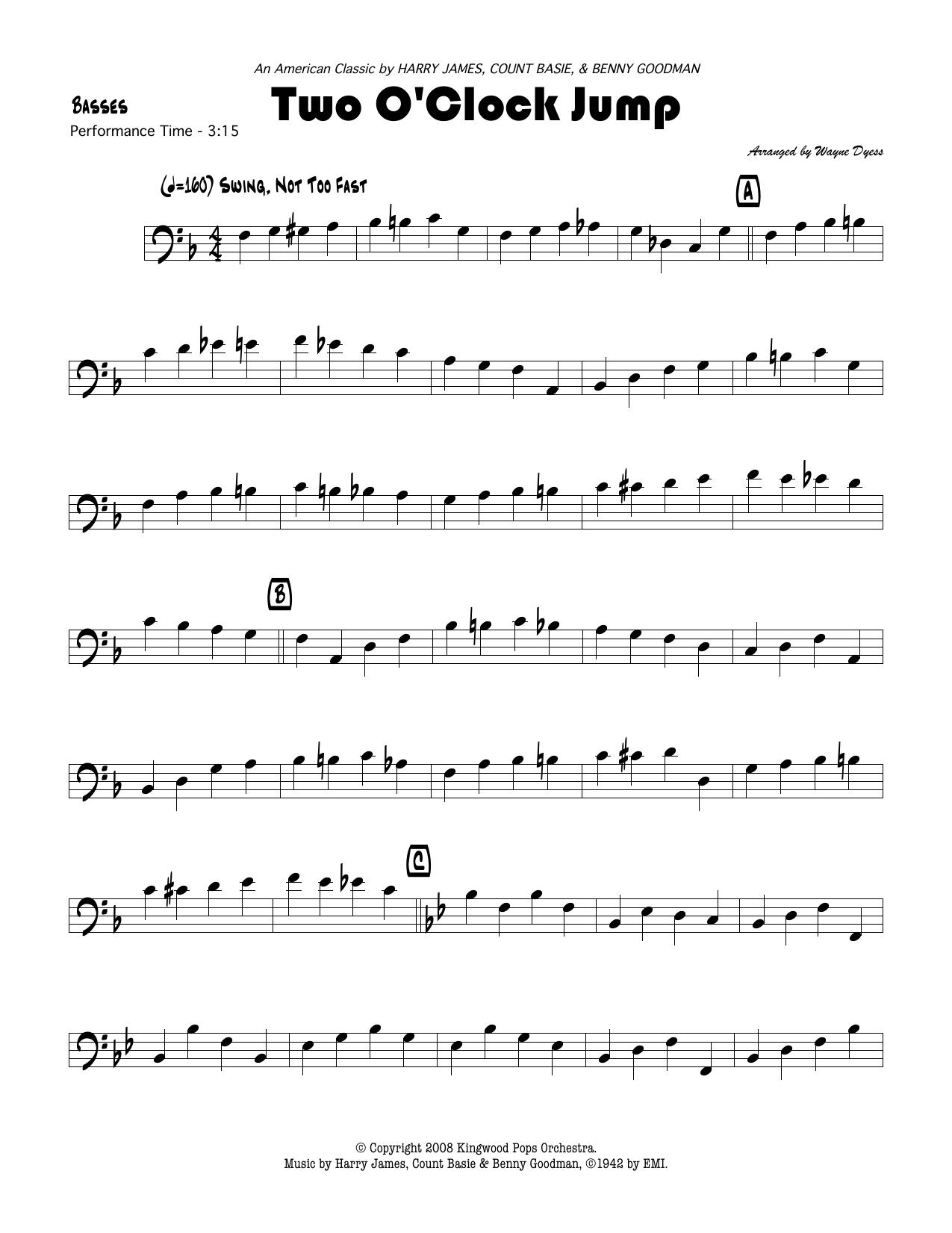
Two O'clock (W.Dyess)
Composed by Harry James, Count Basie, & Benny Goodman
Arranged by Wayne Dyess
- Ensemble: Concert Band
- Style: Swing
- Pages: 25
- Instruments (9): Basses, Bassoon 1, Bassoon 2, Cello, Clarinet 1, Clarinet 2, Tuba, Violin 1, Violin 2
- Difficulty: easy
- Content: Individual Parts
- Format: PDF Download (Instant)
- Price: $22.99
"Two O'clock," arranged by Wayne Dyess, is a vibrant concert band adaptation of the iconic swing standard "Two O'Clock Jump." The original "One O'Clock Jump," a 12-bar blues instrumental, was penned by Count Basie in 1937 and quickly became the theme song for the Count Basie Orchestra, solidifying its place as a cornerstone of the Kansas City big band sound. Harry James, a trumpet virtuoso who had played with Basie and Benny Goodman, then released "Two O'Clock Jump" in 1939, building upon Basie's original with his signature brass triplet choruses and making it his own band's theme. This piece epitomizes the high-energy, riff-driven swing era, a period of immense popularity for big band jazz that filled dance halls and concert venues alike. Its enduring appeal lies in its infectious rhythm, memorable melodic fragments, and improvisational spirit, making it a true jazz standard. Wayne Dyess's arrangement captures the driving, medium-up swing feel that defines this classic, translating its big band essence effectively for the concert band idiom. The musical character is one of unbridled exuberance and rhythmic precision, typically set in a bright tempo around 180-200 BPM. The piece is rooted in the blues, offering a familiar harmonic framework that allows for both tight ensemble work and expressive soloistic flourishes. The mood is celebratory and energetic, evoking the golden age of swing with its powerful brass statements and flowing saxophone lines. Dyess maintains the original's dynamic contrasts and builds tension through layered riffs, ensuring a captivating performance from start to finish. Dyess, known for his meticulous attention to detail and authentic stylistic interpretations, approaches this arrangement by honoring the original's spirit while making it accessible and engaging for concert bands. Expect to find characteristic swing voicings that emulate the big band sound, with particular emphasis on brass fanfares and saxophone soli sections that retain the original's improvisatory feel. The arrangement features the iconic descending trumpet triplet riffs that are synonymous with Harry James's version, providing thrilling moments for the brass section. Wayne Dyess typically emphasizes clear melodic lines, rhythmic accuracy, and dynamic shaping, ensuring that his arrangements are both musically rewarding and pedagogically sound. Melody is primarily carried by the upper woodwinds and trumpets, often in call-and-response with the lower brass and saxophones. The arrangement includes featured solo opportunities, often suggested for trumpet and saxophone, allowing individual musicians to showcase their improvisational skills within the blues-based structure. Technical challenges include maintaining a consistent, driving swing eighth-note feel, precise articulation in fast passages, and balancing the robust brass sections with the agile woodwinds. The rewarding aspect of performing this piece lies in its undeniable audience appeal, the joy of locking into a powerful swing groove, and the opportunity for the entire ensemble to experience the thrill of a classic jazz shout chorus. This arrangement is highly suitable for advanced high school, collegiate, and community concert bands seeking an authentic and challenging swing chart that will energize any program. Conductors should prioritize establishing a rock-solid, medium-up swing feel from the outset, emphasizing a relaxed yet driving eighth-note pulse. The tempo should be consistent, ideally between 180-200 BPM, allowing for both clarity in the intricate brass triplets and fluidity in the saxophone lines. Key technical challenges include achieving precise articulation, particularly the short, detached notes characteristic of swing, and ensuring dynamic contrast between sections. Encourage brass players to use plunger mutes where indicated for authentic jazz color, and guide them in executing controlled falls and doits for stylistic effect. Rehearsal should focus on rhythmic cohesion within sections before combining, paying close attention to the interplay between the rhythm section and the winds. Emphasize vertical alignment in the shout choruses and ensure that soloists are well-supported by the ensemble's background figures. **Q: What instruments are included in this arrangement?** A: This concert band arrangement includes a full conductor score and individual parts for standard concert band instrumentation, typically encompassing flutes, oboes, clarinets, bassoons, saxophones (alto, tenor, baritone), trumpets, horns, trombones, euphonium, tuba, and a comprehensive percussion section. **Q: What is the difficulty level of "Two O'clock (W.Dyess)"?** A: This arrangement is graded as advanced, making it suitable for advanced high school, collegiate, and community concert bands. It presents challenges in rhythmic precision, stylistic articulation, and dynamic control. **Q: What is the musical style and historical context of this piece?** A: "Two O'clock (W.Dyess)" is a swing-style arrangement, drawing from the classic big band era of the late 1930s. It is based on Harry James's iconic interpretation of Count Basie's "One O'Clock Jump," embodying the energetic, riff-driven sound that defined the swing era. **Q: What makes Wayne Dyess's arrangement of "Two O'clock" unique?** A: Wayne Dyess's arrangement uniquely translates the authentic big band swing sound, including Harry James's signature brass triplet riffs and classic jazz voicings, into a playable and engaging format for the concert band, while preserving the original's high energy and improvisational spirit. **Q: What is the typical performance duration or tempo for this arrangement?** A: The typical performance duration for this arrangement is approximately 3-4 minutes, maintaining a consistent medium-up swing tempo of around 180-200 BPM to capture its intended energetic character.
Questions and answers
- What is included in the Two O'clock (W.Dyess) PDF?
- The verified current file contains individual parts across 25 pages.
- How many instruments or parts are listed for Two O'clock (W.Dyess)?
- The verified instrumentation list contains 9 entries for this Concert Band arrangement.
- Who is credited for Two O'clock (W.Dyess)?
- Composer: Harry James, Count Basie, & Benny Goodman. Arranger: Wayne Dyess.
- What difficulty is listed for Two O'clock (W.Dyess)?
- The verified difficulty level is easy.
- What style is listed for Two O'clock (W.Dyess)?
- The catalog lists the style as Swing.
- Can I preview Two O'clock (W.Dyess) before buying?
- Yes. The product page provides a preview generated from the current PDF file.
- How is Two O'clock (W.Dyess) delivered?
- After successful payment, the digital PDF is made available for download. The displayed price is $22.99.
Musicians Also Search For
Two O'clock Wayne Dyess PDF • Two O'clock Wayne Dyess sheet music • Two O'clock arranged by Wayne Dyess • Wayne Dyess concert band charts • Wayne Dyess jazz arrangements PDF • Two O'clock Harry James, Count Basie, & Benny Goodman sheet music • Two O'clock Harry James, Count Basie, & Benny Goodman concert band arrangements • Harry James, Count Basie, & Benny Goodman concert band charts • Two O'clock concert band arrangements • Two O'clock concert band PDF download • Two O'clock jazz sheet music • concert band sheet music download • Two O'clock individual parts download • Two O'clock sheet music PDF • Two O'clock Swing charts • Swing concert band arrangements • buy Two O'clock sheet music • download Two O'clock PDF • Two O'clock jazz charts • best Wayne Dyess concert band arrangements • Harry James, Count Basie, & Benny Goodman arranged by Wayne Dyess • Two O'clock printable sheet music • concert band repertoire PDF