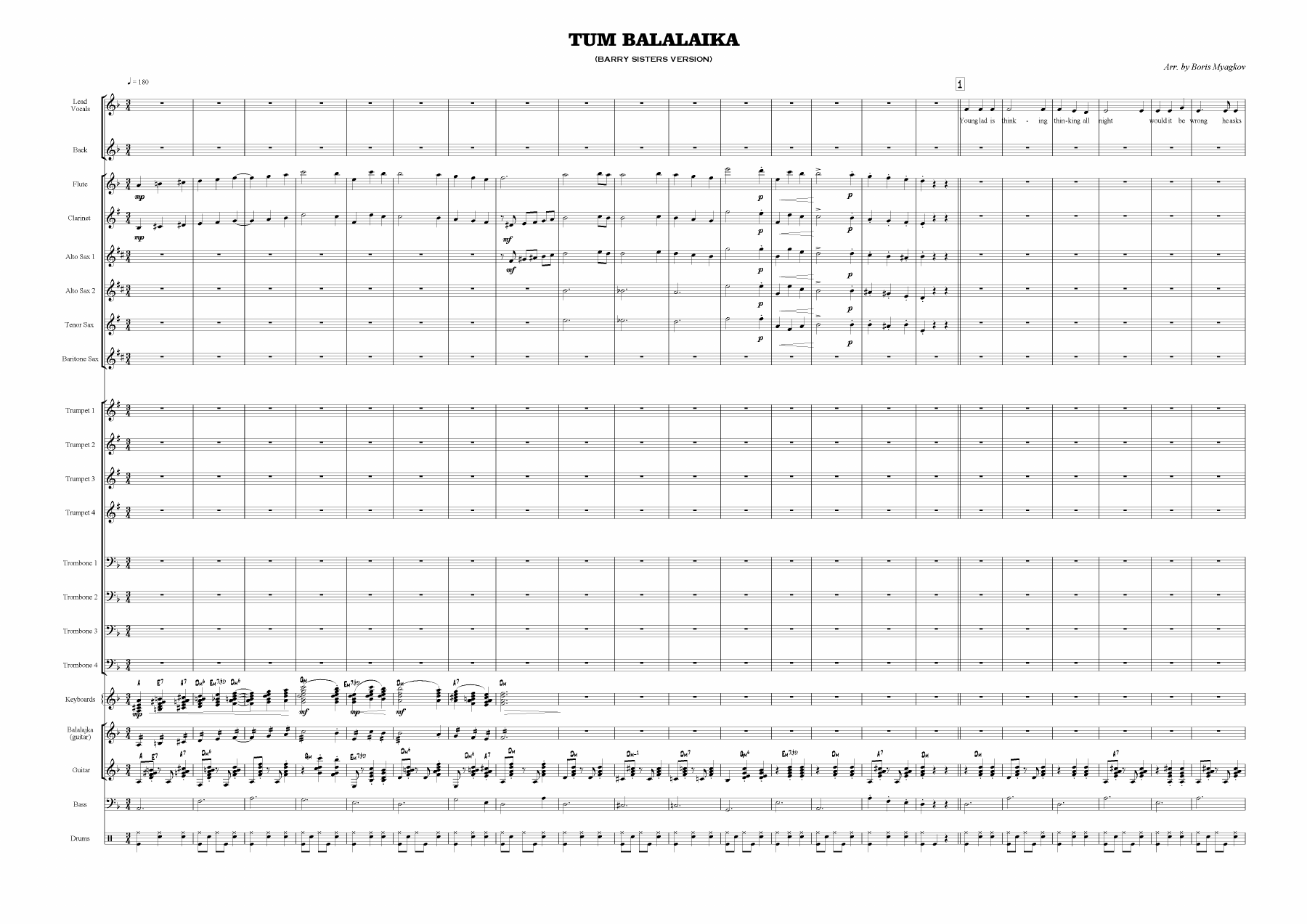
Tum Balalajka (B.Myagkov)
Composed by Boris Myagkov
Arranged by Boris Myagkov
- Ensemble: Big Band
- Style: Jazz Standard
- Pages: 34
- Instruments (20): Lead Vocals, Back Vocals, Flute, Clarinet, Alto Sax 1, Alto Sax 2, Tenor Sax, Baritone Sax, Trumpet 1, Trumpet 2, Trumpet 3, Trumpet 4, Trombone 1, Trombone 2, Trombone 3, Trombone 4, Keyboards, Guitar, Bass, Drums
- Difficulty: medium
- Content: Individual Parts
- Format: PDF Download (Instant)
- Price: $24.99
"Tum Balalajka," as reimagined by Boris Myagkov for big band, transforms a melody steeped in cultural heritage into a sophisticated jazz standard. While the original folk tune, "Tumbalalaika," is a Yiddish folk song of uncertain exact origin, its melodies and themes have resonated for generations, becoming a staple of Jewish and Eastern European musical traditions. Myagkov's interpretation elevates this familiar melody, placing it firmly within the jazz idiom, reminiscent of the vibrant big band era of the mid-20th century, where traditional tunes were often reharmonized and re-contextualized for the dance hall and concert stage. This arrangement presents the piece as a medium-swing jazz standard, set primarily in a bright major key, evoking a mood that is at once reflective and celebratory. The inherent lyrical quality of the melody is preserved, but it is now infused with the rhythmic drive and harmonic richness characteristic of a classic big band chart. Boris Myagkov’s distinctive arranging style shines through in his treatment of "Tum Balalajka." Known for his meticulous voicings and ability to craft arrangements that are both challenging and deeply rewarding, Myagkov employs a sophisticated harmonic palette, introducing extended chords and subtle reharmonizations that give the piece a fresh, contemporary jazz feel while respecting its melodic roots. The arrangement features intricate soli sections for the saxophone and brass sections, showcasing Myagkov's mastery of ensemble writing. Expect carefully constructed shout choruses that build dynamic tension and release, punctuated by well-placed rhythmic figures. The piece includes a tasteful modulation that adds harmonic interest and a sense of journey, culminating in a powerful, yet nuanced, ensemble finish. This approach makes the arrangement a compelling study in jazz orchestration, offering layers of musical detail for both performers and listeners to discover. The performance of "Tum Balalajka" offers numerous highlights and challenges. The primary melodic statements are initially carried by the alto saxophone, later transitioning to the trumpet section, and then shared across the full ensemble, ensuring a varied textural landscape. There are ample opportunities for featured solos, typically for alto saxophone and trumpet, allowing individual musicians to showcase their improvisational skills over Myagkov's rich harmonic backdrop. Technically, the arrangement demands precision in articulation, particularly in the swing figures and brass soli passages. Intonation in the complex voicings requires careful attention, as does the dynamic shaping to fully realize the emotional arc of the piece. The rewarding aspect lies in the ensemble's ability to coalesce around Myagkov's intricate writing, creating a cohesive and swinging performance that honors both the folk origins and the jazz transformation of the melody. This arrangement is ideally suited for college and advanced community big bands, as well as professional ensembles, providing a substantial and engaging piece for their repertoire that challenges musicianship while delivering an enjoyable and memorable listening experience. "Tum Balalajka" is best performed with a consistent medium-swing feel, emphasizing a relaxed yet forward momentum at a tempo around quarter note = 132-144 BPM. Conductors should focus on maintaining a steady pulse and encouraging a light, buoyant swing eighth-note interpretation throughout. Key technical challenges include the intricate saxophone soli passages, which require precise articulation and blend, and the brass shout choruses, demanding strong attacks and unified dynamic shaping. Intonation in the extended harmonies, particularly in slower, sustained sections, will require careful attention during rehearsals. Encourage woodwind players to achieve a warm, blended tone, while brass should aim for clarity and power without harshness. No special techniques like plunger mutes or falls are explicitly notated, allowing for a clean, classic big band sound. Rehearsal time should be allocated to isolating and balancing the inner voices of the soli sections and ensuring a unified ensemble attack and release in the shout choruses. Q: What instruments and parts are included in this arrangement? A: This arrangement is scored for a full big band, including Vocals, Flute, Clarinet, Alto Saxophone 1, Alto Saxophone 2, Tenor Saxophone 1, Tenor Saxophone 2, Baritone Saxophone, Trumpet 1, Trumpet 2, Trumpet 3, Trumpet 4, Trombone 1, Trombone 2, Trombone 3, Bass Trombone, Guitar, Piano, Bass, and Drums, totaling 20 instruments. Q: What is the difficulty level of "Tum Balalajka (B.Myagkov)"? A: This arrangement is considered advanced intermediate to advanced, suitable for college, advanced community, and professional big bands. It presents challenges in intricate voicings, precise articulation, and dynamic control. Q: What is the musical style and historical context of this piece? A: This is a medium-swing jazz standard arrangement of the traditional Yiddish folk song "Tumbalalaika." Boris Myagkov's treatment places it firmly within the mid-20th century big band jazz idiom, blending folk melody with sophisticated jazz harmony and orchestration. Q: What makes Boris Myagkov's arrangement of "Tum Balalajka" unique? A: Myagkov's arrangement is distinguished by its sophisticated reharmonization, intricate soli sections for saxophones and brass, carefully constructed shout choruses, and a tasteful modulation, transforming the traditional folk tune into a compelling and challenging jazz standard. Q: What is the typical performance duration and tempo for this arrangement? A: The performance duration typically ranges from 4 to 6 minutes, depending on the length of improvised solos. The recommended tempo is a medium swing, around quarter note = 132-144 BPM.
Questions and answers
- What is included in the Tum Balalajka (B.Myagkov) PDF?
- The verified current file contains a conductor score and individual parts across 34 pages.
- How many instruments or parts are listed for Tum Balalajka (B.Myagkov)?
- The verified instrumentation list contains 20 entries for this Big Band arrangement.
- Who is credited for Tum Balalajka (B.Myagkov)?
- Composer: Boris Myagkov. Arranger: Boris Myagkov.
- What difficulty is listed for Tum Balalajka (B.Myagkov)?
- The verified difficulty level is medium.
- What style is listed for Tum Balalajka (B.Myagkov)?
- The catalog lists the style as Jazz Standard.
- Can I preview Tum Balalajka (B.Myagkov) before buying?
- Yes. The product page provides a preview generated from the current PDF file.
- How is Tum Balalajka (B.Myagkov) delivered?
- After successful payment, the digital PDF is made available for download. The displayed price is $24.99.
Musicians Also Search For
Tum Balalajka Boris Myagkov PDF • Tum Balalajka Boris Myagkov sheet music • Tum Balalajka arranged by Boris Myagkov • Boris Myagkov big band charts • Boris Myagkov jazz arrangements PDF • Tum Balalajka Boris Myagkov big band arrangements • Tum Balalajka big band arrangements • Tum Balalajka big band PDF download • Tum Balalajka jazz sheet music • big band sheet music download • Tum Balalajka conductor score PDF • Tum Balalajka individual parts download • Tum Balalajka sheet music PDF • Tum Balalajka Jazz Standard charts • Jazz Standard big band arrangements • buy Tum Balalajka sheet music • download Tum Balalajka PDF • Tum Balalajka jazz charts • best Boris Myagkov big band arrangements • Tum Balalajka printable sheet music • big band repertoire PDF