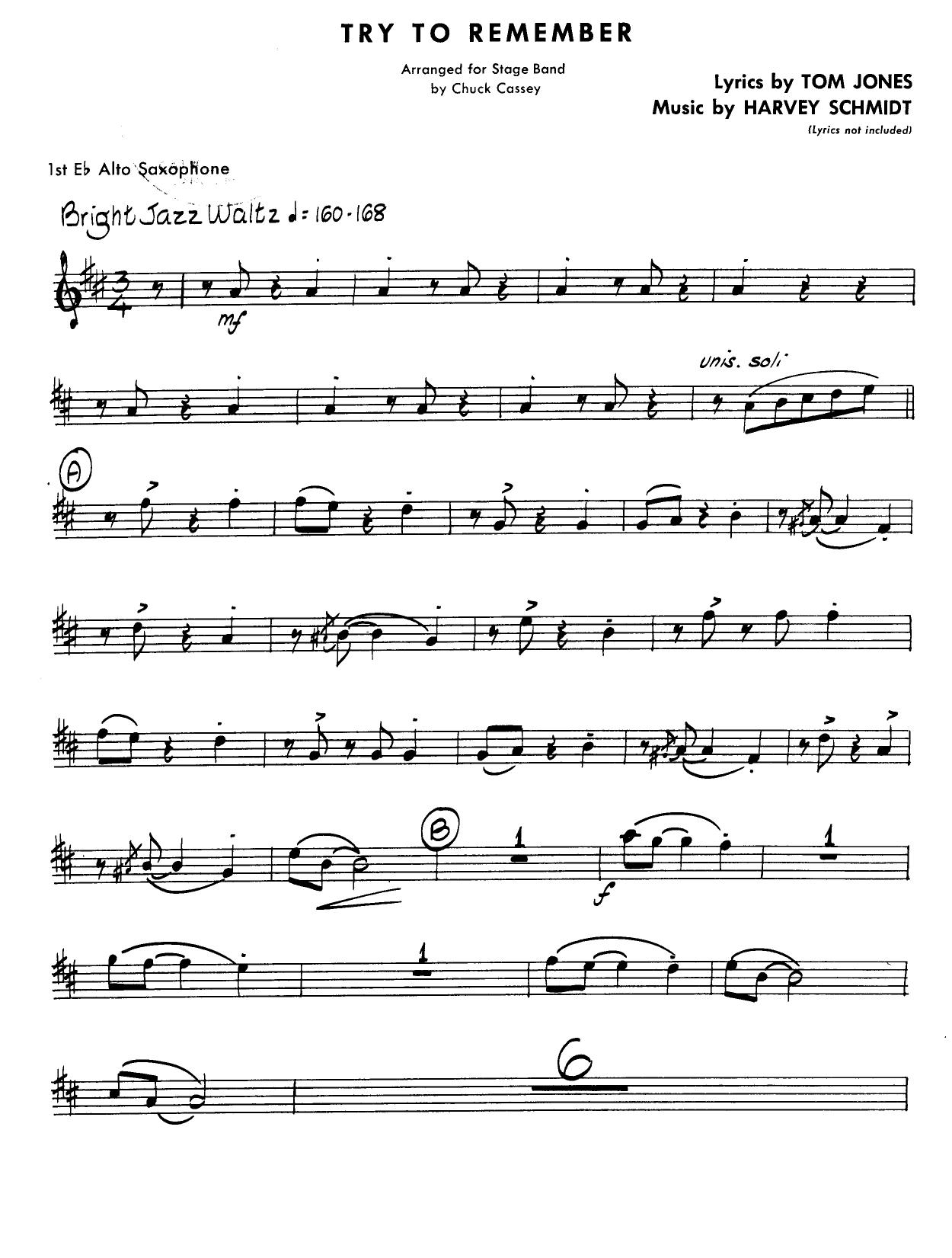
Try To Remember (C.Cassey)
Composed by Harvey Schmidt
Arranged by C.Cassey
- Ensemble: Big Band
- Style: Jazz Standard
- Pages: 43
- Instruments (16): 1st Eb Alto Saxophone, 2nd Eb Alto Saxophone, 1st Bb Tenor Saxophone, 2nd Bb Tenor Saxophone, Eb Baritone Saxophone, 1st Bb Trumpet, 2nd Bb Trumpet, 3rd Bb Trumpet, 4th Bb Trumpet, 1st Trombone, 2nd Trombone, 3rd Trombone, 4th Trombone, String Bass, Piano, Tuba (opt.)
- Difficulty: medium
- Content: Individual Parts
- Format: PDF Download (Instant)
- Price: $24.99
Originating from Harvey Schmidt and Tom Jones’s historic 1960 off-Broadway phenomenon *The Fantasticks*—the longest-running musical in American theatre history—"Try To Remember" quickly transcended its theatrical roots to become a beloved vehicle for jazz interpreters. While vocal legends like Harry Belafonte and Barbra Streisand cemented its place in the mainstream consciousness, the song’s lingering, melancholic melody and graceful harmonic structure made it an irresistible canvas for jazz instrumentalists. Its wistful, nostalgic atmosphere captures a reflective mood, balancing a poignant simplicity with rich underlying changes that invite sophisticated reharmonization and expressive, emotive phrasing. In this masterful big band setting by C.Cassey, the timeless tune is transformed into a lush, atmospheric jazz ballad characterized by a flowing, rubato-leaning pulse that eventually settles into a gentle, shimmering medium-swing feel. The arrangement opens with an evocative, harmonically rich introduction led by the piano and subtle woodwind colorings, immediately establishing an intimate and reflective mood. As the chart unfolds, C.Cassey employs gorgeous, contemporary brass voicings and dense chordal extensions that evoke the sophisticated warmth of the West Coast cool school mixed with modern textural depth. The woodwinds play a pivotal role, utilizing rich double-reed and flute-like saxophone doublings to create a luminous sonic palette before opening up into lush, interconnected soli sections. The narrative arc of the arrangement gently shifts focus across the ensemble, giving various sections a chance to shape the emotional contour of the melody. The lead alto saxophone and flugelhorn share primary thematic duties, delivering the nostalgic melody with lyrical grace and restraint, while a poignant tenor saxophone or guitar solo serves as the emotional centerpiece of the chart. Rather than relying on a bombastic, high-energy shout chorus, C.Cassey builds tension through a breathtaking, harmonically expansive tutti passage that swells dynamically before receding into a delicate, whisper-quiet coda. Technical demands center less on raw velocity and more on breath control, intonation, and stylistic cohesion, requiring players to maintain absolute control over long, sustained lines and subtle dynamic shifts. Advanced high school ensembles with strong section leaders, as well as collegiate and professional community big bands, will find this arrangement an exceptionally rewarding addition to their library. It provides an ideal counterweight to high-octane up-tempo swing charts on a program, teaching young musicians the art of playing softly with intense focus, achieving a unified ensemble blend, and communicating deep emotional resonance through jazz ballad interpretation. Conductors should approach this chart with a primary focus on lyrical phrasing, rubato control, and pristine intonation. The tempo should remain flexible during the introductory phrases, allowing the soloist and rhythm section to breathe before settling into a relaxed, floating half-note or quarter-note pulse. The key technical challenge lies in the sustained, dense harmonic voicings; brass players must keep their air support consistent to prevent sagging pitch during long-held chords, particularly in the muted passages. Encourage the saxophones to use a warm, sub-tone sound in the lower registers to blend seamlessly with the rhythm section. Mutes (straight and cup) are utilized sparingly for textural contrast rather than volume reduction, so ensure the balance between muted brass and open saxophones remains transparent. Rehearsal time should be dedicated to matching vibrato widths across sections and balancing the inner voices of the chordal accompaniment so that the counter-melodies weave smoothly beneath the primary theme without ever obscuring it. Q: What instrumentation and parts are included in this big band arrangement? A: The arrangement is scored for a standard 16-instrument big band lineup, featuring Alto Saxophone 1, Alto Saxophone 2, Tenor Saxophone 1, Tenor Saxophone 2, Baritone Saxophone, 4 Trumpets, 4 Trombones, Piano, String Bass, Guitar, and Drum Set, complete across a 43-page manuscript. Q: What is the difficulty level of this chart? A: This arrangement is graded as intermediate to advanced (suitable for skilled high school, collegiate, and professional big bands), with technical challenges focusing on breath control, balance, intonation, and lyrical phrasing rather than fast tempos. Q: What is the musical style and historical background of the piece? A: It is a sophisticated jazz ballad adaptation of Harvey Schmidt's classic composition from *The Fantasticks*, blending traditional theatrical nostalgia with rich, contemporary jazz harmony and a gentle swing feel. Q: What makes C.Cassey’s arrangement unique? A: Unlike typical swinging interpretations of show tunes, this arrangement stands out for its lush, impressionistic chord voicings, integrated woodwind textures, and a deeply emotive emotional arc that builds through dynamic swells rather than a traditional high-volume shout chorus. Q: What is the recommended performance duration and tempo feel? A: The chart plays out over approximately 4 to 5 minutes, driven by a relaxed, expressive ballad tempo with an underlying, flowing pulse that allows ample room for rubato interpretation and a featured improvised solo.
Questions and answers
- What is included in the Try To Remember (C.Cassey) PDF?
- The verified current file contains individual parts across 43 pages.
- How many instruments or parts are listed for Try To Remember (C.Cassey)?
- The verified instrumentation list contains 16 entries for this Big Band arrangement.
- Who is credited for Try To Remember (C.Cassey)?
- Composer: Harvey Schmidt. Arranger: C.Cassey.
- What difficulty is listed for Try To Remember (C.Cassey)?
- The verified difficulty level is medium.
- What style is listed for Try To Remember (C.Cassey)?
- The catalog lists the style as Jazz Standard.
- Can I preview Try To Remember (C.Cassey) before buying?
- Yes. The product page provides a preview generated from the current PDF file.
- How is Try To Remember (C.Cassey) delivered?
- After successful payment, the digital PDF is made available for download. The displayed price is $24.99.
Musicians Also Search For
Try To Remember C.Cassey PDF • Try To Remember C.Cassey sheet music • Try To Remember arranged by C.Cassey • C.Cassey big band charts • C.Cassey jazz arrangements PDF • Try To Remember Harvey Schmidt sheet music • Try To Remember Harvey Schmidt big band arrangements • Harvey Schmidt big band charts • Try To Remember big band arrangements • Try To Remember big band PDF download • Try To Remember jazz sheet music • big band sheet music download • Try To Remember individual parts download • Try To Remember sheet music PDF • Try To Remember Jazz Standard charts • Jazz Standard big band arrangements • buy Try To Remember sheet music • download Try To Remember PDF • Try To Remember jazz charts • best C.Cassey big band arrangements • Harvey Schmidt arranged by C.Cassey • Try To Remember printable sheet music • big band repertoire PDF