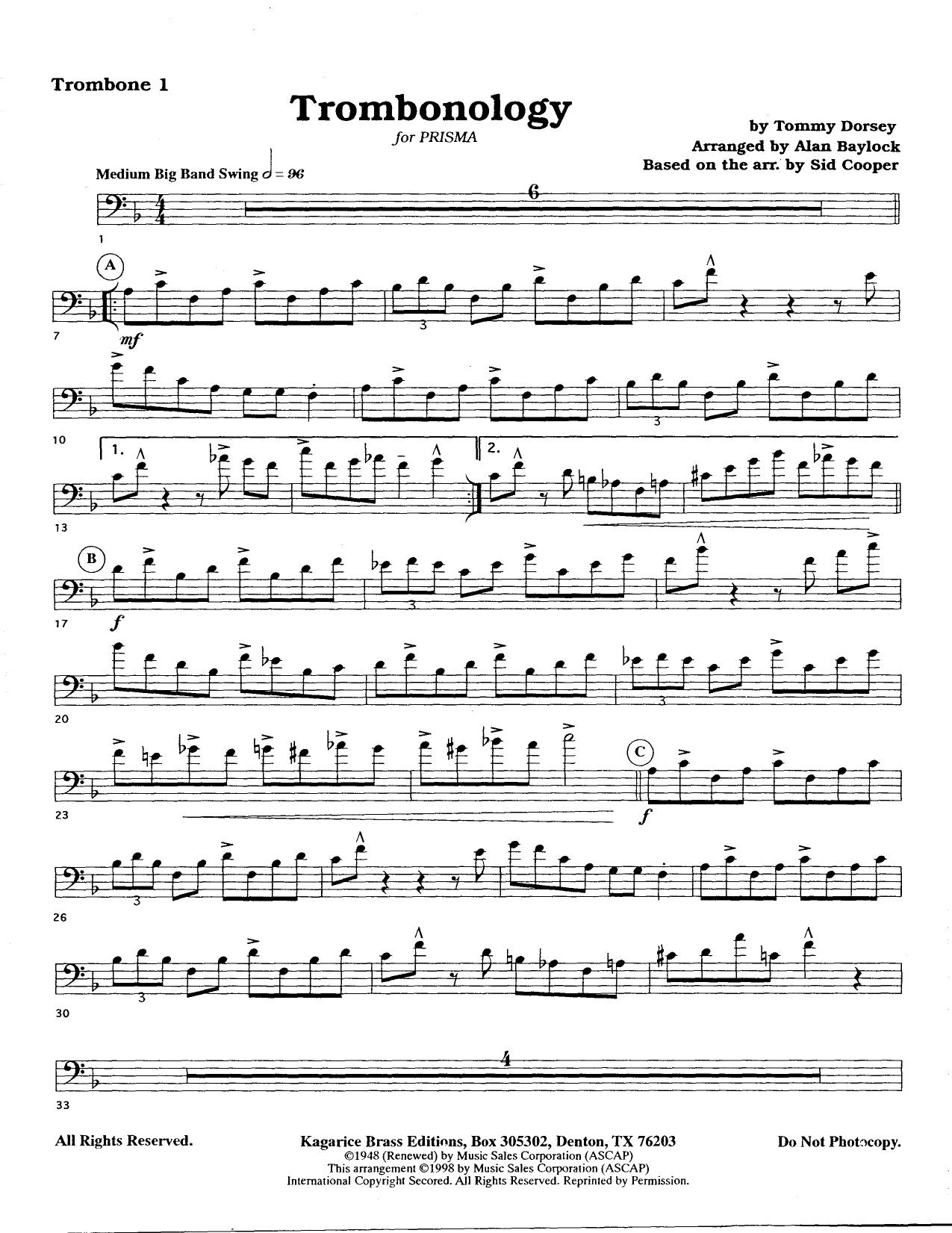
Trombonology (T.Dorsey; (arr.Alan Baylock) Tb Quartet + rhythm
Composed by Tommy Dorsey
Arranged by Alan Baylock
- Ensemble: Big Band
- Style: Jazz Standard
- Pages: 18
- Instruments (8): Trombone 1, Trombone 2, Trombone 3, Trombone 4, Guitar, Piano, Acoustic Bass, Drums
- Difficulty: easy
- Content: Individual Parts
- Format: PDF Download (Instant)
- Price: $24.99
Tommy Dorsey's iconic "Trombonology" emerged from the golden age of the Swing Era, a period defined by big bands, danceable rhythms, and virtuosic soloists. Composed and popularized by Dorsey himself, the "Sentimental Gentleman of Swing," this piece became a signature vehicle for his unparalleled trombone technique and lush, legato phrasing. While often associated with a featured trombone, the original composition, a jazz standard, embodies the energetic and sophisticated big band sound of the 1940s, showcasing intricate ensemble work alongside melodic brilliance. Its enduring appeal lies in its infectious swing feel, memorable melodic lines, and its capacity to highlight the trombone's expressive range, solidifying its place in the jazz canon. Alan Baylock's masterful arrangement of "Trombonology" reimagines this classic for a contemporary big band setting while retaining the original's vibrant spirit. Baylock, known for his sophisticated yet accessible writing, approaches this piece with a keen understanding of both historical context and modern ensemble capabilities. His signature techniques are evident in the rich, often dense voicings that provide a full, resonant sound, particularly in the brass sections. The arrangement features compelling soli sections that weave through the ensemble, showcasing the various instrumental choirs with intricate counterpoint and dynamic interplay. Expect carefully crafted shout choruses that build excitement and intensity, characteristic of Baylock's ability to elevate a piece to a thrilling climax. While honoring Dorsey's melodic genius, Baylock injects fresh harmonic colors and rhythmic nuances, making it feel both classic and contemporary. This arrangement is an exhilarating up-tempo swing in 4/4, set in a bright, driving tempo that demands precision and energy from all sections. The piece opens with a powerful ensemble statement, leading into the main theme, which is expertly distributed throughout the band, often featuring the saxophones and brass in call-and-response or layered voicings. While the original was a trombone feature, Baylock's arrangement integrates the trombone section into the full ensemble texture, allowing for potential featured solos from various instruments, typically tenor saxophone or trumpet, offering opportunities for improvisation over the familiar chord changes. Technical challenges include maintaining a consistent, driving swing feel at a brisk tempo, navigating intricate soli passages with clean articulation, and achieving precise ensemble blend and balance, especially in the powerful shout sections. The rewarding aspect lies in the sheer joy of performing such a historically significant and musically engaging piece, allowing a band to showcase its collective precision, dynamic control, and stylistic authenticity. This arrangement is ideally suited for advanced high school, college, community, and professional jazz ensembles. Its demands on technical proficiency, ensemble cohesion, and stylistic understanding make it an excellent choice for bands looking to tackle a challenging yet incredibly rewarding swing standard. The detailed scoring and dynamic contrasts provide ample teaching moments for conductors, while the exciting musical content ensures a captivating experience for both performers and audiences. "Trombonology" demands a relentless, driving up-tempo swing feel from the very first measure. Conductors should emphasize a strong, consistent pulse and encourage a light, buoyant articulation, particularly in the brass and saxophone soli sections. Key technical challenges include maintaining clarity and precision in the fast-moving ensemble passages and ensuring accurate intonation within the often-dense voicings. Rehearsal time should be dedicated to isolating and polishing the saxophone and brass soli sections, focusing on rhythmic accuracy and blend. Dynamics are crucial; the arrangement features significant contrast, from punchy accents to smooth, sustained phrases. Encourage brass players to use strong, clear attacks without overblowing, especially in the shout choruses. While no specific special techniques like plunger mutes are explicitly notated, a classic big band approach to falls, scoops, and shakes will enhance the authentic swing character. Solos should be encouraged to be energetic and stylistically appropriate to the Swing Era, while still allowing for individual expression. Q: What instruments and parts are included in this arrangement? A: This arrangement is scored for a standard 17-instrument big band, including Alto Saxophone 1 & 2, Tenor Saxophone 1 & 2, Baritone Saxophone, Trumpet 1-4, Trombone 1-4, Piano, Bass, Guitar, and Drums. Q: What is the difficulty level of Alan Baylock's "Trombonology" arrangement? A: This arrangement is considered advanced, suitable for high school, college, community, and professional jazz ensembles due to its up-tempo swing, intricate soli passages, and demands on ensemble precision and stylistic authenticity. Q: What musical style and historical context does "Trombonology" represent? A: "Trombonology" is a classic jazz standard from the Swing Era (1930s-1940s), originally popularized by trombonist Tommy Dorsey, embodying the energetic big band sound and virtuosic soloing of that period. Q: What makes Alan Baylock's arrangement of "Trombonology" unique? A: Baylock's arrangement uniquely combines the historical essence of Dorsey's original with modern big band voicings, sophisticated harmonies, and compelling soli sections, offering a fresh yet authentic take on the classic. Q: What is the typical performance duration and tempo for this piece? A: The performance duration typically ranges from 3:00 to 4:00 minutes, performed at a bright, up-tempo swing feel, usually between 200-240 beats per minute.
Questions and answers
- What is included in the Trombonology (T.Dorsey; (arr.Alan Baylock) Tb Quartet + rhythm PDF?
- The verified current file contains individual parts across 18 pages.
- How many instruments or parts are listed for Trombonology (T.Dorsey; (arr.Alan Baylock) Tb Quartet + rhythm?
- The verified instrumentation list contains 8 entries for this Big Band arrangement.
- Who is credited for Trombonology (T.Dorsey; (arr.Alan Baylock) Tb Quartet + rhythm?
- Composer: Tommy Dorsey. Arranger: Alan Baylock.
- What difficulty is listed for Trombonology (T.Dorsey; (arr.Alan Baylock) Tb Quartet + rhythm?
- The verified difficulty level is easy.
- What style is listed for Trombonology (T.Dorsey; (arr.Alan Baylock) Tb Quartet + rhythm?
- The catalog lists the style as Jazz Standard.
- Can I preview Trombonology (T.Dorsey; (arr.Alan Baylock) Tb Quartet + rhythm before buying?
- Yes. The product page provides a preview generated from the current PDF file.
- How is Trombonology (T.Dorsey; (arr.Alan Baylock) Tb Quartet + rhythm delivered?
- After successful payment, the digital PDF is made available for download. The displayed price is $24.99.
Musicians Also Search For
Trombonology Alan Baylock PDF • Trombonology Alan Baylock sheet music • Trombonology arranged by Alan Baylock • Alan Baylock big band charts • Alan Baylock jazz arrangements PDF • Trombonology Tommy Dorsey sheet music • Trombonology Tommy Dorsey big band arrangements • Tommy Dorsey big band charts • Trombonology big band arrangements • Trombonology big band PDF download • Trombonology jazz sheet music • big band sheet music download • Trombonology individual parts download • Trombonology sheet music PDF • Trombonology Jazz Standard charts • Jazz Standard big band arrangements • buy Trombonology sheet music • download Trombonology PDF • Trombonology jazz charts • best Alan Baylock big band arrangements • Tommy Dorsey arranged by Alan Baylock • Trombonology printable sheet music • big band repertoire PDF