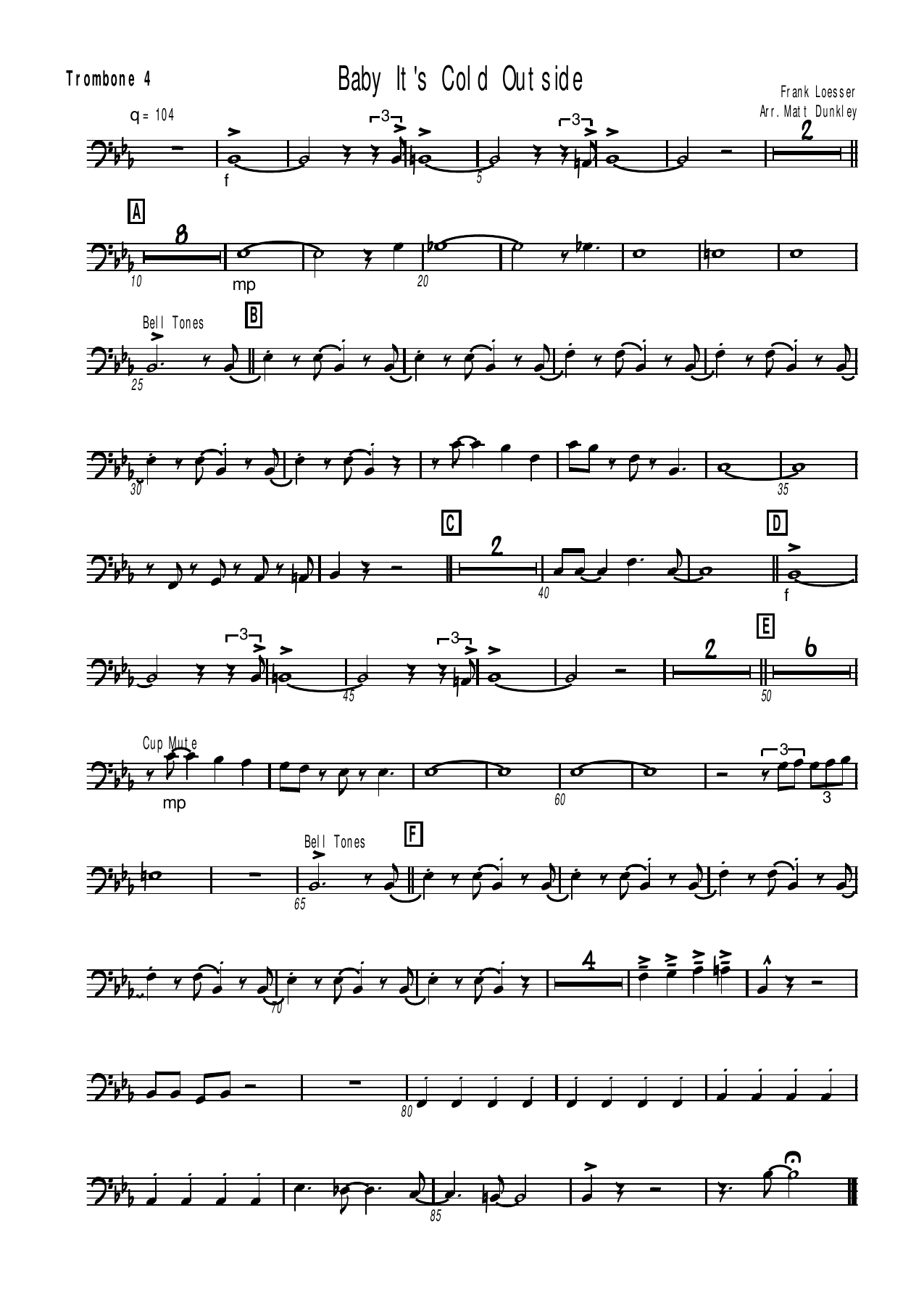
Trombone 4 (M.Dunkley)
Composed by Frank Loesser
Arranged by Matt Dunkley
- Ensemble: Big Band Vocal
- Style: Swing
- Pages: 37
- Instruments (37): Piccolo in Db, C Flute, Piccolo, Oboe, Soprano Saxophone in C, Eb Clarinet, Solo Bb Clarinet, 1st Bb Clarinet, 2d Bb Clarinet, 3d Bb Clarinet, Bassoon, Soprano Saxophone, Alto Saxophone, Tenor Saxophone, Baritone Saxophone, Eb Cornet, Conductor (Bb Cornet), 1st Bb Cornet, 2d Bb Cornet, 3d Bb Cornet, 1st Eb Alto, 2d Eb Alto, 3rd & 4th Eb Altos, 1st & 2nd F Horn, 3rd & 4th F Horn, 1st Bb Tenor, 2d Bb Tenor, 1st Trombone, 2d Trombone, 3d Trombone, Bb Bass, Baritone (Treble Clef), Baritone (Bass Clef), Basses, Tuba, Small Drum, Bass Drum
- Difficulty: easy
- Content: Individual Parts
- Format: PDF Download (Instant)
- Price: $12.99
Frank Loesser's "Trombone 4" emerges from a rich tradition of mid-20th century American popular song, a period often celebrated for its sophisticated melodies, clever lyrics, and enduring appeal. While the title might suggest a novelty piece, Loesser, a prolific and celebrated composer known for Broadway hits like *Guys and Dolls* and *How to Succeed in Business Without Really Trying*, crafted a tune that, in its original context, often showcased the instrumental prowess of the era's big bands. It embodies the classic swing era aesthetic, characterized by a buoyant, medium-up tempo feel, a strong rhythmic pulse, and an infectious, often playful, melodic line. The piece typically evokes a sense of lightheartedness and sophisticated fun, making it a perennial favorite for vocalists and instrumentalists alike who wish to capture the golden age of big band jazz. Its enduring popularity stems from its memorable melody and its inherent flexibility, allowing arrangers to explore its harmonic and rhythmic potential. Matt Dunkley's arrangement of "Trombone 4" for big band and vocal soloist elevates this standard with his signature blend of contemporary orchestral flair and authentic swing sensibilities. Dunkley, renowned for his work across film scores and jazz, approaches this piece with a meticulous ear for voicing and dynamic contrast. The arrangement is set in a bright, medium-swing tempo, typically around 144-152 BPM, and maintains a vibrant, energetic mood throughout. Dunkley's distinctive touch is immediately apparent in the nuanced brass and saxophone voicings, which often feature tight, harmonically rich clusters that provide a lush backdrop for the vocalist. Expect intricate soli sections for the saxophones and brass, showcasing the ensemble's precision and blend, alongside powerful shout choruses that build excitement and drive. The arrangement cleverly uses dynamic shifts and textural variations, moving from intimate, sparse accompaniment to full-band exclamations, ensuring sustained audience engagement. The vocal melody is carried primarily by the soloist, who navigates the familiar tune over a constantly evolving orchestral landscape. While the vocal part is not overly demanding in terms of range, it requires a vocalist with a strong sense of swing, excellent phrasing, and the ability to project over a powerful ensemble. Instrumental solos are strategically placed, offering opportunities for improvisation typically for tenor saxophone and trumpet, allowing these sections to shine within the arrangement's framework. The technical challenges for the ensemble lie in maintaining precise articulation, navigating complex rhythmic figures in the soli sections, and executing the dynamic swells and releases with unified intent. The brass parts, particularly the trumpets, require strong upper register control and endurance. This arrangement is ideally suited for college, community, and professional big bands seeking a sophisticated yet undeniably swinging chart that will both challenge and reward their musicianship, offering a fresh perspective on a beloved standard. Conductors should emphasize a consistent, driving medium-swing feel from the outset, ensuring the rhythm section lays down a solid, unhurried groove. Articulation is paramount; brass players should aim for crisp, unified attacks and releases, particularly in the shout choruses and punctuated figures. Saxophone soli sections demand meticulous attention to blend and intonation, with players encouraged to listen across the section for harmonic balance. The arrangement features several dynamic contrasts, from subtle piano swells to full-throated fortissimo, which require careful rehearsal to execute smoothly and dramatically. Trumpet 1 extends to a high D, requiring a strong lead player. While no specific mutes are explicitly notated for plunger or cup effects, conductors may consider their tasteful application in certain brass fills to enhance the swing aesthetic. Rehearsal time should be dedicated to balancing the vocal soloist with the ensemble, ensuring the intricate background figures support rather than overpower the melody. Q: What instruments are included in this arrangement? A: This is a big band vocal arrangement, typically including standard instrumentation: 5 saxophones (AATTB), 4 trumpets, 4 trombones, guitar, piano, bass, drums, and a vocal soloist part. Q: What is the difficulty level of "Trombone 4 (M.Dunkley)"? A: This arrangement is considered advanced intermediate to advanced, suitable for college, community, and professional big bands due to its intricate voicings, demanding brass parts (including high D for lead trumpet), and sophisticated rhythmic figures. Q: What musical style and historical context does this arrangement represent? A: This arrangement is in the classic swing style, based on Frank Loesser's original composition. It embodies the vibrant, energetic sound of mid-20th century big band jazz, updated with Matt Dunkley's contemporary arranging techniques. Q: What makes Matt Dunkley's arrangement of "Trombone 4" unique? A: Dunkley's arrangement is distinguished by its sophisticated harmonic voicings, dynamic contrasts, intricate soli sections for both brass and saxophones, and powerful shout choruses, all while maintaining an authentic and infectious swing feel. Q: What is the typical performance duration and tempo for this piece? A: The typical performance duration for "Trombone 4 (M.Dunkley)" is approximately 3-4 minutes, performed at a bright, medium-swing tempo, generally in the range of 144-152 beats per minute.
Questions and answers
- What is included in the Trombone 4 (M.Dunkley) PDF?
- The verified current file contains a conductor score and individual parts across 37 pages.
- How many instruments or parts are listed for Trombone 4 (M.Dunkley)?
- The verified instrumentation list contains 37 entries for this Big Band Vocal arrangement.
- Who is credited for Trombone 4 (M.Dunkley)?
- Composer: Frank Loesser. Arranger: Matt Dunkley.
- What difficulty is listed for Trombone 4 (M.Dunkley)?
- The verified difficulty level is easy.
- What style is listed for Trombone 4 (M.Dunkley)?
- The catalog lists the style as Swing.
- Can I preview Trombone 4 (M.Dunkley) before buying?
- Yes. The product page provides a preview generated from the current PDF file.
- How is Trombone 4 (M.Dunkley) delivered?
- After successful payment, the digital PDF is made available for download. The displayed price is $12.99.
Musicians Also Search For
Trombone 4 Matt Dunkley PDF • Trombone 4 Matt Dunkley sheet music • Trombone 4 arranged by Matt Dunkley • Matt Dunkley big band vocal charts • Matt Dunkley jazz arrangements PDF • Trombone 4 Frank Loesser sheet music • Trombone 4 Frank Loesser big band vocal arrangements • Frank Loesser big band vocal charts • Trombone 4 big band vocal arrangements • Trombone 4 big band vocal PDF download • Trombone 4 jazz sheet music • big band vocal sheet music download • Trombone 4 conductor score PDF • Trombone 4 individual parts download • Trombone 4 sheet music PDF • Trombone 4 Swing charts • Swing big band vocal arrangements • buy Trombone 4 sheet music • download Trombone 4 PDF • Trombone 4 jazz charts • best Matt Dunkley big band vocal arrangements • Frank Loesser arranged by Matt Dunkley • Trombone 4 printable sheet music • big band vocal repertoire PDF