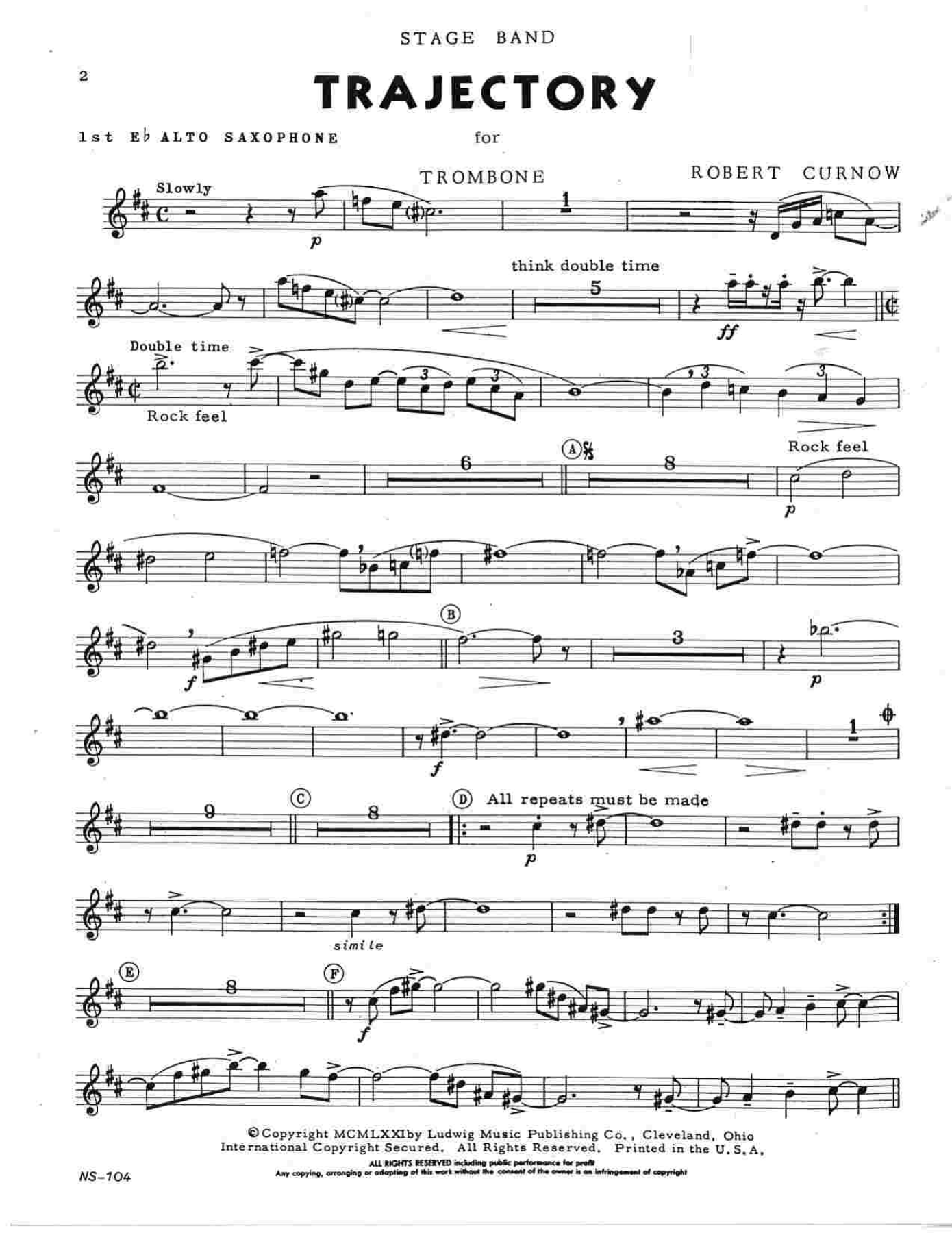
Trajectory For Trombone (B.Curnow)
Composed by Bob Curnow
Arranged by B.Curnow
- Ensemble: Big Band
- Style: Jazz Standard
- Pages: 38
- Instruments (18): 1st Eb Alto Saxophone, 2nd Eb Alto Saxophone, 1st Bb Tenor Saxophone, 2nd Bb Tenor Saxophone, Eb Baritone Saxophone, 1st Bb Trumpet, 2nd Bb Trumpet, 3rd Bb Trumpet, 4th Bb Trumpet, Solo Trombone, 1st Trombone, 2nd Trombone, 3rd Trombone, 4th (Bass) Trombone, Piano, Guitar, Electric Bass, Drums
- Difficulty: medium
- Content: Individual Parts
- Format: PDF Download (Instant)
- Price: $24.99
This compelling big band arrangement, "Trajectory For Trombone," showcases the masterful arranging prowess of Bob Curnow, a figure renowned for his significant contributions to jazz education and his innovative orchestrations of contemporary jazz for large ensembles. Curnow, who served as a trombonist and staff arranger for the Stan Kenton Orchestra in the 1960s and 70s, has carved a unique niche by translating the intricate textures of modern fusion into the powerful, expansive language of the big band. His work often bridges the gap between traditional big band sounds and more contemporary jazz styles, notably through his acclaimed arrangements of Pat Metheny and Lyle Mays' compositions. While the original compositional context of "Trajectory For Trombone" is Curnow's own, it embodies the spirit of a modern jazz standard, offering a fresh, yet enduring, musical statement. "Trajectory For Trombone" is characterized by a vibrant, medium-tempo swing feel, propelling the ensemble with an infectious rhythmic drive. The piece balances moments of lyrical expressiveness with powerful, full-ensemble statements, creating a dynamic and engaging musical narrative. It evokes a mood of sophisticated energy, blending a sense of forward motion with rich harmonic depth. Curnow's signature arranging approach is evident throughout, featuring meticulously crafted voicings that highlight the unique timbres of each section, particularly the trombones. Expect intricate counterpoint, sophisticated harmonic extensions, and strategically placed soli sections that build tension and excitement, culminating in a robust shout chorus that is both exhilarating and harmonically rich. This arrangement prominently features the trombone section, with a dedicated solo trombone part that carries much of the melodic and improvisational weight. The melody often soars through the lead trombone, supported by the lush harmonies of the full brass and saxophone sections. Technical challenges include precise articulation in fast passages, maintaining blend and balance within complex voicings, and navigating extended harmonic structures. The solo trombone part demands excellent control, range, and improvisational fluency. The reward for performance lies in the sheer satisfaction of executing Curnow's intricate writing and delivering a powerful, cohesive big band sound, particularly the impactful interplay between the soloist and the ensemble. Given its demands, this arrangement is ideally suited for college-level jazz ensembles, advanced community big bands, or professional groups seeking a substantial and rewarding piece for their repertoire. The sophisticated harmonic language and technical requirements make it an excellent vehicle for developing advanced musicianship and ensemble cohesion. The detailed scoring ensures that each section has meaningful and challenging material, making it a valuable addition for bands looking to explore contemporary big band literature through the lens of a seasoned master arranger. Conductors should emphasize a consistent, driving medium-swing feel from the outset, ensuring the rhythm section lays a solid, yet elastic, foundation. Key technical challenges include precise ensemble articulation, particularly in the brass and saxophone soli sections, which require meticulous rehearsal to achieve clarity and unified phrasing. Intonation within the extended harmonies demands careful attention, especially in sustained chords, where listening across the section and to the full ensemble is paramount. The solo trombone part requires a player with strong technical command, a lyrical tone, and confident improvisational skills; ample rehearsal time should be allocated for the soloist to integrate seamlessly with the ensemble's dynamic shifts. While no unusual techniques like plunger mutes or extreme falls are explicitly required, a strong command of standard jazz articulations (e.g., falls, doits, scoops) will enhance the authentic jazz feel. Rehearsal tips include isolating challenging rhythmic figures and harmonic passages, using slow, deliberate practice to build accuracy before bringing sections up to tempo. Q: What instruments are included in this arrangement? A: This arrangement is scored for a full big band, including Alto Saxophone 1 & 2, Tenor Saxophone 1 & 2, Baritone Saxophone, Trumpet 1-4, Trombone Solo, Trombone 1-3, Bass Trombone (Trombone 4), Piano, Guitar, Electric Bass, and Drums. Q: What is the difficulty level of "Trajectory For Trombone (B. Curnow)"? A: This arrangement is considered medium-difficult to advanced, appropriate for college, advanced community, or professional big bands due to its sophisticated harmonies, technical demands, and featured solo trombone part. Q: What musical style and historical context does this arrangement represent? A: This piece is a contemporary big band jazz composition by Bob Curnow, reflecting his signature style of blending traditional big band orchestration with modern jazz and fusion elements, drawing from his extensive experience with the Stan Kenton Orchestra and his arrangements of Pat Metheny's music. Q: What makes this arrangement unique? A: Its uniqueness stems from Bob Curnow's distinctive arranging voice, particularly his focus on the trombone as a featured solo instrument within a full big band context, showcasing his characteristic voicings, intricate counterpoint, and dynamic ensemble writing. Q: What is the approximate performance duration or tempo of this piece? A: "Trajectory For Trombone" is a medium-tempo swing piece, and while exact duration can vary with interpretation, it typically falls within a standard big band chart length of approximately 5-7 minutes.
Questions and answers
- What is included in the Trajectory For Trombone (B.Curnow) PDF?
- The verified current file contains individual parts across 38 pages.
- How many instruments or parts are listed for Trajectory For Trombone (B.Curnow)?
- The verified instrumentation list contains 18 entries for this Big Band arrangement.
- Who is credited for Trajectory For Trombone (B.Curnow)?
- Composer: Bob Curnow. Arranger: B.Curnow.
- What difficulty is listed for Trajectory For Trombone (B.Curnow)?
- The verified difficulty level is medium.
- What style is listed for Trajectory For Trombone (B.Curnow)?
- The catalog lists the style as Jazz Standard.
- Can I preview Trajectory For Trombone (B.Curnow) before buying?
- Yes. The product page provides a preview generated from the current PDF file.
- How is Trajectory For Trombone (B.Curnow) delivered?
- After successful payment, the digital PDF is made available for download. The displayed price is $24.99.
Musicians Also Search For
Trajectory For Trombone B.Curnow PDF • Trajectory For Trombone B.Curnow sheet music • Trajectory For Trombone arranged by B.Curnow • B.Curnow big band charts • B.Curnow jazz arrangements PDF • Trajectory For Trombone Bob Curnow sheet music • Trajectory For Trombone Bob Curnow big band arrangements • Bob Curnow big band charts • Trajectory For Trombone big band arrangements • Trajectory For Trombone big band PDF download • Trajectory For Trombone jazz sheet music • big band sheet music download • Trajectory For Trombone individual parts download • Trajectory For Trombone sheet music PDF • Trajectory For Trombone Jazz Standard charts • Jazz Standard big band arrangements • buy Trajectory For Trombone sheet music • download Trajectory For Trombone PDF • Trajectory For Trombone jazz charts • best B.Curnow big band arrangements • Bob Curnow arranged by B.Curnow • Trajectory For Trombone printable sheet music • big band repertoire PDF